. Military Space News .
New Quantum Key System Combines Speed And Distance

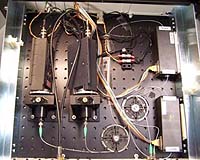
Detection stage of the NIST prototype quantum key distribution system: Photons are "up-converted" from 1310 to 710 nm by one of the two NIST-designed converters at right, then sent to one of two commercial silicon avalanche photo diode units to the left. Credit: NIST
by Staff Writers
Washington DC (SPX) Jun 11, 2007
Researchers at the National Institute of Standards and Technology (NIST) have built a prototype high-speed quantum key distribution (QKD) system, based on a new detector system that achieves dramatically lower noise levels than similar systems. The new system, they say, can perform a theoretically unbreakable "one-time pad" encryption, transmission and decryption of a video signal in real-time over a distance of at least 10 kilometers.

Key distribution-the problem of ensuring that both the sender and receiver of an encrypted message (and no one else) share the same long string of random digits (the so-called "key") used to encode and decode the message-has always been one of the most important challenges in cryptography. Since the 1980's it's been recognized that the unique properties of quantum mechanics-the fact that certain measurements cannot be made without altering the thing measured-offered the possibility of a system that could transmit as long a key as desired between two parties with no chance that it could be copied undetectably by a third party.

Since then the race has been on to build a fast, practical and reliable QKD system. One important requirement for any candidate system is that it be compatible with existing fiber-optic telecom networks that transmit at wavelengths of either 1550 or 1310 nanometers (nm) to reach the greatest distance. Another requirement is a highly efficient photon detector that can detect single photons reliably without introducing significant amounts of "noise." One of the best low-noise detectors, a silicon-based avalanche photo diode (Si-APD), does not function at the telecom wavelengths. Instead, it operates best at much shorter wavelengths around 700 nm. To take advantage of the Si-APD, the NIST group designed a sub-system to "up-convert" single photons from a transmission wavelength of 1310 nm to 710 nm for high-efficiency detection.

Their QKD system that incorporates this up-conversion technique, described in a recent paper,* generates and transmits secure keys at a rate of over half a million bits per second over 10 km of optical fiber, fast enough to encrypt streaming digital video using one-time pad in real time. The group also has transmitted secure keys at rates near 10 kilobits per second at five times that distance. The same team last year set a speed record for transmission of secure keys over a kilometer of fiber (see www.nist.gov/public_affairs/releases/quantumfiber.htm). This work improves the distance by at least 10 times.

Advantages of the new system, according to the research team, include high speed, high efficiency, low noise and convenience of operation. The fact that it uses a 1310 nm transmission wavelength somewhat limits the propagation distance but adds the advantage that the parallel "classical-quantum" communication, which is needed for a full QKD system, can be realized in a single fiber without significant interference.
Community
Email This Article
Comment On This Article

Related Links
NIST's up-conversion QKD research
Understanding Time and Space


Memory Foam Mattress Review
Newsletters :: SpaceDaily :: SpaceWar :: TerraDaily :: Energy Daily
XML Feeds :: Space News :: Earth News :: War News :: Solar Energy News


Researchers Catch Motion Of A Single Electron On Video
Providence RI (SPX) Jun 11, 2007
To observe the motion of an electron - an elementary particle with a mass that is one billionth of a billionth of a billionth of a gram - has been considered to be impossible. So when two Brown University physicists showed movies of electrons moving through liquid helium at the 2006 International Symposium on Quantum Fluids and Solids in Kyoto, they raised some eyebrows.


  • Pentagon Drops Ideology
  • US Military Prepared For Worst With China
  • Defence Treaty Guarantees Security In Post-Cold War Europe
  • Summer Camp In Heiligendamm

  • Detente Over Fear Of Iran
  • Iran's Oil Weapon
  • US Concerned About Possible Secret Iranian Atomic Work
  • US And Russia Hail Pakistani Move To Combat Nuclear Terror

  • Advanced Anti-Radiation Guided Missile Achieves Major Milestone
  • Coping With Gaza's Rockets
  • Raytheon And UAE Sign Rolling Airframe Missile Contract
  • Boeing Wins Next Phase Of US Air Force Missile Technology Program

  • Apropos ABM Without Hysterics
  • WEU Takes Stand For BMD
  • Democrats For Missile Defense
  • Putin Missile Shield Proposal Intensifies Tug-Of-War

  • Airlines To Order Nearly 30,000 New Planes In Next 20 Years
  • Airlines Pledge Emissions Cuts But Warn EU Curbs Could Jeopardise Sector
  • Sandia And Boeing Collaborate To Develop Aircraft Fuel Cell Applications

  • Camcopter S-100 Receives European Permit To Fly
  • Thales Unveils Production Watchkeeper Air Vehicle Design
  • U-Tacs To Provide ISTAR Capability For UK Armed Forces
  • Boeing Australia Limited To Provide ScanEagle UAV To Troops In Afghanistan

  • Al-Qaida Makes Critical Blunder In Iraq
  • US Planning For Smaller Long-Term Presence In Iraq As DoD Chief Replaced
  • US War Czar Admits To Doubts Over Iraq Surge
  • An Escalating War Surges Forward Into The Sands Of Iraq

  • Raytheon-Led Warrior Training Alliance Wins US Army Warfighter FOCUS Program
  • Thales And Boeing Announce FRES Team
  • QinetiQ's Polarisation Technology Results In GBP800K Contract For Further Research Into Tripwire Detection

  • The content herein, unless otherwise known to be public domain, are Copyright 1995-2006 - SpaceDaily.AFP and UPI Wire Stories are copyright Agence France-Presse and United Press International. ESA PortalReports are copyright European Space Agency. All NASA sourced material is public domain. Additionalcopyrights may apply in whole or part to other bona fide parties. Advertising does not imply endorsement,agreement or approval of any opinions, statements or information provided by SpaceDaily on any Web page published or hosted by SpaceDaily. Privacy Statement