
Subscribe free to our newsletters via your
. Military Space News .


BIO FUEL
New, fossil-fuel-free process makes biodiesel sustainable
by Staff Writers
Lansing MI (SPX) May 23, 2014


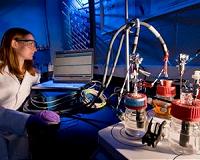
Allison Speers, MSU graduate student, works on a fuel cell that can eliminate biodiesel producers' hazardous wastes and dependence on fossil fuels. Photo by Kurt Stepnitz.

A new fuel-cell concept, developed by an Michigan State University researcher, will allow biodiesel plants to eliminate the creation of hazardous wastes while removing their dependence on fossil fuel from their production process.

The platform, which uses microbes to glean ethanol from glycerol and has the added benefit of cleaning up the wastewater, will allow producers to reincorporate the ethanol and the water into the fuel-making process, said Gemma Reguera, MSU microbiologist and one of the co-authors. "With a saturated glycerol market, traditional approaches see producers pay hefty fees to have toxic wastewater hauled off to treatment plants," she said.

"By cleaning the water with microbes on-site, we've come up with a way to allow producers to generate bioethanol, which replaces petrochemical methanol. At the same time, they are taking care of their hazardous waste problem."

The results, which appear in the journal Environmental Science and Technology, show that the key to Reguera's platform is her patented adaptive-engineered bacteria - Geobacter sulfurreducens. Geobacter are naturally occurring microbes that have proved promising in cleaning up nuclear waste as well in improving other biofuel processes. Much of Reguera's research with these bacteria focuses on engineering their conductive pili or nanowires.

These hair-like appendages are the managers of electrical activity during a cleanup and biofuel production. First, Reguera, along with lead authors and MSU graduate students Allison Speers and Jenna Young, evolved Geobacter to withstand increasing amounts of toxic glycerol. The next step, the team searched for partner bacteria that could ferment it into ethanol while generating byproducts that 'fed' the Geobacter. "It took some tweaking, but we eventually developed a robust bacterium to pair with Geobacter," Reguera said.

"We matched them up like dance partners, modifying each of them to work seamlessly together and eliminate all of the waste." Together, the bacteria's appetite for the toxic byproducts is inexhaustible. "They feast like they're at a Las Vegas buffet," she added.

"One bacterium ferments the glycerol waste to produce bioethanol, which can be reused to make biodiesel from oil feedstocks. Geobacter removes any waste produced during glycerol fermentation to generate electricity. It is a win-win situation." The hungry microbes are the featured component of Reguera's microbial electrolysis cells, or MECs. These fuel cells do not harvest electricity as an output.

Rather, they use a small electrical input platform to generate hydrogen and increase the MEC's efficiency even more. The promising process already has caught the eye of economic developers, who are helping scale up the effort. Through a Michigan Translational Research and Commercialization grant, Reguera and her team are developing prototypes that can handle larger volumes of waste.

Reguera also is in talks with MBI, the bio-based technology "de-risking" enterprise operated by the MSU Foundation, to develop industrial-sized units that could handle the capacities of a full-scale biodiesel plant. The next step will be field tests with a Michigan-based biodiesel manufacturer.

.


Related Links
Michigan State University
Bio Fuel Technology and Application News


Comment on this article via your Facebook, Yahoo, AOL, Hotmail login.

Share this article via these popular social media networks
del.icio.usdel.icio.us DiggDigg RedditReddit GoogleGoogle


Memory Foam Mattress Review
Newsletters :: SpaceDaily :: SpaceWar :: TerraDaily :: Energy Daily
XML Feeds :: Space News :: Earth News :: War News :: Solar Energy News


BIO FUEL
Growing Camelina and Safflower in the Pacific Northwest
Madison WI (SPX) May 20, 2014
A recent study published in Agronomy Journal provides information important to farmers growing oilseed crops. In the study, camelina and safflower were grown in three-year rotations with winter wheat and summer fallow. The study shows that using this rotation may require that no tillage should be done to the soil during the fallow year. Oilseed crops produce relatively little residue-organ ... read more


BIO FUEL
Canadian missile defense radar to be operated, maintained by Raytheon

Propulsion Module For SBIRS GEO-4 Satellite Completed

Canada revisiting ballistic missile defense: official

South Korea orders missile defense systems from ATK

BIO FUEL
Lockheed Martin Demonstrates Javelin Firing From Turret in UK Test

Lockheed Martin weapons turret demonstrated with missile system

Advanced Precision Kill Weapon System rockets for Jordan

Raytheon's JSOW scores direct hits in back-to-back flight tests

BIO FUEL
Northrop Grumman, RMIT Studying Operation of UAVs in Australia

Lockheed Martin Introduces Latest Addition to Small UAV Family

FAA to Expedite Limited Commercial Operations of UAS

Gilat to showcase its BlackRay terminals for Unmanned Platforms in AUVSI 2014

BIO FUEL
Airbus boosts communication capability for British ships

Harris providing tactical communications to country in central Asia

Production Ramps Up on next Advanced EHF Birds

A Multi-Billion Dollar Military Satellite Market

BIO FUEL
Raytheon delivers 1000th Miniature Air Launched Decoy Jammer to USAF

Poland receives surplus German tanks

US senators denounce delays for veterans at clinics

Saudi company to sell Xenonics' night-vision equipment

BIO FUEL
US plans nearly $1 billion arms deal with Iraq

Foreign Military Sales deal in works for Sidewinder missiles

Pentagon chief to head to Saudi, Israel next week

India's Modi pledges defence procurement overhaul

BIO FUEL
Japan to establish island military posts: report

Russia orders troops back to bases ahead of Ukraine vote

Return of the Cold War?

Russia, China seek mutual support in Putin visit

BIO FUEL
Engineers build world's smallest, fastest nanomotor

Nanoscale heat flow predictions

Harnessing Magnetic Vortices for Making Nanoscale Antennas

New method for measuring the temperature of nanoscale objects discovered


The content herein, unless otherwise known to be public domain, are Copyright 1995-2014 - Space Media Network. All websites are published in Australia and are solely subject to Australian law and governed by Fair Use principals for news reporting and research purposes. AFP, UPI and IANS news wire stories are copyright Agence France-Presse, United Press International and Indo-Asia News Service. ESA news reports are copyright European Space Agency. All NASA sourced material is public domain. Additional copyrights may apply in whole or part to other bona fide parties. Advertising does not imply endorsement, agreement or approval of any opinions, statements or information provided by Space Media Network on any Web page published or hosted by Space Media Network. Privacy Statement All images and articles appearing on Space Media Network have been edited or digitally altered in some way. Any requests to remove copyright material will be acted upon in a timely and appropriate manner. Any attempt to extort money from Space Media Network will be ignored and reported to Australian Law Enforcement Agencies as a potential case of financial fraud involving the use of a telephonic carriage device or postal service.