
. Military Space News .
STELLAR CHEMISTRY
New method to detect ultrasound with light
by Staff Writers
Chicago IL (SPX) Feb 14, 2017


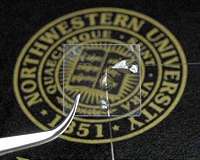
The tiny, transparent Micro-ring device can fit into a contact lens. Image courtesy Cheng Sun.

A tiny, transparent device that can fit into a contact lens has a bright future, potentially helping a range of scientific endeavors from biomedicine to geology. Developed by Northwestern University scientists, the device, called the Micro-ring resonator detector, can determine the speed of the blood flow and the oxygen metabolic rate at the back of the eye. This information could help diagnose such common and debilitating diseases as macular degeneration and diabetes.

The Micro-ring device builds upon Professor Hao F. Zhang's groundbreaking work in 2006 to develop photoacoustic imaging, which combines sound and light waves to create images of biological materials. The imaging technique is being widely explored for both fundamental biological investigations and clinical diagnosis, from nanoscopic cellular imaging to human breast cancer screening.

For three years, Zhang, associate professor of biomedical engineering, worked with Cheng Sun, associate professor of mechanical engineering, and their post-doctoral fellows Biqin Dong and Hao Li to create the Micro-ring resonator detector.

"We believe that with this technology, optical ultrasound detection methods will play an increasingly important role in photoacoustic imaging for the retina and many biomedical applications," Zhang said.

The team's work on the device resulted in a review article, published in the January 2017 edition of the journal Transactions on Biomedical Engineering.

In 2006, Zhang was exploring new retinal imaging technologies when Dr. Amani Fawzi, now an associate professor of ophthalmology at Northwestern's Feinberg School of Medicine, approached him to create a new diagnostic device that could measure biological activities at the back of the eye.

"We needed a device that had large enough bandwidth for spatial resolution," Zhang said. "And it needed to be optically transparent to allow light to go through freely."

"Ultrasound detection devices of that time were usually bulky, opaque, and not sensitive enough. And they had limited bandwidth," Sun said. "It could only capture part of it what was happening in the eye."

To meet Fawzi's challenge, the team needed to develop a radically different type of detector - small enough to be used with human eyes, soft enough to be integrated into a contact lens and yet generate a super-high resolution of hundreds of megahertz.

"The trouble was to fabricate it, have it fit in the size of a contact lens, and make it still work," Sun said.

First, the team considered a device that placed the needle-sized detector on the eyelid, but that method was not ideal. Next, they landed on the idea of a tiny ring implanted in a single-use contact lens worn during diagnosis.

However, that idea added an extra challenge - making the device transparent.

After nearly three years of work, they created the plastic Micro-ring resonator, a transparent device that is 60 micrometers in diameter and 1 micron high. There is movement toward using it with patients.

The team continues to improve the device with support from Northwestern, the National Institutes of Health, Argonne National Laboratory, and the National Science Foundation.

As word spreads about the device, about a dozen scientists from a variety of fields have approached the team about adapting it for their own work. For instance:

+ Urologists want to use the system to study the optics of breast cancer cells, information that could lead to new treatments.

+ Neuroscientists are interested in using the Micro-ring resonator as a window into rodent brains as a way of studying drug protection for the cortex during different points of a stroke. "Typically, researchers use a pure piece of glass, but this allows for a lot more types of imaging," Zhang said.

+ Geologists aim to use the technology to investigate the earth crust and earthquake. "Hearing from a geologist - that was a surprise," he added.

Research paper


Comment on this article using your Disqus, Facebook, Google or Twitter login.


Thanks for being here;
We need your help. The Space Media Network continues to grow but revenues have never been harder to maintain.

With the rise of Ad Blockers, and Facebook - our traditional revenue sources via quality network advertising continues to decline. And unlike so many other news sites, we don't have a paywall - with those annoying usernames and passwords.

Our news coverage takes time and effort to publish 365 days a year.

If you find our news sites informative and useful then please consider becoming a regular supporter or for now make a one off contribution.
SpaceMediaNetwork Contributor
$5 Billed Once


credit card or paypal
SpaceMediaNetwork Monthly Supporter
$5 Billed Monthly


paypal only


.


Related Links
Northwestern University
Stellar Chemistry, The Universe And All Within It


Share this article via these popular social media networks
del.icio.usdel.icio.us DiggDigg RedditReddit GoogleGoogle

Previous Report
STELLAR CHEMISTRY
Chiral quantum optics is a new research field with bright perspectives
Vienna, Austria (SPX) Jan 31, 2017
Recently, surprising physical effects were observed using special microscopic waveguides for light. Such "photonic structures" currently are revolutionizing the fields of optics and photonics, and have opened up the new research area of "Chiral Quantum Optics". Physicists from Copenhagen, Innsbruck, and Vienna, who are leading figures in this field, have now written an overview on the topic whic ... read more


STELLAR CHEMISTRY
New US Missile Hits Target in Space

New Age, New Aims: CIS Air Defense to Be Upgraded for Aerospace Tasks

Raytheon contracted for Patriot missile support

Lockheed Martin to perform additional THAAD development

STELLAR CHEMISTRY
Russian Baltic Fleet Carries Out Air Defense Drills Using S-400 Systems

China tests its new super-accurate missile during war games

Norwegian army acquiring new air defense missile system

China to sell new AR-2 missile to foreign countries

STELLAR CHEMISTRY
U.S. Army orders counter-drone systems

SideArm prototype catches full-size unmanned aerial system flying at full speed

Unmanned Underwater Vehicle turns into Unmanned Aerial Vehicle

DARPA demonstrates SideArm UAS capture system

STELLAR CHEMISTRY
IAI secures $30 million in signals intelligence contracts

Terahertz wireless could make spaceborne satellite links as fast as fiber-optic links

Airbus provides satcom for EU security missions in Mali, Niger and Somalia

Engie, Airbus tapped to support French defense networks

STELLAR CHEMISTRY
Australia awards competitive ammunition load carrier contracts

Army Reserve units getting CROWS gun turrets

U.S. Army spotlights innovative ZH2 vehicle

Austria orders Pandur 6x6 armored personnel carriers

STELLAR CHEMISTRY
US military leaders depict shortfalls ahead of likely spending bonanza

Russia to sell off stake in gun-maker Kalashnikov

US defense chief begins Trump's plans to grow Pentagon

Rich man loses millions in scam by fake French defence staff

STELLAR CHEMISTRY
Trump tells Turkish, Spanish leaders he backs NATO

Moldova president warns NATO over closer ties

German troops bulk up NATO-led force in Lithuania

China likely to build on reef near Philippines: minister

STELLAR CHEMISTRY
Supercomputing, experiment combine for first look at magnetism of real nanoparticle

Scientists determine precise 3-D location 23,000 atoms in a nanoparticle

1,000 times more efficient nano-LED opens door to faster microchips

Three magnetic states for each hole


The content herein, unless otherwise known to be public domain, are Copyright 1995-2024 - Space Media Network. All websites are published in Australia and are solely subject to Australian law and governed by Fair Use principals for news reporting and research purposes. AFP, UPI and IANS news wire stories are copyright Agence France-Presse, United Press International and Indo-Asia News Service. ESA news reports are copyright European Space Agency. All NASA sourced material is public domain. Additional copyrights may apply in whole or part to other bona fide parties. All articles labeled "by Staff Writers" include reports supplied to Space Media Network by industry news wires, PR agencies, corporate press officers and the like. Such articles are individually curated and edited by Space Media Network staff on the basis of the report's information value to our industry and professional readership. Advertising does not imply endorsement, agreement or approval of any opinions, statements or information provided by Space Media Network on any Web page published or hosted by Space Media Network. General Data Protection Regulation (GDPR) Statement Our advertisers use various cookies and the like to deliver the best ad banner available at one time. All network advertising suppliers have GDPR policies (Legitimate Interest) that conform with EU regulations for data collection. By using our websites you consent to cookie based advertising. If you do not agree with this then you must stop using the websites from May 25, 2018. Privacy Statement. Additional information can be found here at About Us.