
. Military Space News .
PHYSICS NEWS
New method uses heat flow to levitate variety of objects
by Staff Writers
Chicago IL (SPX) Feb 17, 2017


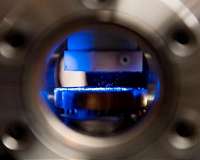
UChicago researchers achieved levitation of macroscopic objects between warm and cold plates in a vacuum chamber. Image courtesy Chicago Jean Lachat.

Although scientists have been able to levitate specific types of material, a pair of UChicago undergraduate physics students helped take the science to a new level. Third-year Frankie Fung and fourth-year Mykhaylo Usatyuk led a team of UChicago researchers who demonstrated how to levitate a variety of objects - ceramic and polyethylene spheres, glass bubbles, ice particles, lint strands and thistle seeds - between a warm plate and a cold plate in a vacuum chamber.

"They made lots of intriguing observations that blew my mind," said Cheng Chin, professor of physics, whose ultracold lab in the Gordon Center for Integrative Science was home to the experiments.

In their work, researchers achieved a number of levitation breakthroughs, in terms of duration, orientation and method: The levitation lasted for more than an hour, as opposed to a few minutes; stability was achieved radially and vertically, as opposed to just vertically; and it used a temperature gradient rather than light or a magnetic field. Their findings appeared Jan. 20 in Applied Physics Letters.

"Magnetic levitation only works on magnetic particles, and optical levitation only works on objects that can be polarized by light, but with our first-of-its-kind method, we demonstrate a method to levitate generic objects," said Chin.

In the experiment, the bottom copper plate was kept at room temperature while a stainless steel cylinder filled with liquid nitrogen kept at negative 300 degrees Fahrenheit served as the top plate. The upward flow of heat from the warm to the cold plate kept the particles suspended indefinitely.

"The large temperature gradient leads to a force that balances gravity and results in stable levitation," said Fung, the study's lead author. "We managed to quantify the thermophoretic force and found reasonable agreement with what is predicted by theory. This will allow us to explore the possibilities of levitating different types of objects." (Thermophoresis refers to the movement of particles by means of a temperature gradient.)

"Our increased understanding of the thermophoretic force will help us investigate the interactions and binding affinities between the particles we observed," said Usatyuk, a study co-author. "We are excited about the future research directions we can follow with our system."

The key to obtaining high levitation stability is the geometrical design of the two plates. A proper ratio of their sizes and vertical spacing allows the warm air to flow around and efficiently capture the levitated objects when they drift away from the center. Another sensitivity factor is that the thermal gradient needs to be pointing upward - even a misalignment of one degree will greatly reduce the levitation stability.

"Only within a narrow range of pressure, temperature gradient and plate geometric factors can we reach stable and long levitation," Chin said. "Different particles also require fine adjustment of the parameters."

The apparatus offers a new ground-based platform to investigate the dynamics of astrophysical, chemical and biological systems in a microgravity environment, according to the researchers.

Researchers achieved levitation of lint among other particles (courtesy of Chin Lab).

Levitation of macroscopic particles in a vacuum is of particular interest due to its wide applications in space, atmospheric and astro-chemical research. And thermophoresis has been utilized in aerosol thermal precipitators, nuclear reactor safety and the manufacturing of optical fibers through vacuum deposition processes, which apply progressive layers of atoms or molecules during fabrication.

The new method is significant because it offers a new approach to manipulating small objects without contacting or contaminating them, said Thomas Witten, the Homer J. Livingston Professor Emeritus of Physics. "It offers new avenues for mass assembly of tiny parts for micro-electro-mechanical systems, for example, and to measure small forces within such systems.

"Also, it forces us to re-examine how 'driven gases,' such as gases driven by heat flow, can differ from ordinary gases," he added. "Driven gases hold promise to create new forms of interaction between suspended particles."

Levitation of materials in ground-based experiments provides an ideal platform for the study of particle dynamics and interactions in a pristine isolated environment, the paper concluded. Chin's lab is now looking at how to levitate macroscopic substances greater than a centimeter in size, as well as how these objects interact or aggregate in a weightless environment. "There are ample research opportunities to which our talented undergraduate students can contribute," Chin said.

Research paper


Comment on this article using your Disqus, Facebook, Google or Twitter login.


Thanks for being here;
We need your help. The Space Media Network continues to grow but revenues have never been harder to maintain.

With the rise of Ad Blockers, and Facebook - our traditional revenue sources via quality network advertising continues to decline. And unlike so many other news sites, we don't have a paywall - with those annoying usernames and passwords.

Our news coverage takes time and effort to publish 365 days a year.

If you find our news sites informative and useful then please consider becoming a regular supporter or for now make a one off contribution.
SpaceMediaNetwork Contributor
$5 Billed Once


credit card or paypal
SpaceMediaNetwork Monthly Supporter
$5 Billed Monthly


paypal only


.


Related Links
University of Chicago
The Physics of Time and Space


Share this article via these popular social media networks
del.icio.usdel.icio.us DiggDigg RedditReddit GoogleGoogle

Previous Report
PHYSICS NEWS
Increasing the sensitivity of next-generation gravitational wave detectors
Washington DC (SPX) Feb 14, 2017
Nearly one year ago the LIGO Collaboration announced the detection of gravitational waves, once again confirming Einstein's theory of General Relativity. This important discovery by the Advanced Laser Interferometer Gravitational-Wave Observatory (aLIGO) has spurred great interest in improving these advanced optical detectors. The mission of gravitational wave scientists worldwide is to ma ... read more


PHYSICS NEWS
Raytheon developing new tool for war game assessment

U.S. Army awards $3 billion in missile defense contracts

New US Missile Hits Target in Space

New Age, New Aims: CIS Air Defense to Be Upgraded for Aerospace Tasks

PHYSICS NEWS
UAE orders MBDA anti-ship missiles

Lockheed Martin completes tests with modernized TACMS missiles

Raytheon, Rheinmetall to collaborate on future defense projects

Thales, Bharat Dynamics ink STARStreak capability transfer deal

PHYSICS NEWS
Born killers: French army grooms eagles to down drones

Leonardo supplying radars for Patroller drones

Ukroboronprom presents modified Phantom unmanned vehicle

Monitoring birds by drone

PHYSICS NEWS
IAI secures $30 million in signals intelligence contracts

Terahertz wireless could make spaceborne satellite links as fast as fiber-optic links

Airbus provides satcom for EU security missions in Mali, Niger and Somalia

Engie, Airbus tapped to support French defense networks

PHYSICS NEWS
UAE orders battle management system from Harris

U.S. Marines place $150M order for Target Sight Systems

Orbital ATK reports new orders for Bushmaster guns

Russia ready to export new T-90 tank variant

PHYSICS NEWS
Global arms trade highest since Cold War: study

SIPRI: Arms imports rise in Asia, Middle East

Pentagon chief says military running smoothly amid turbulent transition

Germany, Norway expand defense industry coooperation

PHYSICS NEWS
Germany to boost troops as US urges more defence spending

Pence reassures Europe, demands NATO funds

US aircraft carrier strike group patrolling S. China Sea

Trump's envoy at UN warns Russia US stands firm on NATO, EU

PHYSICS NEWS
Nano-level lubricant tuning improves material for electronic devices and surface coatings

Liquid metal nano printing set to revolutionize electronics

Switched-on DNA spark nano-electronic applications

Learning how to fine-tune nanofabrication


The content herein, unless otherwise known to be public domain, are Copyright 1995-2024 - Space Media Network. All websites are published in Australia and are solely subject to Australian law and governed by Fair Use principals for news reporting and research purposes. AFP, UPI and IANS news wire stories are copyright Agence France-Presse, United Press International and Indo-Asia News Service. ESA news reports are copyright European Space Agency. All NASA sourced material is public domain. Additional copyrights may apply in whole or part to other bona fide parties. All articles labeled "by Staff Writers" include reports supplied to Space Media Network by industry news wires, PR agencies, corporate press officers and the like. Such articles are individually curated and edited by Space Media Network staff on the basis of the report's information value to our industry and professional readership. Advertising does not imply endorsement, agreement or approval of any opinions, statements or information provided by Space Media Network on any Web page published or hosted by Space Media Network. General Data Protection Regulation (GDPR) Statement Our advertisers use various cookies and the like to deliver the best ad banner available at one time. All network advertising suppliers have GDPR policies (Legitimate Interest) that conform with EU regulations for data collection. By using our websites you consent to cookie based advertising. If you do not agree with this then you must stop using the websites from May 25, 2018. Privacy Statement. Additional information can be found here at About Us.