
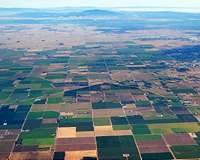
Water conservation is a growing concern globally, and particularly for farmers in the USA, where decades of irrigating huge fields has depleted vital resources of fresh surface water and groundwater. An ESA spin-off that can help to preserve water supplies while guaranteeing crop irrigation is now undergoing final testing.
The ambitious plan of former ESA employee Javier Marti is to tackle irrigation overuse, based on a concept developed at the agency's technology centre in the Netherlands: using reflected satellite navigation signals for remotely sensing the Earth's surface.
Lying under eight states in the central US, the vast Ogallala aquifer supplies almost a third of the ground water for crop irrigation in the country – but a large portion of the aquifer, particularly in the states of New Mexico, Texas and Oklahoma, could dry up within a generation or two if no action is taken.
Two thirds of the aquifer's water lies under Nebraska, making the state a focus for testing the approach that Javier's company Divirod has developed.
Over the coming months, several farms will regulate and optimise their irrigation using the new technique to reduce water consumption.
"Our system compares reflected and direct satnav signals to reveal the moisture content of soil and crops," explained Javier, Divirod's CEO.
"We anticipate our system could save farmers around 30% in operating costs in terms of both water and energy. Crop yields depend on many factors, but we estimate we could also improve yields by 10-12%."
Using satnav signals for remote sensing
Javier worked with ESA engineer Manuel Martin-Neira on the Agency's SMOS soil moisture and ocean salinity satellite. Here, he got the idea of using reflected satnav signals from a project proposed by Manuel for remote sensing. Manuel proposed using the microwave signals to measure terrestrial features such as the topography of oceans.
"Satellites carrying altimeters that use radar can only measure along the line of flight, whereas I realised that using reflected satnav signals would let us take measurements from several different points," explained Manuel.
Spin-off from space
"Javier and Manuel's work resulted in three ESA patents for using reflected satnav signals, a breakthrough now available for developing new terrestrial applications," said ESA Technology Transfer Programme officer Mercedes Sanchez Alvarez.
"It's great to see that Javier has taken the same signal approach and used it in another manner to develop a practical system for ground measurements of surface soil moisture content, water levels in reservoirs, snowpack and wetlands, among other applications."
Manuel added, "Although the principles of how SMOS measures soil moisture are different from the Divirod approach, both techniques provide essentially the same thing.
"But what is nice here is that satellite navigation itself is the focus of much development, so basing a soil moisture measurement system on it should enable cost-effective results."
Javier explained that the key is how the satnav signals are processed. "Using satnav for remote sensing is not unique, but we have developed software that lets us measure variations across a huge field down to a resolution of around 5×5 m or less, using only one sensor on a pole in the centre of the field.
"For some applications we could reduce this resolution to below a square metre in the future."
This detailed coverage can be integrated into irrigation systems so that water is delivered precisely to different areas across each field as required.
Sensors can also be built into the industrial centre pivot irrigation systems that are widely used across the USA and combined with machine learning to create a self-contained, closed-loop scheme.
Better cultivation in Nebraska
"I'm really excited about the prospect of using the Divirod technology to refine how we use water on our farm," said Roric Paulman, owner of Paulman Farms in Nebraska, one of the initial trial sites.
"We're sited in a water restriction management area now. Nebraska legislation recognises that the surface water and groundwater needs in the future are important to the sustainability of the aquifer."
The alternative methods of assessing soil moisture are physical probes and satellite images. However, a probe measures only the value at one point, and extrapolating from that can be complicated by the different soil types, slopes and varying ground elevation – even across a single field.
"The problems with satellite imagery are not only resolution and cost, but also the time it takes to gather the data and translate it into a setting for the irrigation tool. This can take days, but on a farm we're working in real time," added Roric.
Towards efficient water use
Divirod is carrying out sensor tests at the University of Nebraska's Lincoln Experiment Station to confirm the sensor measurements. It will also be one of the technologies investigated by the Ogallala Water Coordinated Agriculture Project, which may involve thousands of sensors.
Although agriculture is a focus for Divirod, the company is already exploring other applications. From May, sensors will be tested at two sites in Boulder, Colorado, for their potential for moderating water usage in municipal landscapes. There has also been interest from the Middle East. A provisional patent has been filed and more could follow.
Tillage farming damaging earthworm populations
The digging, stirring and overturning of soil by conventional ploughing in tillage farming is severely damaging earthworm populations around the world, say scientists. The findings published in the scientific journal Global Change Biology show a systematic decline in earthworm populations in soils that are ploughed every year. The deeper the soil is disturbed the more harmful it is for the earth … read more
