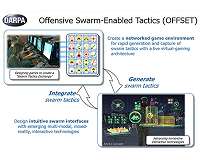
DARPA's OFFensive Swarm-Enabled Tactics (OFFSET) program envisions future small-unit infantry forces using small unmanned aircraft systems (UASs) and/or small unmanned ground systems (UGSs) in swarms of 250 robots or more to accomplish diverse missions in complex urban environments.
By leveraging and combining emerging technologies in swarm autonomy and human-swarm teaming, the program seeks to enable rapid development and deployment of breakthrough capabilities to the field. DARPA is continuing its pursuit of these goals through awarding Phase 1 contracts to teams led by Raytheon BBN Technologies (Cambridge, Massachusetts) and the Northrop Grumman Corporation (Linthicum, Maryland).
Each team will serve as a swarm systems integrator tasked with designing, developing, and deploying an open architecture for swarm technologies in physical and virtual environments.
Each system would include an extensible game-based architecture to enable design and integration of swarm tactics, a swarm tactics exchange to foster community interaction, immersive interfaces for collaboration among teams of humans and swarm systems, and a physical testbed to validate developed capabilities.
Each team will be responsible for experimentation and systems-integration efforts for realizing swarm capabilities, including producing tactics and technologies to test on its respective architecture.
To augment their efforts and enhance OFFSET's potential contributions to the warfighter, DARPA also aims to engage with a wider developer and user audience through rapid technology-development and integration efforts called swarm sprints. Participants in these experiments-"sprinters"-can work with one or both integration teams and each other to create and test their own novel swarm tactics and enabling technologies.
Roughly every six months, DARPA plans to solicit proposals from potential sprinters, with each swarm sprint focusing on one of five thrust areas: swarm tactics, swarm autonomy, human-swarm teaming, virtual environment, and physical testbed.
More information about the first three thrust areas and swarms in general is available here:
The end of each sprint would coincide with physical and virtual capability-based experiments designed to test and assess integration of the thrust-specific OFFSET technologies. The experiments would also provide direct engagement between DARPA, the teams and sprinters, and warfighters who could help further tailor OFFSET capabilities to meet real-world operational needs.
"The swarm sprints are empirical experiments designed to accelerate our understanding of what swarms can do in urban environments," said Timothy Chung, program manager in DARPA's Tactical Technology Office (TTO).
"By having swarm sprints at regular intervals, we're able to ensure that we're keeping up with the latest technologies-and are in fact helping inform and advance those technologies-to better suit the needs of the OFFSET program. Given the wide range of capabilities that we're interested in, we're looking for wherever those innovative solutions are going to come from, whether they be small businesses, academic institutions, or large corporations."
OFFSET is preparing for two kinds of swarm sprints: Core swarm sprints that occur at regular six-month intervals, and ad hoc swarm sprints that allow for on-demand exploration of topics aligned with a specific thrust area. DARPA anticipates that ad hoc swarm sprints could take place concurrently during core swarm sprints.
DARPA is looking for participants for the first core sprint now. The focus of this effort is the generation of swarm tactics for a mixed swarm of 50 air and ground robots to isolate an urban objective within an area of two square city blocks over a mission duration of 15 to 30 minutes. Operationally relevant tactics to achieve that mission include performing reconnaissance, identifying ingress and egress points, and establishing a perimeter around an area of operation.
Instructions for submitting a proposal seeking to participate in the first core swarm sprint, as well as full OFFSET program details, are available on the Federal Business Opportunities website: . Proposals are due at 5:00 p.m. Eastern on Wednesday, November 29, 2017.
SecAF addresses air and space innovation
Secretary of the Air Force Heather Wilson spoke about the importance of modernization and innovation in space during a Center for Strategic and International Studies forum in Washington, D.C., Oct. 5, 2017.
"Our mission is to organize, train and equip air and space forces," said Wilson. "We are the ones, since 1954, who are responsible for everything from 100 feet below the earth in missil … read more