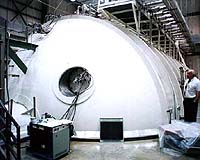
The cryogenic vacuum chamber at the XRCF where components of the James Webb Telescope are being tested.
The cryogenic vacuum chamber at the XRCF where components of the James Webb Telescope are being tested. |
Barry Hale (lead technician) and Jay Carpenter (facility engineer) are working the night shift. At least two people man this facility every night, monitoring screens on a large panel in the control room. Twelve people have alternated shifts 24 by 7 since late May.
Why have all these people become "all-nighters?" The success of NASA's next great space telescope depends upon it: "We're testing the James Webb Space Telescope," explains XRCF team leader Jeff Kegley.
Scheduled for launch in 2013, the Webb telescope is widely regarded as the premier observatory of the next decade. It is an infrared telescope, which means it senses the heat of stars and galaxies millions and even billions of light years away. To pick up those incredibly faint signs of warmth, the telescope itself must be kept extremely cold-and that is why everyone is staring at screens.
The Webb telescope will operate in space at a temperature of -238 deg Celsius (-396 deg Fahrenheit). Such extreme cold may cause the telescope's structures and mirrors to change shape. Before that happens, the telescope is being tested at the XRCF, piece by piece, inside a vacuum chamber that simulates the hyper-cold of space. Results reveal any distortion that happens to the components so changes can be made if needed.
But there's a lot more to the night shift than staring at control panel test data. Like most night crews, Hale and Carpenter make "rounds." These rounds include going outdoors to check the "nitrogen farm," where huge white tanks of liquid nitrogen loom in the darkness like dairy cattle in a pasture. The nitrogen is used to cool the vacuum chamber where components are tested, and the men check for leaks each night.
Hale and Carpenter have also caught glimpses of some real animals out on the farm. One night, Hale had a close encounter of the UNkind with a skunk - giving new meaning to the term "skunk works."
By making these "dangerous" field surveillance rounds and watching the control room screens, the night crew ensures that all equipment pressures, flow rates, temperatures, and valve positions stay in proper range for the tests. They also manipulate helium refrigeration systems, vacuum chamber pressure, and liquid nitrogen zones for the vacuum chamber to keep the test article on a particular test plan profile.
"Tonight's test article is a section of the ISIM Breadbox," says Carpenter. "That's our nickname for the Integrated Science Instrument Module support structure, which holds the telescope's four main science instruments." (For instrument wonks, their names are Mid-Infrared Instrument, Near-Infrared Camera, Near-Infrared Spectrograph, and Fine Guidance Sensor.)
As the Breadbox in the test chamber endures the transition from room temperature down to -233 deg Celsius (-387 deg Fahrenheit), an Electronic Speckle Pattern Interferometer optically measures the structural distortion. No, this is not a rare salamander, but it is a rare instrument.
"This is one of only two instantaneous phase-shift speckled interferometers in the world," says Joseph Geary of the University of Alabama-Huntsville who, by the way, is also working night shift on this particular night. The interferometer is being used to detect thermal distortions of the Breadbox as small as a few nanometers (billionths of a meter).
In a few days, after the Breadbox testing draws to a close, the crew will reconfigure the facility for mirror segment verification tests. The Webb telescope consists of 18 individual mirror segments that will ultimately form a 6.5-meter mirror assembly. In the spring, engineers will begin testing the optical quality of each individual mirror segment. The 24/7 testing will continue through 2010. That's a lot of testing, a lot of night shifts, and a lot of skunks.
Carpenter comments that he doesn't really mind working nights, but says "It's a little hard on my family to be quiet during the day when I have to sleep. My granddaughter wants to play, but she isn't allowed to knock on my door. That's a little hard for me, too."
Kegley says he likes to work the night shift occasionally because it's a good chance to catch up on work. "You don't get many calls or e-mails to interrupt you at 3 o'clock in the morning."
Community
 India To Set Up Largest Asian Telescope In Himalayas In 2012
 New Delhi (RIA Novosti) Aug 07, 2007
| The content herein, unless otherwise known to be public domain, are Copyright 1995-2006 - SpaceDaily.AFP and UPI Wire Stories are copyright Agence France-Presse and United Press International. ESA PortalReports are copyright European Space Agency. All NASA sourced material is public domain. Additionalcopyrights may apply in whole or part to other bona fide parties. Advertising does not imply endorsement,agreement or approval of any opinions, statements or information provided by SpaceDaily on any Web page published or hosted by SpaceDaily. Privacy Statement |