
Subscribe free to our newsletters via your
. Military Space News .


SUPERPOWERS
One year on, China's Bo scandal haunts Chongqing
by Staff Writers
Chongqing, China (AFP) Feb 6, 2013


China police chief 'who owns hundreds of houses' sacked
Beijing (AFP) Feb 6, 2013 - A Chinese police chief has been sacked after reports he owned hundreds of houses and a false identity card, state media said Wednesday in the latest scandal to fuel public outrage over corruption.

Zhao Haibin was stripped of his public offices for "engaging in business deals using a fake identity card", the state-run Xinhua news agency reported, citing the Lufeng city government in the southern province of Guangdong.

Authorities had decided to carry out a comprehensive investigation into "the problems the media has exposed", it said.

Zhao, a senior police officer and local Communist Party official, made headlines Tuesday in media reports saying that a businessman accused him of having amassed 192 houses in Huizhou, with others in Shenzhen and Zhuhai.

The case is the latest of a series involving officials owning multiple houses with different identity cards and residence permits.

Gong Aiai, a vice president of a bank in the northern province of Shaanxi and a delegate to the local legislature, was reported to have 41 properties in Beijing, including several in one of the capital's most expensive developments, and more in other cities.

State media said she used four different residence permits and three identity cards, and was detained by police Monday on suspicion of "forging official documents and stamps".

The cases have sparked mounting criticism in Chinese social media over rampant graft and high home prices that are running out of reach of the average citizen.

"The grandmaster of properties is finally unveiled in Lufeng. Zhao Haibin... is unprecedented but he definitely will not be unbeatable in the future," said a post on China's Twitter-like Sina Weibo microblog.

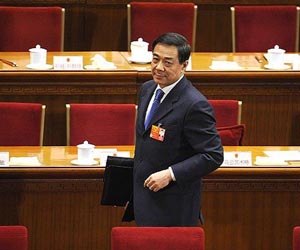
One year after Chongqing's police chief set off China's biggest scandal in decades, the megacity has seen revelations of torture and corruption but little action on alleged abuses during the reign of disgraced leader Bo Xilai.

Symbols of Bo's time in power have been erased from the city he ruled as Communist Party chief, but media reports on his wrongdoings say little of his links with leaders of the party in which he was once a rising star.

The scandal began to emerge on February 6, when Wang Lijun fled to a US consulate seeking asylum after falling out with his patron Bo, now held at a secret location awaiting trial for crimes including abuse of power and bribery.

Wang has been jailed for 15 years on similar charges, while Bo's wife was handed a suspended death sentence for the murder of a British businessman -- one of the most lurid elements in the drama.

As Chongqing boss and member of the elite Politburo, Bo stood out for his suave and open demeanour, seen as refreshing among China's rigid leadership. But his signature ideological and anti-mafia campaigns drew both hero-worship and accusations of serious abuses.

The gang crackdown saw thousands of people arrested and several high-profile executions, while his "Sing Red" Maoist revivalism saw stadiums packed out for patriotic concerts and officials sent to work in the countryside, raising memories of the disastrous Cultural Revolution.

Analysts say a stream of reports in recent months -- including details of torture centres, hushed-up sex tapes of local politicians, and labour camp sentences for dissenters -- foreshadow harsh punishment for Bo.

Chongqing's mayor declared last month that his influence had been "eradicated", and characters rendered in Wang's own calligraphy have been erased from a pair of huge concrete balls outside the police headquarters.

But more fundamental changes in the 33-million-strong municipality, such as legal attempts to overturn what human rights lawyers see as unjust verdicts during Bo's tenure, have foundered.

Ren Jianyu, a low-level Chongqing official sentenced to two years labour for criticising Bo's policies online, was released early after nationwide outrage, but his lawsuit for wrongful imprisonment was rejected in November.

Last week a request for damages by Fang Hong, a blogger who was sent to a Chongqing labour camp for posting a scatological joke about Bo online also failed.

"Before and after Bo and Wang, the re-education through labour committees in Chongqing are still mighty," said Fang's lawyer, referring to the panels which send people to the notorious camps.

At a secret base amid pine-clad mountains in the Tieshanping Forest Park, police are said to have tortured confessions from scores of suspects during Bo's so-called anti-mafia crackdown.

Detainees were put in a device known as a "Tiger Bench", a state-run newspaper reported, quoting one victim as saying they "wouldn't sleep for days and nights, and were not able to escape from beatings".

In September the Xinhua news agency said a Communist Party investigation found evidence that Bo covered up his wife's murder case, had multiple mistresses, and accepted "massive bribes" during his tenure.

But in a country where reports about top politicians are strictly controlled and official corruption is endemic, Bo's once strong links with Party leaders are studiously ignored as authorities attempt to cauterise the damage.

"The reporting is managed," said Steve Tsang, professor of contemporary Chinese studies at Britain's Nottingham University.

"Journalists who knew about those abuses are now allowed to report about them, and you also have the Communist Party wanting to project an image that the abuses were at the local level," he said.

Even so the accounts seem to have done little to alter Bo's popularity in Chongqing, where many locals say they benefited from rapid economic growth and lower crime rates under his rule.

"I think he was a very gentle leader, who was close to the people," a 23-year-old travel agent surnamed Xiong told AFP. "There is a lot said about his corruption, but us Chongqingers still think he was a good person."

Chen Shuliang, a 100-year-old party member from Chongqing's countryside, was more blunt. "Bo wasn't corrupt," he insisted.

Party authorities must tread a fine line between displaying Bo's abuses ahead of his trial, and preventing other similar injustices being exposed nationwide, analysts say.

"It's understood that similar cases are not uncommon in different parts of the country," said Willy Lam, a politics expert at Chinese University of Hong Kong.

"If the human rights lawyers are successful, that would set a precedent for other cases for miscarriages of justice to be overturned," he added, "and obviously Beijing doesn't want that because it would lead to instability."

.


Related Links
Learn about the Superpowers of the 21st Century at SpaceWar.com
Learn about nuclear weapons doctrine and defense at SpaceWar.com


Comment on this article via your Facebook, Yahoo, AOL, Hotmail login.

Share this article via these popular social media networks
del.icio.usdel.icio.us DiggDigg RedditReddit GoogleGoogle


SUPERPOWERS
Japan summons China envoy in island row
Tokyo (AFP) Feb 5, 2013
Tokyo summoned China's envoy Tuesday in protest at what it says was another incursion into its territorial waters, after Beijing's ships sailed near islands at the centre of a bitter dispute. "The foreign ministry summoned the Chinese ambassador over ships entering the waters near Senkaku islands," said an official, referring to a chain claimed as the Diaoyus by Beijing. The move comes a ... read more


SUPERPOWERS
Boeing-led Missile Defense Team Completes GMD Flight Test

NGC Fire Control Play Key Role in Missile Defense Test

Missile defense EEKV shows value

First Patriot missiles 'operational' on Turkey-Syria border

SUPERPOWERS
Israel deploys 3rd missile system to north: reports

Lockheed Martin Receives US Army Contract for Guided MLRS Rocket Production

India wheels out new long-range missile in annual parade

Raytheon awarded contract for HARM upgrade

SUPERPOWERS
Elbit Systems Introduces its Hermes 900 UAS in a New Configuration Adapted for the Maritime Mission

US needs to keep up drone war against Qaeda: Panetta

Northrop Grumman's Next-Gen Fire Scout to Beef Up Avionics Protection

Elbit Systems and Windward Team to Introduce Advanced Maritime Surveillance Solution for India

SUPERPOWERS
TACLANE-1G Encryptor Certified by NSA

Boeing Completes FAB-T Software Qualification Testing For AEHF and Milstar Birds

Smartphone to hold integrated warrior gear

Raytheon offers Global Aircrew Strategic Network Terminal Soultion

SUPERPOWERS
Commander sees women in elite US special forces

Canada receives upgraded LAV III

Marines Get Improved Precision Extended Range Munitions

Raytheon, US Navy demonstrate new dual targeting capability for JSOW C-1

SUPERPOWERS
Global firms eye lucrative contracts at India air show

Israel seeks major arms deals with India

Rheinmetall, Cassidian gain orders

Shoigu: Russia seeks army 'modernization'

SUPERPOWERS
Outside View: The trials of Chuck Hagel

Asian astrologers warn of sss-stormy Year of Snake

US, Egypt defense chiefs back security ties: Pentagon

China radar-lock on Japan ship 'dangerous': PM Abe

SUPERPOWERS
A new genre of 'intelligent' micro- and nanomotors

Flat boron by the numbers

Notre Dame studies benefits and threats of nanotechnology research

A nano-gear in a nano-motor inside


The content herein, unless otherwise known to be public domain, are Copyright 1995-2014 - Space Media Network. AFP, UPI and IANS news wire stories are copyright Agence France-Presse, United Press International and Indo-Asia News Service. ESA Portal Reports are copyright European Space Agency. All NASA sourced material is public domain. Additional copyrights may apply in whole or part to other bona fide parties. Advertising does not imply endorsement,agreement or approval of any opinions, statements or information provided by Space Media Network on any Web page published or hosted by Space Media Network. Privacy Statement