
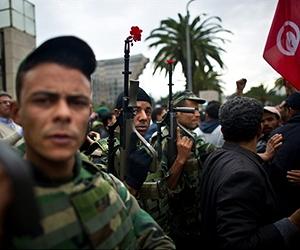
Two years after the revolutions, Arab Spring nations continue to face turbulent transitions as they try to forge ahead through new challenges and old legacies.
The new set of actors in these Arab countries have the unenviable task of steering the ship of state through domestic, regional and international challenges — not the least of which are ensuring a peaceful democratic transition, procuring jobs for tens of thousands of unemployed graduates, attracting investments for economic recovery, containing the inevitable fallout from the European financial crisis and restoring a climate of security and confidence in state institutions.
A no less crucial challenge is building a new political culture where "fault lines" are turned into low-intensity disagreements that are amenable to debate and compromise within the country's new democratic environment.
This requires the establishment of a climate where differences of views don't necessarily lead to confrontation and violence.
Past legacies are of no help. For one thing, the political history since independence has been too often that of "winners-take-all." It was certainly the case in Tunisia during the two first regimes that ruled the country at the end of French rule.
Political opponents, especially Islamists, and also followers of Destourian dissident leader Saleh Bin Yousuf, leftists and others, were harshly repressed. Unfortunately, no reconciliation was attempted and no apologies were extended by the oppressors to their victims.
Inadequate cultural, educational and communication policies did the rest. Governments failed to instill young minds with the values of unfettered debate and uninhibited dialogue.
The legacy of exclusion and eradication of all views that used to be deemed politically incorrect never prepared citizens of the country to see the commonalities that bound them. Focus was instead on the divides supposedly separating them.
Decade-old reflexes of hostility and suspicion are only coming now to the surface. Amplified by the sudden blooming of freedom of expression, differences appear like unbridgeable chasms. Exaggerated insistence on "Islamist/secularist polarization," along with the enduring practices of demonization and fear-mongering make politics seem like a giant zero-sum-game. Instead of being mutually-enriching, different value-systems can become catalysts for dangerous confrontations and destructive clashes.
In reality, Tunisians share more common bonds than they are willing to admit. On top of such bonds, is a shared heritage of religious moderation and cultural openness that doesn't stop at political boundaries.
Establishing new traditions of dialogue and willingness to make concessions will open the way for a concerted effort by all political actors to meet the country's socio-economic challenges. Accepting compromises through dialogue is the best way to ensure a win-win outcome. Politics of brinkmanship and expediency is not the answer to dealing with the deep roots of discontent.
If you look today at the map of poverty and unemployment hotspots in the country, you can easily notice that the geography of decade-old developmental shortcomings very much overlaps with that of current social protests.
Providing jobs and economic growth in long-neglected areas will take time regardless of who is in power. The problem has to do with accumulated policy flaws and adverse global fallouts. Social discontent is therefore likely to endure, as is the impatience of younger generations.
Consensus-building, beyond political considerations, is needed to accomplish tangible progress in meeting the demands of unemployed youth and other dissatisfied segments of the population. Non-partisan initiatives, such as the recent Business Federation "national economic emergency initiative" are badly needed.
While the outside world should be more forthcoming in providing concrete economic assistance to Tunisia, the main responsibility in dealing with Tunisia's challenges will be that of Tunisians.
For that to happen, meeting the country's vital economic and national security challenges should be beyond partisan politics. Overcoming the apparent disconnect between competing groups in order to ensure the success of the transition, requires learning how to resolve differences peacefully.
Other countries' experiences teach us that national reconciliation is a much better guarantor of democratic transition and economic recovery than dismissive approaches.
A frank and honest appraisal of what went wrong in the past could provide for a very useful basis in the rebuilding process, that of today and tomorrow.
The country's glorious 3,000-year history should instill Tunisians with enough confidence and optimism to gear their country towards focusing on the promises of the future, however huge the frustrations of the past were.
In meeting its challenges, Tunisia has a great deal of assets to build on, not the least of which are its legacy of openness and tolerance, the quality of its human resources, the homogeneous nature of its ethnic and religious make-up and its deep-rooted tradition of pragmatism.
Considering such assets, the odds are in Tunisia's favor as it presses on toward anchoring a durable culture of free debate and inclusive dialogue.
(Oussama Romdhani is a former Tunisian minister of communication.)
(United Press International's "Outside View" commentaries are written by outside contributors who specialize in a variety of important issues. The views expressed do not necessarily reflect those of United Press International. In the interests of creating an open forum, original submissions are invited.)
