
. Military Space News .
Pillars Of Creation Formed In The Shadows

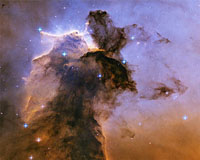
The Eagle Nebula pillars (right) are examples of these structures, but there are many others, often called "Elephant Trunks" by astronomers because of their elongated appearance. Click here for more image ands captions
by Staff Writers
Hertfordshire, UK (SPX) Apr 27, 2009
Research by astronomers at the Dublin Institute of Advanced Studies suggests that shadows hold the key to how giant star-forming structures like the famous "Pillars of Creation" take shape.

The pillars are dense columns within giant clouds of dust and gas where massive stars form. Several theories have been proposed to explain why the pillars develop around the edge of ionized gas bubbles surrounding young, very hot stars. Using computer models, the Dublin group has found that partially-shadowed clumps of gas tend to creep towards darker areas, causing pile-ups behind dense knots of gas and dust that screen the intense ultraviolet light emitted by the stars.

Jonathan Mackey, who is presenting the results at the European Week of Astronomy and Space Science in Hatfield said, "We created a simulation with a random distribution of lots of dense clouds with different sizes and shapes.

"We found that in certain cases a number of clouds can merge together in the shadows to form structures that look very like observed pillars. They are sufficiently dense to match the observations, can form in about 150,000 years and can survive for about 100,000 years. Although this is a preliminary study, we believe our results are quite robust and will be confirmed by more detailed modeling."

The team, led by Dr. Andrew Lim, found that the configuration of clumps of gas had to be favorable for the pillars to form. Some age estimates put the Eagle Nebula pillars at no more than 100,000 years old, and models show that the shadow from a single clump would not attain the density to form a pillar in that relatively short timescale.

"Many of our models do not produce pillars that are as long and narrow as those in the Eagle Nebula, at least not at the observed gas density. It needs the right configuration of dense clumps of gas to form a long pillar. Unless the shadowed region is already very dense to begin with, it just takes too long to collect and organize the gas into a pillar," said Lim.

The group plans to add increasing levels of realism to the model over the next couple of years, bringing in more accurate representations of the complex chemistry of interstellar gas, the effects of radiation from diffuse sources. Adding in the effects of gravity will also be important as the pillars contain dense gas condensations which are in the process of collapsing under their own weight to form the next generation of stars.

Mackey said, "Gravity is relatively unimportant when the pillars are forming, but there comes a point when they get very dense and it cannot be ignored any longer. We plan to include gravitation in future work so that we can study the next generation of stars which are forming in the pillars."

Share This Article With Planet Earth
del.icio.usdel.icio.us DiggDigg RedditReddit
YahooMyWebYahooMyWeb GoogleGoogle FacebookFacebook


Related Links
Formation of Elephant Trunks in H II Regions
Stellar Chemistry, The Universe And All Within It


Memory Foam Mattress Review
Newsletters :: SpaceDaily :: SpaceWar :: TerraDaily :: Energy Daily
XML Feeds :: Space News :: Earth News :: War News :: Solar Energy News


Dust Cleared To Get Better Look At Youngest Supernova Remnant
Raleigh NC (SPX) Apr 24, 2009
Researchers at North Carolina State University have used a mathematical model that allows them to get a clearer picture of the galaxy's youngest supernova remnant by correcting for the distortions caused by cosmic dust.


  • The Future Of NATO Part Five
  • Australia must boost military to deal with China rise: think tank
  • Future Of NATO Will Be Determined In Afghanistan Part Six
  • NATO Bloated And Weakened From Expansion Part Two

  • NKorea needs time to make good on nuke threat: analysts
  • UN nuclear inspectors quit NKorea, US team to follow
  • BMD Watch: S-400s For Belarus Part Two
  • US nuclear experts expelled from NKorea: Xinhua

  • USAF Awards Raytheon Contract For Laser-Guided Maverick Missile
  • Raytheon Standard Missile-2 Destroys Target
  • Indian tests cruise missile: official
  • US says warships deployed before NKorea launch

  • Seeking New BMD Strategies Part One
  • THAAD Launchers And Fire Control And Communications Units Rolled Out
  • Kinetic Energy Interceptors Team Delivers Pathfinder Ground Test Missile Avionics
  • Northrop Grumman Urges ABM Focus On Early Engagement And Flexibility

  • China Eastern Airlines reports huge loss in 2008
  • Airlines fear failure of global climate talks
  • State takes control of China's first private airline: report
  • Troubled private Chinese airline says president missing

  • Boeing Demonstrates Command And Control Of ScanEagle From Wedgetail
  • Raven UAS Achieves 30-Hour Persistent Surveillance
  • Russia Defense Watch: UAVs from Israel
  • Russia buys unmanned drones from Israel: report

  • It will take Iraq time to put down extremists: Petraeus
  • US must stay engaged in Iraq despite Afghanistan: analysts
  • Suicide bomber wounds 38 at Iraqi army base
  • Commentary: Gulf war jitters

  • Northrop Grumman Upgrades Ship Navigation Radars With Enhanced Naval Display Features
  • Boeing Awarded US Navy Contract to Develop Free Electron Laser
  • PDR Validates Maturity Of Future Combat Systems Common Controller
  • Boeing Teams With TAK To Develop Wing Assembly For 2,000-Pound JDAM ER

  • The content herein, unless otherwise known to be public domain, are Copyright 1995-2007 - SpaceDaily.AFP and UPI Wire Stories are copyright Agence France-Presse and United Press International. ESA Portal Reports are copyright European Space Agency. All NASA sourced material is public domain. Additional copyrights may apply in whole or part to other bona fide parties. Advertising does not imply endorsement,agreement or approval of any opinions, statements or information provided by SpaceDaily on any Web page published or hosted by SpaceDaily. Privacy Statement