
. Military Space News .
Planet Or Failed Star

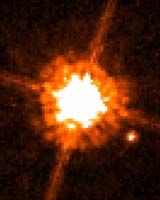
This NASA/ESA Hubble Space Telescope image shows one of the smallest objects ever seen around a normal star. Astronomers believe the object is a brown dwarf because it is 12 times more massive than Jupiter. The brown dwarf candidate, called CHXR 73 B, is the bright spot at lower right. It orbits a red dwarf star, dubbed CHXR 73, which is a third less massive than the Sun. At 2 million years old, the star is very young when compared with our middle-aged 4.6-billion-year-old Sun. CHXR 73 B orbits 19.5 billion miles from its star, or roughly 200 times farther than Earth is from the Sun. The star looks significantly larger than CHXR 73 B because it is much brighter than its companion. CHXR 73 B is 1/100 as bright as its star. The cross-shaped diffraction spikes around the star are artifacts produced within the telescope's optics. The star is 500 light-years away from Earth. Hubble's Advanced Camera for Surveys snapped the image in near-infrared light on Feb. 10 and 15, 2005. The colour used in the image does not reflect the object's true colour. Credit: NASA, ESA, and K. Luhman (Penn State University, USA)
by Staff Writers
Baltimore MD (SPX) Sep 08, 2006
Astronomers using NASA's Hubble Space Telescope have photographed one of the smallest objects ever seen around a normal star beyond our Sun. Weighing in at 12 times the mass of Jupiter, the object is small enough to be a planet. The conundrum is that it's also large enough to be a brown dwarf, a failed star.

The Hubble observation of the diminutive companion to the low-mass red dwarf star CHXR 73 is a dramatic reminder that astronomers do not have a consensus in deciding which objects orbiting other stars are truly planets

- - even though they have at last agreed on how they will apply the definition of "planet" to objects inside our solar system.

Kevin Luhman of Penn State University in University Park, Pa., leader of the team that found the object, called CHXR 73 B, is casting his vote for a brown dwarf. "New, more sensitive telescopes are finding smaller and smaller objects of planetary-mass size," said Luhman. "These discoveries have prompted astronomers to ask the question, are planetary-mass companions always planets?"

Some astronomers suggest that an extrasolar object's mass determines whether it is a planet. Luhman and others advocate that an object is only a planet if it formed from the disk of gas and dust that commonly encircles a newborn star. Our solar system planets formed 4.6 billion years ago out of a dust disk around our Sun.

Brown dwarfs, by contrast, form just like stars: from the gravitational collapse of large, diffuse clouds of hydrogen gas. Unlike stars, brown dwarfs do not have quite enough mass to ignite hydrogen fusion reactions in their cores, which power stars such as our Sun.

CHXR 73 B is 19.5 billion miles from its red dwarf sun. That's roughly 200 times farther than Earth is from our Sun. At 2 million years old, the star is very young when compared with our middle-aged 4.6-billion-year-old Sun.

"The object is so far away from its star that it is unlikely to have formed in a circumstellar disk," Luhman explained. Disks around low-mass stars are about 5 to 10 billion miles in diameter. There isn't enough material at that distance from the red dwarf to create a planet. Theoretical models show that giant planets like Jupiter form no more than about 3 billion miles from their stars.

Hubble's Advanced Camera for Surveys discovered the object while conducting a survey of free-floating brown dwarfs. Astronomers have found hundreds of brown dwarfs in our galaxy since the first brown dwarfs were spied about a decade ago. Most of them are floating through space and not orbiting stars.

"It is important to study young star systems to understand how small bodies formed. Young brown dwarfs are brighter than older, cooler brown dwarfs. This allows them to be seen even at lower masses, where older dwarfs would still be undetectable," said team member John Wilson of the University of Virginia in Charlottesville.

One way to further settle the uncertainty would be if a disk of dust could be observed around CHXR 73's companion. Like stars, brown dwarfs have circumstellar disks, too. They would be no more than about 2 billion miles in diameter.

NASA's Spitzer Space Telescope has detected disks around several free-floating brown dwarfs. But CHXR 73 B is too close to its star for Spitzer to detect the disk. So astronomers will have to wait for the launch of the James Webb Space Telescope in 2013 to determine if this companion has a disk. The Webb telescope will combine Hubble's sharpness, which is needed for detecting close companions, and Spitzer's infrared sensitivity, which is necessary for seeing cool, dusty disks.

The team's result will appear in the Sept. 20 issue of the Astrophysical Journal.

Related Links
Hubble
Beyond Sol

Earth-Like Planets May Be More Common Than Once Thought
Boulder CO (SPX) Sep 08, 2006
More than one-third of the giant planet systems recently detected outside Earth's solar system may harbor Earth-like planets, many covered in deep oceans with potential for life, according to a new study led by the University of Colorado at Boulder and Pennsylvania State University.


  • Alliance With Bush By Blair Was Great Error
  • Chinese Investments Welcome But After Security Concerns Are Met Says India
  • Russia Calls Off Joint US Exercises Scheduled For End Of September
  • US Confirms Major Power Meeting On Iran In Berlin

  • US Envoy Says North Korea Talks In Bad Way
  • Iran Sanctions Essential Says US
  • Lockheed Martin Awarded Contract For Sonar Upgrades For UK Nuke Missile Submarines
  • Kremlin Aide Warns Against Military Operation In Iran

  • Louisville Facility To Build NLOS-LS Precision Attack Missile
  • Raytheon's Louisville Facility to Build NLOS-LS Precision Attack Missile
  • Iran Tests Tactical Missile During War Games
  • Raytheon Company Awarded $266M Standard Missile-3 Contract

  • US Anti-Missile Shield Could Spark Arms Race Warns Russian Army Chief
  • Israeli Defense Chiefs Upgrade BMD Plans
  • Raytheon Helps Ballistic Missile Intercept In Space
  • PAC-3 Missile Destroys Tactical Ballistic Missile In Test

  • US Sanctions On Russia Could Hurt Boeing
  • Boeing Puts Aircraft Market At 2.6 Trillion Dollars
  • Innovative Solutions Make Transportation Systems Safer Secure and Efficient
  • Joint Strike Fighter Is Not Flawed Finds Australian Government

  • Teal Group Predicts World UAV Market Will Top $54 Billion Over Next Decade
  • Israeli Elbit To Build Drones In Poland
  • Sagem Defense Securite Transforms Danish UAVs For Canadian Forces
  • Flying Start To North West Shelf Unmanned Aircraft Trial

  • Adrift In A Complex War In The Sands Of Eden
  • Outside View: Making progress in Iraq
  • Analysis: Kurds Raise Flag Amid Fears Of War
  • Democrats Push Bush To Sack US Defense Chief Rumsfeld

  • Iran Claims To Have Developed A 2,000 Pound Guided Bomb
  • Iran Adds New Fighter Jet To Air Force
  • Northrop Grumman Wins Joint Warfighting Center Contract Worth Up To $686 Million
  • Unique Solution Against Remotely Activated Explosive Devices

  • The content herein, unless otherwise known to be public domain, are Copyright 1995-2006 - SpaceDaily.AFP and UPI Wire Stories are copyright Agence France-Presse and United Press International. ESA PortalReports are copyright European Space Agency. All NASA sourced material is public domain. Additionalcopyrights may apply in whole or part to other bona fide parties. Advertising does not imply endorsement,agreement or approval of any opinions, statements or information provided by SpaceDaily on any Web page published or hosted by SpaceDaily. Privacy Statement