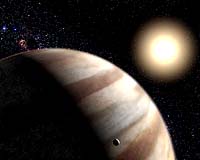
by jove survival is hardwork
by jove survival is hardwork |
In the October 10, 2003, issue of The Astrophysical Journal Letters, astronomers Myron Lecar and Dimitar Sasselov showed what influences this race. They found that planet formation is a contest, where a growing planet must fight for survival lest it be swallowed by the star that initially nurtured it.
"The endgame is a race between the star and its giant planet," says Sasselov. "In some systems, the planet wins and survives, but in other systems, the planet loses the race and is eaten by the star."
Although Jupiter-sized worlds have been found orbiting incredibly close to their parent stars, such giant planets could not have formed in their current locations. The oven-like heat of the nearby star and dearth of raw materials would have prevented any large planet from coalescing. "It's a lousy neighborhood to form gas giants," says Lecar. "But we find a lot of Jupiter-sized planets in such neighborhoods. Explaining how they got there is a challenge."
Theorists calculate that so-called "hot Jupiters" must form farther out in the disk of gas and dust surrounding the new star and then migrate inward. A challenge is to halt the planet's migration before it spirals into the star.
A Jupiter-like world's migration is powered by the disk material outside the planet's orbit. The outer protoplanetary disk inexorably pushes the planet inward, even as the planet grows by accreting that outer material. Lecar and Sasselov showed that a planet can win its race to avoid destruction by eating the outer disk before the star eats it.
Our solar system differs from the "hot Jupiter" systems in that the race must have ended quite early. Jupiter migrated for only a short distance before consuming the material between it and the infant Saturn, bringing the King of Planets to a halt. If the protoplanetary disk that birthed our solar system had contained more matter, Jupiter might have lost the race. Then it and the inner planets, including Earth, would have spiraled into the Sun.
"If Jupiter goes, they all go," says Lecar.
"It's too early to say that our solar system is rare, because it's easier to find 'hot Jupiter' systems with current detection techniques," says Sasselov. "But we certainly can say we're fortunate that Jupiter's migration stopped early. Otherwise, the Earth would have been destroyed, leaving a barren solar system devoid of life."
Related Links
 Planet-Formation Model Indicates Earthlike Planets Might Be Common
 Seattle - Dec 11, 2003
| The content herein, unless otherwise known to be public domain, are Copyright 1995-2006 - SpaceDaily.AFP and UPI Wire Stories are copyright Agence France-Presse and United Press International. ESA PortalReports are copyright European Space Agency. All NASA sourced material is public domain. Additionalcopyrights may apply in whole or part to other bona fide parties. Advertising does not imply endorsement,agreement or approval of any opinions, statements or information provided by SpaceDaily on any Web page published or hosted by SpaceDaily. Privacy Statement |