to lands beyond beyond
to lands beyond beyond |
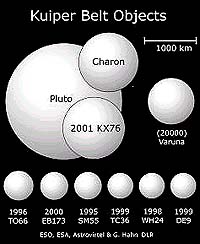
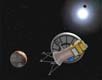
Now in preliminary development for NASA, New Horizons would be the first mission to explore Pluto and its moon, Charon, as well as the ancient Kuiper Belt of rocky, icy objects beyond the planets. If approved and funded later this year, New Horizons would launch in January 2006, swing around Jupiter for scientific studies and a gravity boost in 2007, and reach Pluto as early as 2015.
"As we continued to study the mission, and optimized our launch window, we realized that we could get the spacecraft to Pluto sooner," says New Horizons Mission Director Robert W. Farquhar, of The Johns Hopkins University Applied Physics Laboratory in Laurel, Md., which manages the mission and will build and operate the spacecraft.
"In our best estimates we can cover the 3 billion miles from Earth to Pluto faster than we once thought, while keeping all the mission's goals intact."
New Horizons project leaders say a faster trip benefits the mission in many ways.
"This a great opportunity to improve our scientific return while reducing mission risks and costs," says New Horizons Principal Investigator S. Alan Stern, of the Southwest Research Institute in Boulder, Colo.
"We'll get a better look at Pluto itself, since more of the surface will be sunlit (from the spacecraft's flyby perspective) and the atmosphere will be another year away from freezing onto the planet's surface.
"We'll have more fuel for the journey into the Kuiper Belt after exploring Pluto-Charon, and the shorter cruise time reduces some of the costs associated with flight operations."
New Horizons will characterize the global geology and geomorphology of Pluto and Charon, map their surface compositions and temperatures, and study Pluto's complex atmosphere in detail. The spacecraft will then visit up to three Kuiper Belt objects beyond Pluto.
Related Links
 Nuclear Hammers and Nuclear Hamstrings
 Washington - Feb 20, 2002
| The content herein, unless otherwise known to be public domain, are Copyright 1995-2006 - SpaceDaily.AFP and UPI Wire Stories are copyright Agence France-Presse and United Press International. ESA PortalReports are copyright European Space Agency. All NASA sourced material is public domain. Additionalcopyrights may apply in whole or part to other bona fide parties. Advertising does not imply endorsement,agreement or approval of any opinions, statements or information provided by SpaceDaily on any Web page published or hosted by SpaceDaily. Privacy Statement |