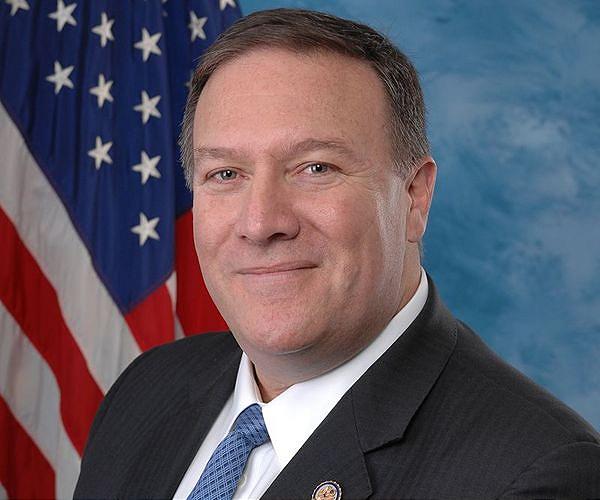
Secretary of State Mike Pompeo insisted Wednesday the United States will enforce new "UN" sanctions on Iran starting next week, despite overwhelming consensus that Washington is out of bounds.
"The United States will do what it always does. It will do its share as part of its responsibilities to enable peace, this time in the Middle East," Pompeo told a joint news conference with British Foreign Secretary Dominic Raab.
"We'll do all the things we need to do to make sure that those sanctions are enforced," he said.
Pompeo last month headed to the United Nations to announce the "snapback" of sanctions under a 2015 Security Council resolution after failing to extend an embargo on conventional arms sales to Iran.
The resolution allows any participant in a nuclear accord with Iran negotiated under former president Barack Obama to reimpose sanctions, which would take effect one month afterward.
President Donald Trump pulled out of the accord, which he has repeatedly denounced, but Pompeo argues that the United States remains a "participant" as it was listed in the 2015 resolution.
The sanctions are authorized by a "valid UN Security Council resolution," Pompeo said.
Trump has already enforced sweeping unilateral US sanctions on Iran, inflicting a heavy toll in a bid to curb the clerical state's regional influence.
The United Nations has clearly said that it cannot proceed with the reimposition of UN sanctions, with 13 of the Security Council's 15 nations objecting to the US move.
European allies of the United States say that they support extending the arms embargo but want to preserve a diplomatic solution on the nuclear issue, which they see as more important.
Playing down differences, Raab said of the nuclear accord: "We have always welcomed US and indeed any other efforts to broaden it."
"The means by which we get there, there may be shades of difference but we have handled them… constructively," he said.
The issue has come to a head less than two months before Trump seeks another term against Democrat Joe Biden, a supporter of the accord that curbed Iran's nuclear program.
US sanctions 'ruining lives', Iran tells UN court
The Hague (AFP) Sept 16, 2020 –
Iran urged the UN's top court on Wednesday to hear its bid to overturn US nuclear sanctions, saying they were destroying the Iranian economy and "ruining millions of lives".
The International Court of Justice (ICJ) in The Hague is hearing arguments this week from Tehran and Washington before deciding whether it has jurisdiction to deal with the case.
Iran dragged the United States to the ICJ in 2018 when President Donald Trump pulled the US out of a landmark deal limiting Iran's nuclear programme and reimposed sanctions.
Tehran's representative Hamidreza Oloumiyazdi told the court by videolink that the sanctions were a "clear breach" of a 1955 "Treaty of Amity" between Iran and the United States.
"The US measures and the underlying policy of maximum pressure disregard the very foundation of international law," Oloumiyazdi said.
He said the sanctions were causing "hardship and suffering" including a record drop in Iran's trade, a near-doubling of food prices and "severe" effects on the health system.
"All that matters now for the US administration is whether its measures are succeeding in destroying the Iranian economy and ruining the lives of millions of Iranians," Oloumiyazdi added.
The US urged the ICJ to reject the case on Monday, saying the sanctions have nothing to do with the friendship treaty, which predated the 1979 Islamic revolution in Iran and subsequent severing of ties between the two countries.
It argued that the sanctions were necessary because Iran posed a "grave threat" to international security.
Washington formally ended the Treaty of Amity in late 2018 after the ICJ ordered it to ease sanctions on humanitarian goods as an emergency measure while the overall lawsuit is dealt with.
A decision on jurisdiction by the ICJ, which was set up after World War II to rule in disputes between nations, could take several months, while a final ruling would take years.
The 2015 nuclear deal — involving the five permanent members of the UN Security Council — Britain, China, France, Russia and the United States, plus Germany — has hung by a thread since Trump pulled out.
The accord promises Iran sanctions relief in exchange for curbing its nuclear programme, but Tehran has stepped up nuclear activities since last year after the US reimposed sanctions.