
Subscribe free to our newsletters via your
. Military Space News .


STELLAR CHEMISTRY
Red skies discovered on extreme brown dwarf
by Staff Writers
Hatfield UK (SPX) Feb 13, 2014


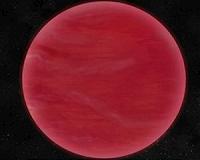
Artist's impression of ULAS J222711-004547. This newly discovered brown dwarf is characterized by an unusually thick layer of clouds, made of mineral dust. These thick clouds give ULAS J222711-004547 its extremely red colour, distinguishing it from "normal" brown dwarfs. Image courtesy Neil J Cook, Centre for Astrophysics Research, University of Hertfordshire.

A peculiar example of a celestial body, known as a brown dwarf, with unusually red skies has been discovered by a team of astronomers from the University of Hertfordshire's Centre for Astrophysics Research.

Brown dwarfs straddle the line between stars and planets. They are too big to be considered as planets; yet they do not have sufficient material to fuse hydrogen in their cores to fully develop into stars. They are midway in mass between stars, like our Sun, and giant planets, like Jupiter and Saturn. Sometimes described as failed stars, they do not have an internal source of energy - so they are cold and very faint, and keep on cooling over time.

The brown dwarf, named ULAS J222711-004547, caught the researchers' attention for its extremely red appearance compared to "normal" brown dwarfs. Further observations with the VLT (Very Large Telescope) in Chile and the use of an innovative data analysis technique have shown that the reason for its peculiarity is the presence of a very thick layer of clouds in its upper atmosphere.

Federico Marocco, who led the research team from the University of Hertfordshire, said: "These are not the type of clouds that we are used to seeing on Earth. The thick clouds on this particular brown dwarf are mostly made of mineral dust, like enstatite and corundum.

"Not only have we been able to infer their presence, but we have also been able to estimate the size of the dust grains in the clouds."

Size of dust grains influences sky colour
The size of the dust grains influences the colour of the sky. In a similar way that the old saying of "Red sky at night, shepherd's delight. Red sky in the morning, shepherd's warning" is used at sunrise and sunset to indicate the changing weather, a red sky on the brown dwarf suggests an atmosphere loaded with dust and moisture particles.

If our morning skies are red, it is because clear skies to the east permit the sun to light the undersides of moisture-bearing clouds coming in from the west. Conversely, in order to see red clouds in the evening, sunlight must have a clear path from the west in order to illuminate moisture-bearing clouds moving off to the east. However, the recently discovered brown dwarf ULAS J222711-004547 has a very different atmosphere where the sky is always red.

The giant planets of the Solar System, like Jupiter and Saturn, show various cloud layers including ammonia and hydrogen sulphide as well as water vapour. The atmosphere observed in this particular brown dwarf is hotter - with water vapour, methane and probably some ammonia but, unusually, it is dominated by clay-sized mineral particles.

Extreme atmospheres
Getting a good understanding of how such an extreme atmosphere works will help us to better understand the range of atmospheres that can exist.

Dr Avril Day-Jones, from the University of Hertfordshire's Centre for Astrophysics Research, who contributed to the discovery and analysis said: "Being one of the reddest brown dwarfs ever observed, ULAS J222711-004547 makes an ideal target for multiple observations to understand how the weather is in such an extreme atmosphere."

"By studying the composition and variability in luminosity and colours of objects like this, we can understand how the weather works on brown dwarfs and how it links to other giant planets."

Part of this work was carried out under the Marie Curie 7th European Community Framework Programme grant no. 247593, Interpretation and Parameterization of Extremely Red COOL dwarfs (IPERCOOL) International Research Staff Exchange Scheme.

The paper, "The extremely red L dwarf ULAS J222711-004547 - dominated by dust", is published in the Monthly Notices of the Royal Astronomical Society by Oxford University Press

.


Related Links
University of Hertfordshire
Stellar Chemistry, The Universe And All Within It


Comment on this article via your Facebook, Yahoo, AOL, Hotmail login.

Share this article via these popular social media networks
del.icio.usdel.icio.us DiggDigg RedditReddit GoogleGoogle


STELLAR CHEMISTRY
GOES EXIS Quadruplets Together in a Cleanroom "Nursery"
Boulder CO (SPX) Feb 11, 2014
Four Extreme Ultraviolet and X-ray Irradiance Sensors or EXIS instruments that will fly aboard four of NOAA's Geostationary Operational Environmental Satellite-R or GOES-R Series spacecraft were recently lined up like babies in a nursery. The EXIS Team at NOAA's Laboratory for Atmospheric and Space Physics (LASP) in Boulder, Colorado took a short timeout during the week of January 20, 2014 ... read more


STELLAR CHEMISTRY
First US missile shield destroyer arrives in Europe

Israel to help India develop missile defense shield

Israel shoots down rocket fired from Gaza: reports

Israeli leaders step up warnings of growing missile threat

STELLAR CHEMISTRY
Israel FM slams 'warmongering' Iran's missile tests

Iran says will not negotiate missile programme

USAF Selects LockMart To Integrate Air Operations and Missile Defense Assets

Raytheon marks delivery of 2000th Griffin missile

STELLAR CHEMISTRY
ARCA is developing a high performance unmanned aerial vehicle

MQ-8C Fire Scout Completes First Flight

LockMart and AeroVironment Eye Joint Opportunities in UAV Markets

Anglo-French accord covers development of drones

STELLAR CHEMISTRY
US Marines Reach Milestone For New General Dynamics-built Aviation CCS

MUOS Satellite Tests Show Extensive Reach In Polar Communications Capability

Space squadron optimizes wideband communication constellations

GA-ASI and Northrop Showcase Unmanned Electronic Attack Capabilities

STELLAR CHEMISTRY
Indonesia takes final delivery of BMP-3F vehicles

US military funds 'Mission: Impossible' vanishing devices

US Army and Lockheed Martin Complete Advanced Autonomous Convoy Demonstration

Northrop Grumman Delivers 100th EA-18G Airborne Electronic Attack Kit

STELLAR CHEMISTRY
Egypt's Sisi negotiates arms deal in Russia

Ljubljana mayor, defence minister charged in scam deal: report

India, Italy remain in standoff over trial of Italian marines

Arms makers left frustrated as India awaits elections

STELLAR CHEMISTRY
US would 'help' Philippines in South China Sea: Navy chief

Japan mayor pleads against US airbase

China anger over Spanish arrest warrant for Jiang Zemin

Chinese state media slam Japan PM's 'gangster logic'

STELLAR CHEMISTRY
Molecular Traffic Jam Makes Water Move Faster through Nanochannels

Physicists at Mainz University build pilot prototype of a single ion heat engine

Quantum dots provide complete control of photons

New boron nanomaterial may be possible


The content herein, unless otherwise known to be public domain, are Copyright 1995-2014 - Space Media Network. AFP, UPI and IANS news wire stories are copyright Agence France-Presse, United Press International and Indo-Asia News Service. ESA Portal Reports are copyright European Space Agency. All NASA sourced material is public domain. Additional copyrights may apply in whole or part to other bona fide parties. Advertising does not imply endorsement,agreement or approval of any opinions, statements or information provided by Space Media Network on any Web page published or hosted by Space Media Network. Privacy Statement