
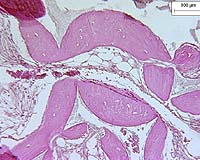
 File image. |
The problem is obtaining them. Those that are the true source of life, in the first days of embryonic development, are of course the most highly sought after; still undifferentiated, they are "pluripotent," meaning they can evolve into liver, muscle, eye - any kind of cell. But the issue of how to obtain them clearly raises insurmountable ethical questions.
"In this regard, the recent discovery of the "reprogramming" phenomenon, by which somatic cells can be induced to convert to a pluripotent state simply by forcing the expression of a few genes, opens a phenomenal number of possibilities in regenerative medicine," says Didier Trono, Dean of the EPFL School of Life Sciences.
"Imagine, for example, collecting a few cells from the hair follicle of a hemophiliac patient, reprogramming them to the pluripotentiality of their embryonic precursor, correcting the mutation responsible for the coagulation disorder that plagues the patient, and then re-administering them, genetically "cured," after having orchestrated a differentiation into fully functional progeny."
Increased risks for cancer?
But a study that has just been published in the journal Cell Death and Differentiation, to be followed by two articles in the journal Nature, is dampening those hopes. Conducted by the Department of Biochemistry at the University of Geneva and the European Institute of Oncology in Milan, with the participation of Trono's laboratory, it concludes that these reprogrammed cells exhibit a "genomic instability" that appears to be caused by the process used to return the cells to their embryonic state.
Even more serious, the genetic mutations observed resemble mutations that are found in cancer cells. The scientists draw the conclusion that reprogrammed stem cells need to be extensively investigated before they can even be considered for use in regenerative medicine.
The experiments were done using mouse mammary and fibroblast cells. The researchers used three different processes for reprogramming the cells to a "stem," or embryonic, state. The first method was developed expressly for this study, and the others have already been well documented.
Yet all the processes led to the same, implacable conclusion: the genetic anomalies multiplied, in a manner that seems to indicate that they are inherent to the reprogramming process itself, which typically makes use of oncogenes. "Interestingly, oncogenes have the potential to induce genomic instability," the authors explain.
These results underline the necessity of conducting further studies.
First, to see if the genetic anomalies are serious enough to compromise the function and stability of cells regenerated using the reprogrammed cells; and second, to "refine the methods used for generating induced pluripotent cells, in order to avoid this problem. These results will thus motivate scientists to come up with a solution," concludes Trono.
 del.icio.us del.icio.us |
 Digg Digg |
 Reddit Reddit |
 YahooMyWeb YahooMyWeb |
 Google Google |
 Facebook Facebook |

 Stem Cell Discovery Could Lead To Improved Bone Marrow Transplants
| The content herein, unless otherwise known to be public domain, are Copyright 1995-2010 - SpaceDaily. AFP and UPI Wire Stories are copyright Agence France-Presse and United Press International. ESA Portal Reports are copyright European Space Agency. All NASA sourced material is public domain. Additional copyrights may apply in whole or part to other bona fide parties. Advertising does not imply endorsement,agreement or approval of any opinions, statements or information provided by SpaceDaily on any Web page published or hosted by SpaceDaily. Privacy Statement |


