
. Military Space News .


.
NANO TECH
Research reveals shocking new way to create nanoporous materials
by Staff Writers
Cambridge UK (SPX) Nov 30, 2011

The researchers have also demonstrated how the nanoporous materials created by the unique process can be used to develop filters capable of removing very small dyes from water.

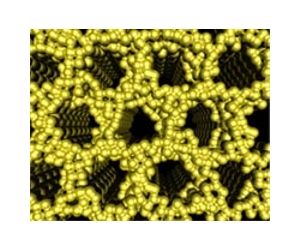
Scientists have developed a new method of creating nanoporous materials with potential applications in everything from water purification to chemical sensors.

In order to produce a porous material it is necessary to have multiple components. When the minor component is removed, small pores are left in its place. Until now, creating nanoporous materials was limiting as it was believed the minor component had to be connected throughout the structure as well as to the outside in order for it to be removed.

However, new research published in the journal Nature Materials has demonstrated a much more effective, flexible method called collective osmotic shock (COS) for creating porous structures.

The research, by scientists at the University of Cambridge, has shown how by using osmotic forces even structures with minor components entirely encapsulated in a matrix can be made porous (or nanoporous).

The lead author, Dr Easan Sivaniah from the University of Cambridge's Cavendish Laboratory, explains how the process works: "The experiment is rather similar to the classroom demonstration using a balloon containing salty water. How does one release the salt from the balloon?

The answer is to put the balloon in a bath of fresh water. The salt can't leave the balloon but the water can enter, and it does so to reduce the saltiness in the balloon. As more water enters, the balloon swells, and eventually bursts, releasing the salt completely.

"In our experiments, we essentially show this works in materials with these trapped minor components, leading to a series of bursts that connect together and to the outside, releasing the trapped components and leaving an open porous material."

The researchers have also demonstrated how the nanoporous materials created by the unique process can be used to develop filters capable of removing very small dyes from water.

Dr Sivaniah added: "It is currently an efficient filter system that could be used in countries with poor access to fresh potable water, or to remove heavy metals and industrial waste products from ground water sources. Though, with development, we hope it can also be used in making sea-water drinkable using low-tech and low-power routes."

Other applications were explored in collaboration with groups having expertise in photonics (Dr Hernan Miguez, University of Sevilla) and optoelectronics (Professor Sir Richard Friend, Cavendish Laboratory).

Light-emitting devices were demonstrated using titania electrodes templated from COS materials whilst the novel stack-like arrangement of materials provide uniquely efficient photonic multilayers with potential applications as sensors that change colour in response to absorbing trace amounts of chemicals, or for use in optical components.

Dr Sivaniah added, "We are currently exploring a number of applications, to include use in light-emitting devices, solar cells, electrodes for supercapacitors as well as fuels cells."

The paper 'Collective osmotic shock in ordered materials' will be published in the 27 November 2011 edition of Nature Materials.

Related Links
University of Cambridge
Nano Technology News From SpaceMart.com
Computer Chip Architecture, Technology and Manufacture


.
.
Get Our Free Newsletters Via Email
...
Buy Advertising Editorial Enquiries


.

. Comment on this article via your Facebook, Yahoo, AOL, Hotmail login.

Share this article via these popular social media networks
del.icio.usdel.icio.us DiggDigg RedditReddit GoogleGoogle


NANO TECH
Tiny levers, big moves in piezoelectric sensors
Washington DC (SPX) Nov 30, 2011
A team of university researchers, aided by scientists at the National Institute of Standards and Technology (NIST), have succeeded in integrating a new, highly efficient piezoelectric material into a silicon microelectromechanical system (MEMS). This development could lead to significant advances in sensing, imaging and energy harvesting. A piezoelectric material, such as quartz, expands s ... read more


NANO TECH
Medvedev threatens missile deployment on EU borders

Boeing and Northrop Grumman GMD Team Statement on Competitive Missile Defense Contract

Iran 'builds own missile defense system'

Northrop Grumman Plays Key Role in Unprecedented Joint Service Air and Missile Defense Demonstration

NANO TECH
MEADS Conducts First Flight Test At White Sands Missile Range

General killed in Iran blast 'was working on missiles'

Arms blast death toll rises to at least 36: Iran media

India: more AWACS and BrahMos missiles

NANO TECH
Argus One UAV Completes Flight Testing With New Pod Bay and Propulsion System

Kratos on Winning Team to Provide Army Unmanned Aerial System Technical Support

US drone kills six militants: Pakistani officials

Lockheed Martin Wins Major Contract From US Army To Maintain Aerostat Detection Systems

NANO TECH
Raytheon First to Successfully Test With On-Orbit AEHF Satellite

Lockheed Martin AMF JTRS Team Demonstrates Communications and Tactical Data Sharing At Army Exercise

Boeing Ships WGS-4 to Cape Canaveral for January Launch

Harris to maintain satellite ground system

NANO TECH
Boeing Receives Contract to Upgrade F-15C Trainers

Lockheed Martin Awarded Contract to Support US Army Maneuver Training

New Weapon for Australian Soldiers

Cambodia landmine summit sparks hopes for survivor

NANO TECH
Japan firm raided over tech exports to China: reports

Contest for $1 billion jet deal heats up

S. African paper publishes 'sealed' arms deal interview

Mercosur mulls focus on arms suppliers

NANO TECH
India-China meeting off over Dalai Lama: source

In Myanmar trip, US seeks clout on China doorstep

Perry says China's communists doomed, lack virtue

Three-way US-China drills possible: Australia

NANO TECH
Rheinmetall demonstrates laser weapons

LockMart Directed Energy Leader Receives Purdue's Outstanding Aerospace Engineer Award


.

The content herein, unless otherwise known to be public domain, are Copyright 1995-2011 - Space Media Network. AFP and UPI Wire Stories are copyright Agence France-Presse and United Press International. ESA Portal Reports are copyright European Space Agency. All NASA sourced material is public domain. Additional copyrights may apply in whole or part to other bona fide parties. Advertising does not imply endorsement,agreement or approval of any opinions, statements or information provided by Space Media Network on any Web page published or hosted by Space Media Network. Privacy Statement