
. Military Space News .
TIME AND SPACE
Researchers help expand search for new state of matter
by Staff Writers
Fayetteville AR (SPX) Apr 07, 2020

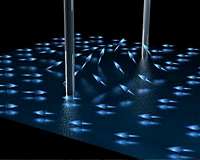
file illustration only

A recent discovery by University of Arkansas physicists could help researchers establish the existence of quantum spin liquids, a new state of matter. They've been a mystery since they were first proposed in the 1970s. If proven to exist, quantum spin liquids would be a step toward much faster, next-generation quantum computing.

Scientists have focused attention and research on the so-called Kitaev-type of spin liquid, named in honor of the Russian scientist, Alexei Kitaev, who first proposed it. In particular, they have looked extensively at two materials - RuCl3 and Na2IrO - as candidates for this type. Both have small quantum spin numbers.

"Traditional candidates are pretty limited to only these two," said Changsong Xu, a researcher in the Department of Physics and first author of a paper published in the journal Physical Review Letters.

In their recent work, U of A physicists have greatly expanded the number of materials that might be candidates as Kitaev quantum spin liquids by looking at materials with higher quantum spin numbers, and by putting materials under physical strain to tune their magnetic states.

"Suddenly, we realize there are dozens of candidates we can propose," said Xu.

Quantum spin liquids are defined by their unusual magnetic arrangement. Magnets have a north and south pole, which combined are called dipoles. These are typically produced by the quantum spin of electrons. Inside a magnetic material, dipoles tend to all be parallel to each other (ferromagnetism) or periodically alternate their up and down direction (antiferromagnetism).

In the case of hypothetical quantum spin liquids, dipoles aren't as well ordered. Instead, they exhibit unusual ordering within a small distance of each other. Different ordering creates different types of spin liquids.

Xu, along with Distinguished Professor of Physics Laurent Bellaiche and colleagues in China and Japan, used computational models to predict a Kitaev quantum spin liquid state in materials such as chromium iodide and chromium germanium telluride. The work, which was supported by grants from the Arkansas Research Alliance and the Department of Energy, will give researchers many more materials to study in a search to prove the existence of quantum spin liquids, said Xu.

Research paper


Related Links
University Of Arkansas
Understanding Time and Space


Thanks for being here;
We need your help. The Space Media Network continues to grow but revenues have never been harder to maintain.

With the rise of Ad Blockers, and Facebook - our traditional revenue sources via quality network advertising continues to decline. And unlike so many other news sites, we don't have a paywall - with those annoying usernames and passwords.

Our news coverage takes time and effort to publish 365 days a year.

If you find our news sites informative and useful then please consider becoming a regular supporter or for now make a one off contribution.
SpaceMediaNetwork Contributor
$5 Billed Once


credit card or paypal
SpaceMediaNetwork Monthly Supporter
$5 Billed Monthly


paypal only


TIME AND SPACE
Laser technique enables powerful smaller particle accelerators
Rochester NY (SPX) Apr 06, 2020
By observing electrons that have been accelerated to extremely high energies, scientists are able to unlock clues about the particles that make up our universe. Accelerating electrons to such high energies in a laboratory setting, however, is challenging: typically, the more energetic the electrons, the bigger the particle accelerator. For instance, to discover the Higgs boson - the recently observed "God particle," responsible for mass in the universe - scientists at the CERN laboratory in Switze ... read more

Comment using your Disqus, Facebook, Google or Twitter login.


Share this article via these popular social media networks
del.icio.usdel.icio.us DiggDigg RedditReddit GoogleGoogle

TIME AND SPACE
Lockheed awarded $932.8M to make THAADs for U.S., Saudi Arabia

Missile Defense Agency's Long Range Discrimination Radar closer to delivery

Arrows of misfortune as US Missile Defence needs upgrading

Syrian air defence responds to 'Israeli missiles': state media

TIME AND SPACE
Raytheon awarded $641.3M for work on Tomahawks for Navy

Raytheon nabs $2.1B for work on Standard Missile-3 Block IB rounds

Raytheon, Aerojet announce $1B deal for Standard Missile projects

Raytheon nabs $392.4M for tactical missiles

TIME AND SPACE
SUGUS kicks off, a European project for integrating drones into the airspace

New research improves drone detection

Skyryse introduces automation flight operating system FlightOS

Hughes awarded contract by GA-ASI to connect US Army's Gray Eagle UAV with future SatComs

TIME AND SPACE
AEHF-6 Satellite Actively Communicating With U.S. Space Force

AEHF-6 satellite completes protected satellite constellation

Sixth Advanced Extremely High Frequency satellite ready for launch

Lockheed Martin selects SEAKR Wolverine mission processor for Protected Tactical SATCOM

TIME AND SPACE
AFRL creates safer-than-steel synthetic winch cable for cargo aircraft

Mesoamerican copper smelting technology aided colonial weaponry

Raytheon, Uptake bring AI to Marines' M88 maintenance

Navy awards $74M in contracts for BLU 111 warhead assemblies

TIME AND SPACE
Coronavirus challenges US military machine

DoD urges defense contractors, subcontractors to stay at work

Lockheed Martin names new CEO

Pentagon 'wishes to reconsider' awarding JEDI contract to Microsoft

TIME AND SPACE
Trump says US can avoid major epidemic as virus spreads

Last Soviet marshal and 1991 coup plotter Yazov dies

After US, Greece to sign defence deal with France: officials

As world hunkers down, Trump moves full-speed against US foes

TIME AND SPACE
New DNA origami motor breaks speed record for nano machines

Deep-sea osmolyte makes biomolecular machines heat-tolerant

Nanobubbles in nanodroplets

New production method for carbon nanotubes gets green light


The content herein, unless otherwise known to be public domain, are Copyright 1995-2024 - Space Media Network. All websites are published in Australia and are solely subject to Australian law and governed by Fair Use principals for news reporting and research purposes. AFP, UPI and IANS news wire stories are copyright Agence France-Presse, United Press International and Indo-Asia News Service. ESA news reports are copyright European Space Agency. All NASA sourced material is public domain. Additional copyrights may apply in whole or part to other bona fide parties. All articles labeled "by Staff Writers" include reports supplied to Space Media Network by industry news wires, PR agencies, corporate press officers and the like. Such articles are individually curated and edited by Space Media Network staff on the basis of the report's information value to our industry and professional readership. Advertising does not imply endorsement, agreement or approval of any opinions, statements or information provided by Space Media Network on any Web page published or hosted by Space Media Network. General Data Protection Regulation (GDPR) Statement Our advertisers use various cookies and the like to deliver the best ad banner available at one time. All network advertising suppliers have GDPR policies (Legitimate Interest) that conform with EU regulations for data collection. By using our websites you consent to cookie based advertising. If you do not agree with this then you must stop using the websites from May 25, 2018. Privacy Statement. Additional information can be found here at About Us.