
 |
 |
 |
 |
 |
 |
 |
 |
 |
 |

| . |  |
. |

Sydney, Australia (SPX) Apr 04, 2011 University of Sydney astrophysicists are behind a major breakthrough in the study of the senior citizens of our galaxy: stars known as Red Giants. Using high precision brightness measurements taken by the Kepler spacecraft, scientists have been able to distinguish profound differences inside the cores of stars that otherwise look the same on the surface. The discovery, published in the latest edition of the journal Nature and made possible by observations using NASA's powerful Kepler space telescope, is shedding new light on the evolution of stars, including our own sun. The paper's lead author, the University of Sydney's Professor Tim Bedding, explains, "Red giants are evolved stars that have exhausted the supply of hydrogen in their cores that powers nuclear fusion, and instead burn hydrogen in a surrounding shell. Towards the end of their lives, red giants begin burning the helium in their cores." The Kepler space telescope has allowed Professor Bedding and colleagues to continuously study starlight from hundreds of red giants at an unprecedented level of precision for nearly a year, opening up a window into the stars' cores. "The changes in brightness at a star's surface is a result of turbulent motions inside that cause continuous star-quakes, creating sound waves that travel down through the interior and back to the surface," Professor Bedding said. "Under the right conditions, these waves interact with other waves trapped inside the star's helium core. It is these 'mixed' oscillation modes that are the key to understanding a star's particular life stage. By carefully measuring very subtle features of the oscillations in a star's brightness, we can see that some stars have run out of hydrogen in the center and are now burning helium, and are therefore at a later stage of life." Astronomer Travis Metcalfe of the US National Center for Atmospheric Research, in a companion piece in the same Nature issue which highlights the discovery's significance, compares red giants to Hollywood stars, whose age is not always obvious from the surface. "During certain phases in a star's life, its size and brightness are remarkably constant, even while profound transformations are taking place deep inside." Professor Bedding and his colleagues work in an expanding field called asteroseismology. "In the same way that geologists use earthquakes to explore Earth's interior, we use star quakes to explore the internal structure of stars," he explained. Professor Bedding said: "We are very excited about the results. We had some idea from theoretical models that these subtle oscillation patterns would be there, but this confirms our models. It allows us to tell red giants apart, and we will be able to compare the fraction of stars that are at the different stages of evolution in a way that we couldn't before." Daniel Huber, a PhD student working with Professor Bedding, added: "This shows how wonderful the Kepler satellite really is. The main aim of the telescope was to find Earth-sized planets that could be habitable, but it has also provided us with a great opportunity to improve our understanding of stars."
Share This Article With Planet Earth
Related Links Kepler at NASA Stellar Chemistry, The Universe And All Within It

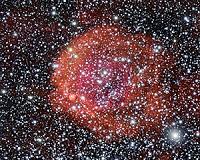 The Rose-Red Glow Of Star Formation
Paris, France (SPX) Mar 31, 2011 The vivid red cloud in this new image from ESO's Very Large Telescope is a region of glowing hydrogen surrounding the star cluster NGC 371. This stellar nursery lies in our neighbouring galaxy, the Small Magellanic Cloud. The object dominating this image may resemble a pool of spilled blood, but rather than being associated with death, such regions of ionised hydrogen - known as HII region ... read more |
|
|
| The content herein, unless otherwise known to be public domain, are Copyright 1995-2010 - SpaceDaily. AFP and UPI Wire Stories are copyright Agence France-Presse and United Press International. ESA Portal Reports are copyright European Space Agency. All NASA sourced material is public domain. Additional copyrights may apply in whole or part to other bona fide parties. Advertising does not imply endorsement,agreement or approval of any opinions, statements or information provided by SpaceDaily on any Web page published or hosted by SpaceDaily. Privacy Statement |


 del.icio.us
 Digg
Digg Reddit
 YahooMyWeb
 Google
 Facebook


