
. Military Space News .
Russian capsule carrying US tourist docks with space station

by Staff Writers
Moscow (AFP) Oct 14, 2008
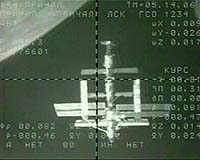
A Russian Soyuz capsule carrying US millionaire video game guru Richard Garriott, the world's sixth space tourist, successfully docked with the International Space Station (ISS) on Tuesday.

"The docking took place at 12:32 Moscow time (0832 GMT) and they entered about an hour later," a spokeswoman for the space control centre in the town of Korolyov told AFP, adding that Garriott and his crewmates "feel very well."

Television footage showed six crewmen in blue suits -- three fresh off the Soyuz and three who had already been on the ISS -- smiling and waving aboard the station. The astronauts were also shown floating in zero gravity.

Tuesday's rendezvous in space was unusual for its family connections.

Garriott is the son of former US astronaut Owen Garriott, who in 1973 spent two months aboard Skylab, the first orbiting space station.

On the ISS, he met a member of the world's other space dynasty: Sergei Volkov, the son of former Soviet cosmonaut Alexander Volkov, who was shown joking with Owen Garriott at a televised press conference after the docking.

"When I woke up this morning, I thought, 'Why don't I fly into space today?' I did my exercises and felt well, so why not?" Alexander Volkov said.

"If we could go together, that would be a good idea," Owen Garriott replied.

Apart from Richard Garriott, who is paying 30 million dollars (22 million euros) for his 10-day space journey, the capsule also took Russian cosmonaut Yury Lonchakov and US astronaut Michael Fincke to the ISS.

The 47-year-old US space tourist, who has called his journey into orbit a lifelong dream, created the Ultima series of computer role-playing games in the 1980s and later earned millions of dollars as a video-game entrepreneur.

He is due to fly back on October 24, along with Sergei Volkov and another Russian cosmonaut, Oleg Kononenko, in a descent that will be closely watched for signs of a glitch that has bedevilled recent landings of the Soyuz capsule.

In a landing on April 19, the capsule entered the atmosphere at an unusually steep angle, subjecting astronauts to uncomfortably strong G forces and landing 420 kilometres (260 miles) from its target.

Coming after a similar incident in October 2007, the so-called "ballistic" descent raised questions about the safety of the Soyuz, a workhorse spacecraft that has carried out more than 1,600 flights.

Russian space officials blamed the problem on a faulty explosive bolt used to separate the Soyuz from the ISS, and two cosmonauts went on a spacewalk in July to fix the problem.

But the chief of the US National Aeronautics and Space Administration (NASA) said in August that the Soyuz glitch was still a mystery.

NASA will be totally reliant on the Soyuz for transporting astronauts and cargo to the ISS after its space shuttle fleet retires in 2010 and until the shuttle's successor vehicle is ready, expected in 2015 at the earliest.

  • Editor's note: In a recent report we described Space Tourist Richard Garriott as the first second generation astronaut. In several ways this statement is clearly incorrect. Firstly, Garriott was pipped at the post by a Russian - Sergei Volkov - who was on the Space Station to personally welcome Garriott aboard. Moreover, the term "astronaut" is not applicable here as Garriott was trained by the Russian space agency as a commercial cosmonaut, and in proper context Garriott is the second second-generation cosmonaut ... and incredibly they both meet in space.

    Community
    Email This Article
    Comment On This Article

    Share This Article With Planet Earth
    del.icio.usdel.icio.us DiggDigg RedditReddit
    YahooMyWebYahooMyWeb GoogleGoogle FacebookFacebook


    Related Links
    Station and More at Roscosmos
    S.P. Korolev RSC Energia
    Russian Space News


    Memory Foam Mattress Review
    Newsletters :: SpaceDaily :: SpaceWar :: TerraDaily :: Energy Daily
    XML Feeds :: Space News :: Earth News :: War News :: Solar Energy News


    US telecoms satellite put into orbit: company
    Moscow (AFP) Sept 24, 2008
    The Russo-Ukrainian rocket Zenit on Wednesday put the US telecommunications satellite Galaxy-19 in orbit, Russia's space flights regulator said.


  • China will play 'positive role' in financial crisis, Wen says
  • Russia gives territory to China, ending border dispute
  • Outside View: Russia flexes Med sea power
  • Outside View: Russia trains to fight NATO

  • Russia, North Korea to hold nuclear talks Wednesday
  • NKorea grants UN nuclear watchdog access to Yongbyon: IAEA
  • NKorea vows to disable nuclear plants after deal with US
  • US boasts all inspections demands met in N Korea blacklist deal

  • NKorea prepares mass missile launches: reports
  • Russia denies missile sales to Iran
  • US advises North Korea against test-firing missiles
  • NKorea fires short-range missiles: Yonhap

  • BMD Focus: Sineva launch success
  • BMD Focus: Russia may not sell Iran S-300s
  • BMD Watch: BrahMos ALCM planned
  • Russia Eyes New Customers For Iskander E Missile

  • Researchers Scientists Perform High Altitude Experiments
  • Airbus expecting 'large' China order by early 2009: CEO
  • Airbus globalises production with China plant
  • Safer Skies For The Flying Public

  • US drones fly after missile strike in Pakistan: residents
  • TAAC 2008 Unmanned Aircraft Systems Conference
  • Sky Warrior UAS Completes First Automatic Takeoffs And Landings
  • Pterodactyl-Inspired Robot To Master Air, Ground, And Sea

  • US commander accuses Iran of trying to bribe Iraqis
  • Analysis: Transition time a vulnerability
  • Dogs of War: A big step for accountability
  • US Army releases manual on 'stability operations'

  • Russian helicopter plans part two
  • AAAS Satellite Image Analysis Reveals South Ossetian Damage
  • Winner Of DoD Wearable Power Prize Competition Announced
  • A New Explosive

  • The content herein, unless otherwise known to be public domain, are Copyright 1995-2007 - SpaceDaily.AFP and UPI Wire Stories are copyright Agence France-Presse and United Press International. ESA Portal Reports are copyright European Space Agency. All NASA sourced material is public domain. Additional copyrights may apply in whole or part to other bona fide parties. Advertising does not imply endorsement,agreement or approval of any opinions, statements or information provided by SpaceDaily on any Web page published or hosted by SpaceDaily. Privacy Statement