
 A UV event captured by NASA's Solar Dynamics Observatory. |
"One of the highlights of the last year is just that everything worked so smoothly," says astrophysicist Dean Pesnell, the project scientist for SDO at NASA's Goddard Space Flight Center in Greenbelt, Md. "We turned it on in March and it immediately started sending us data at 150 megabits per second. It worked from the very get go."
The first things scientists and the public saw from SDO was an array of wonderfully detailed pictures of the sun. One of the three instruments on board, called the Atmospheric Imaging Assembly (AIA), captures a shot of the sun every 12 seconds in 10 different wavelengths - each wavelength helps illuminate aspects of the sun at different temperatures. The images are all available in real time online for everyone to see.
"It's been great to watch how popular these images are," says Phil Chamberlin, another astrophysicist at Goddard and one of SDO's deputy project scientists. "The public has been extremely interested. And it's important that people see what the sun is doing and how it affects us."
These images have regularly caught solar flares, coronal mass ejections, filament eruptions and other space weather phenomena in the act. Such images are helping to flesh out such questions as why the sun's corona - its atmosphere - is thousands of times hotter than the surface of the sun.
For example, given how quickly SDO takes its pictures, scientists were recently able to track plumes of plasma heating up as they moved from the sun's surface up into the corona.
Another fruitful area of research from SDO involves understanding the massive explosions on the sun's surface called solar flares. Scientists have been able to use the GOES spacecraft to look at X-rays emitted from solar flares for some 40 years. But observing them in X-rays means one can only see those parts of the flares that are about 10 million degrees Celsius.
Other spacecraft have since shown the flares in other wavelengths, but SDO's ability to provide detailed images of the same event in so many wavelengths allows one to see different parts of the flare no matter what temperature. It now appears that flares may be more complex than previously known.
The other two instruments onboard SDO also have made a strong impact. The Extreme Ultraviolet Variability Experiment (EVE) examines the extreme ultraviolet photons from the sun that are responsible for heating in Earth's upper atmosphere.
The Helioseismic and Magnetic Imager (HMI) observes how the magnetic fields across the surface of the sun change, as well as seismic activity across the sun. "These are the doorway to the interior of the sun," says Pesnell. "This is how we understand what's going on inside it."
One of SDO's greatest successes so far may be how well these three instruments coordinate with other spacecraft observing the sun. For example, the two STEREO spacecraft moved into position on opposite sides of the sun on February 6, 2011 and will continue towards the far side and all the way around again over the next eight years.
For that entire time, STEREO and SDO together will offer scientists their first opportunity to watch the entire sun simultaneously. There are many clues that solar weather can be connected over distances up to a million miles, but this will be the first chance to see how flares on one side coordinate with flares on the other.
In addition, sun observers such as the Reuven Ramaty High Energy Solar Spectroscopic Imager (RHESSI) can show the highest energy, highest temperature bursts on the sun. These can be overlaid on SDO's images to get a more comprehensive picture of each individual event.
On January 28, 2011, for example, two bursts of plasma jumped out from each side of the sun simultaneously - an example of unconfirmed theories that such things often happen 180 degrees apart. Luckily, RHESSI caught the same event in its images, offering an unprecedented chance to examine all parts of the bursts at all temperatures.
"It's not just SDO. It's RHESSI, STEREO, SDO's three instruments all together," says Chamberlin. "The whole is much greater than the sum of the individual parts. We've been talking about putting together this great Heliophysics observatory and this really is what we have."
SDO is the first mission in a NASA science program called Living With a Star, the goal of which is to develop the scientific understanding necessary to address those aspects of the sun-Earth system that directly affect our lives and society. NASA Goddard built, operates, and manages the SDO spacecraft for NASA's Science Mission Directorate in Washington.
 del.icio.us del.icio.us |
 Digg Digg |
 Reddit Reddit |
 YahooMyWeb YahooMyWeb |
 Google Google |
 Facebook Facebook |

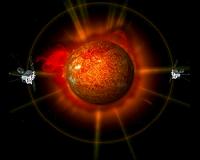 First Ever STEREO Images Of The Entire Sun
| The content herein, unless otherwise known to be public domain, are Copyright 1995-2010 - SpaceDaily. AFP and UPI Wire Stories are copyright Agence France-Presse and United Press International. ESA Portal Reports are copyright European Space Agency. All NASA sourced material is public domain. Additional copyrights may apply in whole or part to other bona fide parties. Advertising does not imply endorsement,agreement or approval of any opinions, statements or information provided by SpaceDaily on any Web page published or hosted by SpaceDaily. Privacy Statement |


