
. Military Space News .
STELLAR CHEMISTRY
Satellite galaxies at edge of Milky Way coexist with dark matter
by Staff Writers
Rochester NY (SPX) Mar 31, 2017


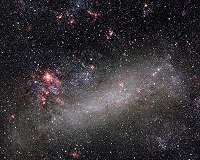
The Large Magelanic Cloud is a well-known satellite or dwarf galaxy that closely orbits the Milky Way and is visible in Earth's southern hemisphere. RIT researchers make the case for the existence of "missing" satellite galaxies that are cloaked in dark matter and cannot be directly observed.

Research conducted by scientists at Rochester Institute of Technology rules out a challenge to the accepted standard model of the universe and theory of how galaxies form by shedding new light on a problematic structure.

The vast polar structure - a plane of satellite galaxies at the poles of the Milky Way - is at the center of a tug-of-war between scientists who disagree about the existence of mysterious dark matter, the invisible substance that, according to some scientists, comprises 85 percent of the mass of the universe.

A paper accepted for publication in the Monthly Notices for the Royal Astronomical Society bolsters the standard cosmological model, or the Cold Dark Matter paradigm, by showing that the vast polar structure formed well after the Milky Way and is an unstable structure.

The study, "Is the Vast Polar Structure of Dwarf Galaxies a Serious Problem for CDM?" - available online at https:/?/?arxiv.?org/?abs/?1612.?07325 - was co-authored by Andrew Lipnicky, a Ph.D. candidate in RIT's astrophysical sciences and technology program, and Sukanya Chakrabarti, assistant professor in RIT's School of Physics and Astronomy, whose grant from the National Science Foundation supported the research.

Lipnicky and Chakrabarti analyze the distribution of the classical Milky Way dwarf galaxies that form the vast polar structure and compares it to simulations of the "missing" or subhalo dwarf galaxies thought to be cloaked in dark matter.

Using motion measurements, the authors traced the orbits of the classical Milky Way satellites backward in time. Their simulations showed the vast polar structure breaking up and dispersing, indicating that the plane is not as old as originally thought and formed later in the evolution of the galaxy. This means that the vast polar structure of satellite galaxies may be a transient feature, Chakrabarti noted.

"If the planar structure lasted for a long time, it would be a different story," Chakrabarti said. "The fact that it disperses so quickly indicates that the structure is not dynamically stable. There is really no inconsistency between the planar structure of dwarf galaxies and the current cosmological paradigm."

The authors removed the classical Milky Way satellites Leo I and Leo II from the study when orbital analyses determined that the dwarf galaxies were not part of the original vast polar structure but later additions likely snatched from the Milky Way. A comparison excluding Leo I and II reveals a similar plane shared by classical galaxies and their cloaked counterparts.

"We tried many different combinations of the dwarf galaxies, including distributions of dwarfs that share similar orbits, but in the end found that the plane always dispersed very quickly," Lipnicky said.

Opposing scientific thought rejects the existence of dark matter. This camp calls into question the standard cosmological paradigm that accepts both a vast polar structure of satellite galaxies and a hidden plane of dark-matter cloaked galaxies. Lipnicky and Chakrabarti's study supports the co-existence of these structures and refutes the challenge to the accepted standard model of the universe.

Their research concurs with a 2016 study led by Nuwanthika Fernando, from the University of Sydney, which found that certain Milky Way planes are unstable in general. The paper published in the Monthly Notices for the Royal Astronomical Society.

Research paper

STELLAR CHEMISTRY
Explaining the accelerating expansion of the universe without dark energy
London, UK (SPX) Mar 31, 2017
Enigmatic dark energy, thought to make up 68% of the universe, may not exist at all, according to a Hungarian-American team. The researchers believe that standard models of the universe fail to take account of its changing structure, but that once this is done the need for dark energy disappears. The team publish their results in a paper in Monthly Notices of the Royal Astronomical Society. ... read more

Related Links
Rochester Institute of Technology
Stellar Chemistry, The Universe And All Within It


Thanks for being here;
We need your help. The Space Media Network continues to grow but revenues have never been harder to maintain.

With the rise of Ad Blockers, and Facebook - our traditional revenue sources via quality network advertising continues to decline. And unlike so many other news sites, we don't have a paywall - with those annoying usernames and passwords.

Our news coverage takes time and effort to publish 365 days a year.

If you find our news sites informative and useful then please consider becoming a regular supporter or for now make a one off contribution.
SpaceMediaNetwork Contributor
$5 Billed Once


credit card or paypal
SpaceMediaNetwork Monthly Supporter
$5 Billed Monthly


paypal only


Comment using your Disqus, Facebook, Google or Twitter login.

Share this article via these popular social media networks
del.icio.usdel.icio.us DiggDigg RedditReddit GoogleGoogle

STELLAR CHEMISTRY
Raytheon to supply Multi-Object Kill Vehicle technology

Israel's latest missile interceptor enters service

Always on Guard: All You Need to Know About Russia's Missile Defense

Raytheon completes ballistic missile radar detection test

STELLAR CHEMISTRY
Brazil considering Pantsir-S1 buy from Russia

Latest NKorean missile was a Scud: US official

Rockwell Collins to begin work on second CRIIS system

US confident it can thwart N.Korean missiles: US general

STELLAR CHEMISTRY
U.S. Navy tests updated Triton drone

Whiteflies provide insight into stabilizing manmade drones during takeoff

A novel hybrid UAV that may change the way people operate drones

General Atomics building ground control station for drones

STELLAR CHEMISTRY
AF announces major changes to space enterprise

Battle of the ModRecs Lays Groundwork for Improved Spectrum Management

Israel taps Elbit Systems for advanced radios

Hensoldt, Leonardo offering Mode 5 IFF systems

STELLAR CHEMISTRY
Northrop Grumman to support IBCS development for U.S. Army

General Dynamics, US Ordnance share contract for M2 machineguns

General Dynamics contracted for tank ammo cartridges

Rheinmetall subsidiary receives orders for mine-clearance systems

STELLAR CHEMISTRY
Israel's Delek Group sets sights on global stage

Trump lifts rights conditions on Bahrain arms sales

Trump pressured to approve defense deals with India

Israel defence exports surge to $6.5 bln

STELLAR CHEMISTRY
Trump, Xi talks "significant" for US-China ties: officials

U.S., Lithuanian troops conduct Savage Wolf exercise

Russia defends Syria against 'chemical attack' outcry

Duterte orders Philippine troops to South China Sea reefs

STELLAR CHEMISTRY
Nanoscopic golden springs change color of twisted light

Photonic crystal and nanowire combo advances 'photonic integration'

Carbon nanotubes self-assemble into tiny transistors

New Nano Devices Could Withstand Extreme Environments in Space


The content herein, unless otherwise known to be public domain, are Copyright 1995-2024 - Space Media Network. All websites are published in Australia and are solely subject to Australian law and governed by Fair Use principals for news reporting and research purposes. AFP, UPI and IANS news wire stories are copyright Agence France-Presse, United Press International and Indo-Asia News Service. ESA news reports are copyright European Space Agency. All NASA sourced material is public domain. Additional copyrights may apply in whole or part to other bona fide parties. All articles labeled "by Staff Writers" include reports supplied to Space Media Network by industry news wires, PR agencies, corporate press officers and the like. Such articles are individually curated and edited by Space Media Network staff on the basis of the report's information value to our industry and professional readership. Advertising does not imply endorsement, agreement or approval of any opinions, statements or information provided by Space Media Network on any Web page published or hosted by Space Media Network. General Data Protection Regulation (GDPR) Statement Our advertisers use various cookies and the like to deliver the best ad banner available at one time. All network advertising suppliers have GDPR policies (Legitimate Interest) that conform with EU regulations for data collection. By using our websites you consent to cookie based advertising. If you do not agree with this then you must stop using the websites from May 25, 2018. Privacy Statement. Additional information can be found here at About Us.