
Subscribe free to our newsletters via your
. Military Space News .


WATER WORLD
Saving the Great Plains water supply
by Staff Writers
East Lansing MI (SPX) Dec 17, 2013


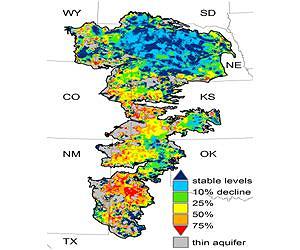
Significant portions of the Ogallala Aquifer, one of the largest bodies of water in the United States, are at risk of drying up if it continues to be drained at its current rate. Image courtesy of MSU. For a larger version of this image please go here.

Significant portions of the Ogallala Aquifer, one of the largest bodies of water in the United States, are at risk of drying up if it continues to be drained at its current rate. In the current issue of Earth's Future, a journal of the American Geophysical Union, Michigan State University scientists are proposing alternatives that will halt and hopefully reverse the unsustainable use of water drawdown in the aquifer.

The body of water, also known as the High Plains Aquifer, spans from Texas to South Dakota and drives much of the region's economy. "Already, there are regions in Texas and Kansas where farmers can't pump enough water to meet the demands of their crops," said Bruno Basso, co-author and MSU ecosystem scientist.

"If current withdrawal rates continue, such depletion will expand across extensive portions of the central and southern areas served by the aquifer during the next few decades." Despite the widespread, rapid decline of the water table, the number of irrigated acres across the region continues to increase.

The situation isn't completely dire, though, as the National Science Foundation-funded research revealed. Basso, David Hyndman and Anthony Kendall, MSU colleagues and co-authors, offered some policy solutions to avert some aspects of this water crisis. Federal crop insurance could be changed to allow substantial water reductions, especially crops categorized as fully irrigated. An example of such a sustainable model was recently proposed by the governor of Kansas.

It could save significant amounts of water, and it could be adopted regionally. Another sustainable approach would be to adopt wholesale precision agriculture strategies. These would allow farmers to identify which areas in fields need more water and fertilizer.

New precision agriculture strategies combine GPS technologies with site-specific management to apply optimal amounts of water and nutrients, which will increase farmer's profitability and reduce environmental impact.

"When you have a cut in your hand and need disinfectant, you don't dive into a pool of medicine, you apply it only where you need it and in the quantity that is strictly necessary; we can do the same in agricultural now," said Basso, part of MSU's Global Water Initiative. Lastly, policies should address the issue in terms of crop yield - more crop per drop of water. Selecting crops with higher density can increase yield and decrease groundwater evaporation.

Upgrades in irrigation systems can reduce water loss from 30 percent to almost zero. And careful water management can stop excess water from flooding fields and leaching valuable nutrients from the soil. Simply put, the current water management strategies of the High Plains Aquifer are unsustainable. For the region to maintain this water source, there has to be a complete paradigm shift, Basso added.

"We emphasize the critical role of science as a foundation for policies that can help mitigate the disaster that is occurring across this region," Basso said. "Policies solidly grounded in science are critical to ensure long-term sustainability and environmental integrity for future generations."

.


Related Links
Michigan State University
Water News - Science, Technology and Politics


Comment on this article via your Facebook, Yahoo, AOL, Hotmail login.

Share this article via these popular social media networks
del.icio.usdel.icio.us DiggDigg RedditReddit GoogleGoogle


WATER WORLD
Researchers split water into hydrogen, oxygen using light, nanoparticles
Houston TX (SPX) Dec 17, 2013
Researchers from the University of Houston have found a catalyst that can quickly generate hydrogen from water using sunlight, potentially creating a clean and renewable source of energy. Their research, published online Sunday in Nature Nanotechnology, involved the use of cobalt oxide nanoparticles to split water into hydrogen and oxygen. Jiming Bao, lead author of the paper and an ... read more


WATER WORLD
Patriot missiles demonstrate field readiness

U.S. to boost Israel defense missile funding by $173M

Astrium, Raytheon team to compete for NATO ballistic missile defense work

Iran nuclear accord means NATO missile defence unnecessary: Russia

WATER WORLD
US to cut funding on Turkish Chinese-missile purchase

Merrill Lynch rejects Turkey role over China missile plans: report

Turkey says no new bids to rival China missile offer

Kongsberg seals Penguin missile deal with New Zealand

WATER WORLD
US Air Force has secretly built a new stealth drone

Northrop starts production of Global Hawk UAS for NATO

Pentagon chief talks drones with Pakistan PM

Northrop Grumman Begins On-Time Production of First NATO Global Hawk

WATER WORLD
Military Communication Improved as 6th Boeing-built Wideband Satellite Enters Service

Radio Gateway Connects US and Allied Troops to a Common Mobile Network

Northrop Grumman Reinvents Satellite Communications for Aircraft

US Navy Accepts MUOS-2 Satellite, Ground Stations After On-Orbit Testing

WATER WORLD
Researchers Develop World's Highest Quantum Efficiency UV Photodetectors

Lockheed Martin Joint Light Tactical Vehicle Completes Manufacturing Review

Raytheon demonstrates unparalleled precision in live-fire testing of self-propelled howitzer

U.S. Army holds online development event

WATER WORLD
Lockheed Martin names CEO Hewson as new chair

Bristol-Myers Squibb Foundation funds veteran programs

Obama opens way to Gulf grouping military sales

EU leaders mull defence cooperation as tight budgets bite

WATER WORLD
'No one will prevail over Russia militarily'

China's graft crackdown hits watches, luxury market

NATO chief hopes for new EU defence commitment

US warship threatened China's security: state media

WATER WORLD
Alzheimer-substance may be the nanomaterial of tomorrow

Oregon scientists offer new insights on controlling nanoparticle stability

Less is more with adding graphene to nanofibers

Graphene-based nano-antennas may enable networks of tiny machines


The content herein, unless otherwise known to be public domain, are Copyright 1995-2014 - Space Media Network. AFP, UPI and IANS news wire stories are copyright Agence France-Presse, United Press International and Indo-Asia News Service. ESA Portal Reports are copyright European Space Agency. All NASA sourced material is public domain. Additional copyrights may apply in whole or part to other bona fide parties. Advertising does not imply endorsement,agreement or approval of any opinions, statements or information provided by Space Media Network on any Web page published or hosted by Space Media Network. Privacy Statement