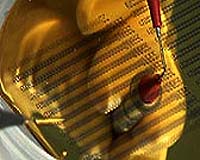
A researcher at LLNL checks the circuit continuity in a flexible polymer microelectrode array for possible implantation in a test subject's eye.
A researcher at LLNL checks the circuit continuity in a flexible polymer microelectrode array for possible implantation in a test subject's eye. |
The Cooperative Research and Development Agreement (CRADA) allows Second Sight Medical Products of Sylmar, Calif. to obtain a limited exclusive license for inventions developed during the DOE Retinal Prosthesis Project.
"The Department of Energy has led the way to many scientific breakthroughs, especially when several scientific disciplines combined to make a whole greater than the sum of the parts," Energy Secretary Spencer Abraham said.
"This project is one such example where biology, physics and engineering have joined forces to deliver a capability that will enable blind people to see. This agreement between the DOE laboratories and the private sector will facilitate transfer of many aspects of DOE technology to a clinical device that has the potential of restoring sight to millions of blind individuals", Abraham said.
An artificial retina could restore vision to millions of people suffering from eye diseases such as macular degeneration (the leading cause of blindness in people over 60), retinitis pigmentosa (the leading cause of blindness in people under 50), or those who are legally blind due to the loss of photoreceptor function.
Lawrence Livermore partnered with four other national laboratories, three universities and Second Sight on the project.
Engineers from LLNL's Center for Micro- and Nanotechnology specifically are developing a flexible silicone implant (microelectrode array) that sits on the surface of the retina. The electrode array can contact delicate retinal tissue without damaging it.
The implantable retinal prosthesis is based on a system that converts a video camera signal into a stimulation pattern that is applied directly to the intra-ocular retinal surface. This is referred to as an epiretinal implant - the device is in contact with the surface of the retina. Visual signals are captured by a small video camera in the eyeglasses of the blind person and processed through a microcomputer worn on a belt.
Although the device will not restore full vision, it is expected to provide enough optical resolution for patients to read and recognize fine shapes.
LLNL's pioneering use of polydimethlsiloxane, or PDMS, allowed the microelectrode array to conform to the curved shape of the retina.
"PDMS has the look and feel of thin plastic food wrap," said Livermore's principal investigator, Courtney Davidson. "Yet it's biocompatible, making it a good candidate material for long-term implants."
Partners in the project include Oak Ridge, Argonne, Sandia and Los Alamos national laboratories, the University of California, Santa Cruz, the University of Southern California Doheny Eye Institute and North Carolina State University.
Project leader Dr. Mark Humayun of USC has shown that electrical stimulation of the viable retinal cells can result in visual perception. These findings helped spark the worldwide effort to develop a retinal prosthesis device.
The first patient to receive a prototype implant in 2002 was able to see large letters and to differentiate between a cup, a plate and a knife after being blind for more than 50 years. To date, six volunteers have received implants of a micro-electronic device that rests on the surface of the retina to perform the function of normal photoreceptive cells.
The artificial retina technology was featured today at the department's "What's Next Expo," an event designed to showcase the newest, most innovative, cutting-edge scientific and technological advances to interest young people in pursuing careers in math and science.
Second Sight was founded in 1998 to create a retinal prosthesis to provide sight to patients blinded from outer retinal degenerations.
Related Links
 Singapore Scientists Invent High-Tech SOS Shirt For Elderly
 Singapore (AFP) Oct 11, 2004
| The content herein, unless otherwise known to be public domain, are Copyright 1995-2006 - SpaceDaily.AFP and UPI Wire Stories are copyright Agence France-Presse and United Press International. ESA PortalReports are copyright European Space Agency. All NASA sourced material is public domain. Additionalcopyrights may apply in whole or part to other bona fide parties. Advertising does not imply endorsement,agreement or approval of any opinions, statements or information provided by SpaceDaily on any Web page published or hosted by SpaceDaily. Privacy Statement |