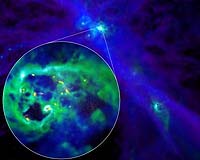
Researchers using supercomputer simulations have exposed a very violent and critical relationship between interstellar gas and dark matter when galaxies are born - one that has been largely ignored by the current model of how the universe evolved. The findings, published today in Science, solve a longstanding problem of the widely accepted model - Cold Dark Matter cosmology - which suggests there is much more dark matter in the central regions of galaxies than actual scientific observations suggest.
"This standard model has been hugely successful on the largest of scales-those above a few million light-years-but suffers from several persistent difficulties in predicting the internal properties of galaxies," says Sergey Mashchenko, research associate in the Department of Physics and Astronomy at McMaster University. "One of the most troublesome issues concerns the mysterious dark matter that dominates the mass of most galaxies."
Supercomputer cosmological simulations prove that indeed, this problem can be resolved. Researchers modeled the formation of a dwarf galaxy to illustrate the very violent processes galaxies suffer at their births, a process in which dense gas clouds in the galaxy form massive stars, which, at the ends of their lives, blow up as supernovae.
"These huge explosions push the interstellar gas clouds back and forth in the centre of the galaxy," says Mashchenko, the lead author of the study. "Our high-resolution model did extremely accurate simulations, showing that this 'sloshing' effect - similar to water in a bathtub- kicks most of the dark matter out of the centre of the galaxy."
Cosmologists have largely discounted the role interstellar gas has played in the formation of galaxies and this new research, says Mashchenko, will force scientists to think in new terms and could lead to a better understanding of dark matter.
The simulations reported in the research paper were carried out on the Shared Hierarchical Academic Research Computing Network (SHARCNET).