|
 |
 |
 |
 |
 |
 |
 |
 |
 |

| . |  |
. |
Seeing Through The Dark
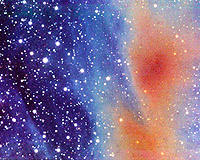
Helsinki, Finland (SPX) Mar 09, 2008 Astronomers have measured the distribution of mass inside a dark filament in a molecular cloud with an amazing level of detail and to great depth. The measurement is based on a new method that looks at the scattered near-infrared light or 'cloudshine' and was made with ESO's New Technology Telescope. Associated with the forthcoming VISTA telescope, this new technique will allow astronomers to better understand the cradles of newborn stars. The vast expanses between stars are permeated with giant complexes of cold gas and dust opaque to visible light. Yet these are the future nurseries of stars to be. "One would like to have a detailed knowledge of the interiors of these dark clouds to better understand where and when new stars will appear," says Mika Juvela, lead author of the paper in which these results are reported. Because the dust in these clouds blocks the visible light, the distribution of matter within interstellar clouds can be examined only indirectly. One method is based on measurements of the light from stars that are located behind the cloud. "This method, albeit quite useful, is limited by the fact that the level of details one can obtain depends on the distribution of background stars," says co-author Paolo Padoan. In 2006, astronomers Padoan, Juvela, and colleague Veli-Matti Pelkonen, proposed that maps of scattered light could be used as another tracer of the cloud's inner structure, a method that should yield more advantages. The idea is to estimate the amount of dust located along the line of sight by measuring the intensity of the scattered light. Dark clouds are feebly illuminated by nearby stars. This light is scattered by the dust contained in the clouds, an effect dubbed 'cloudshine' by Harvard astronomers Alyssa Goodman and Jonathan Foster. This effect is well known to sky lovers, as they create in visible light wonderful pieces of art called 'reflection nebulae'. The Chameleon I complex nebula is one beautiful example. When making observations in the near-infrared, art becomes science. Near-infrared radiation can indeed propagate much farther into the cloud than visible light and the maps of scattered light can be used to measure the mass of the material inside the cloud. To put this method to the test and use it for the first time for a quantitative estimation of the distribution of mass within a cloud, the astronomers who made the original suggestion, together with Kalevi Mattila, made observations in the near-infrared of a filament in the Corona Australis cloud. The observations were made in August 2006 with the SOFI instrument on ESO's New Technology Telescope at La Silla, in the Chilean Atacama Desert. The filament was observed for about 21 hours. Their observations confirm that the scattering method is providing results that are as reliable as the use of background stars while providing much more detail. "We can now obtain very high resolution images of dark clouds and so better study their internal structure and dynamics," says Juvela. "Not only is the level of details in the resulting map no longer dependent on the distribution of background stars, but we have also shown that where the density of the cloud becomes too high to be able to see any background stars, the new method can still be applied." "The presented method and the confirmation of its feasibility will enable a wide range of studies into the interstellar medium and star formation within the Milky Way and even other galaxies," says co-author Mattila. "This is an important result because, with current and planned near-infrared instruments, large cloud areas can be mapped with high resolution," adds Pelkonen. "For example, the VIRCAM instrument on ESO's soon-to-come VISTA telescope has a field of view hundreds of times larger than SOFI. Using our method, it will prove amazingly powerful for the study of stellar nurseries." The report appears this week in the journal Astronomy and Astrophysics ("A Corona Australis cloud filament seen in NIR scattered light - I. Comparison with extinction of background stars", by Mika Juvela, Veli-Matti Pelkonen, Paolo Padoan, and Kalevi Mattila). Juvela, Pelkonen and Mattila are associated with the Helsinki University Observatory (Finland), while Padoan is at the University of California, San Diego, USA. Community Email This Article Comment On This Article Related Links European Organisation for Astronomical Research in the Southern Hemisphere Space Telescope News and Technology at Skynightly.com
 Large Binocular Telescope Achieves First Binocular Light
 Mount Graham AZ (SPX) Mar 07, 2008
The Large Binocular Telescope on Mount Graham, Ariz., has taken celestial images using its twin side-by-side, 8.4-meter (27.6 foot) primary mirrors together, achieving first "binocular" light. |
|
|

| The content herein, unless otherwise known to be public domain, are Copyright 1995-2007 - SpaceDaily.AFP and UPI Wire Stories are copyright Agence France-Presse and United Press International. ESA Portal Reports are copyright European Space Agency. All NASA sourced material is public domain. Additional copyrights may apply in whole or part to other bona fide parties. Advertising does not imply endorsement,agreement or approval of any opinions, statements or information provided by SpaceDaily on any Web page published or hosted by SpaceDaily. Privacy Statement |