
. Military Space News .
STELLAR CHEMISTRY
Silver sawtooth creates valley-coherent light for nanophotonics
by Staff Writers
Groningen, Netherlands (SPX) Feb 11, 2020

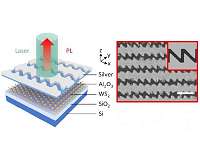
After excitation of the device with green laser light (green), coherent fluorescence occurs (red) thanks to the silver saw tooth (right panel). The scale bar is 500 nm

Scientists at the University of Groningen used a silver sawtooth nanoslit array to produce valley-coherent photoluminescence in two-dimensional tungsten disulfide flakes at room temperature. Until now, this could only be achieved at very low temperatures. Coherent light can be used to store or transfer information in quantum electronics. This plasmon-exciton hybrid device is promising for use in integrated nanophotonics (light-based electronics). The results were published in Nature Communications on 5 February.

Tungsten disulfide has interesting electronic properties and is available as a 2D material. 'The electronic structure of monolayer tungsten disulfide shows two sets of lowest energy points or valleys,' explains Associate Professor Justin Ye, head of the Device Physics of Complex Materials group at the University of Groningen.

One possible application is in photonics, as it can emit light with valley-dependent circular polarization - a new degree of freedom to manipulate information. However, valleytronics requires coherent and polarized light. Unfortunately, previous work showed that photoluminescence polarization in tungsten disulfide is almost random at room temperature.

Valleys
'Tungsten disulfide is unique in that these two valleys are not identical,' says Ye. This means that to create linearly polarized light, both valleys must respond coherently to generate light in the photoluminescence. 'But the intervalley scattering at room temperature largely destroys the coherence, so appreciable coherence is only achieved at very low temperatures that are close to zero.'

Ye and his postdoctoral researcher Chunrui Han (now working at the Institute of Microelectronics, Chinese Academy of Sciences) therefore tried a different approach to create linearly polarized light by using a plasmonic metasurface, in the form of a silver sawtooth nanoslit array. Such a material interacts strongly with tungsten disulfide and can transfer resonance induced by light in the form of an electromagnetic field in the metal. 'It enhances the light-material interaction,' says Ye.

Silver
By adding a thin layer of silver metasurface on top of a monolayer of tungsten disulfide, linear polarization induced by the valley coherence is increased to around 27 percent at room temperature. 'This room temperature performance is even better than the valley polarization obtained in many previous reports measured at very low temperatures,' says Ye.

The linear polarization could be further increased to 80 percent by adding the anisotropy of plasmonic resonance, in the form of the sawtooth pattern, to the optical response of the tungsten disulfide. This means that Ye and Han are now able to induce linearly polarized photoluminescence in this material.

This accomplishment will make it possible to use both valley coherence of tungsten disulfide and plasmonic coherence of metasurfaces in optoelectronics at ambient temperatures. The next step is to replace the laser light that induced photoluminescence with electrical input.

Research Report: "Polarized resonant emission of monolayer WS2 coupled with plasmonic sawtooth nanoslit array"


Related Links
University Of Groningen
Stellar Chemistry, The Universe And All Within It


Thanks for being here;
We need your help. The Space Media Network continues to grow but revenues have never been harder to maintain.

With the rise of Ad Blockers, and Facebook - our traditional revenue sources via quality network advertising continues to decline. And unlike so many other news sites, we don't have a paywall - with those annoying usernames and passwords.

Our news coverage takes time and effort to publish 365 days a year.

If you find our news sites informative and useful then please consider becoming a regular supporter or for now make a one off contribution.
SpaceMediaNetwork Contributor
$5 Billed Once


credit card or paypal
SpaceMediaNetwork Monthly Supporter
$5 Billed Monthly


paypal only


STELLAR CHEMISTRY
Controlling light with light
Boston MA (SPX) Feb 07, 2020
The future of computation is bright - literally. Researchers from the Harvard John A. Paulson School of Engineering and Applied Sciences (SEAS), in collaboration with researchers at McMaster University and University of Pittsburgh, have developed a new platform for all-optical computing, meaning computations done solely with beams of light. "Most computation right now uses hard materials such as metal wires, semiconductors and photodiodes to couple electronics to light," said Amos Meeks, a graduat ... read more

Comment using your Disqus, Facebook, Google or Twitter login.


Share this article via these popular social media networks
del.icio.usdel.icio.us DiggDigg RedditReddit GoogleGoogle

STELLAR CHEMISTRY
'Over in under a minute': commander divulges how quickly moscow's defences can thwart missile attack

Greece to send Patriot missiles to Saudi Arabia: official

US awaits Iraq's okay to deploy Patriots to protect troops

Lockheed nabs $114M deal to deliver Patriot missiles to UAE

STELLAR CHEMISTRY
Ukraine says Iran 'knew from start' missile downed plane

New footage shows Iranian missiles hitting Ukraine plane

Raytheon awarded $9M to maintain HARM weapons for Morocco, Turkey, U.S.

Iran's 'catastrophic mistake': Speculation, pressure, then admission

STELLAR CHEMISTRY
Extended range: VECTOR flies beyond 300 km using a UHF datalink

Researchers develop new bio-inspired wing design for small drones

AFRL XQ-58A Valkyrie expands flight envelope in fourth test

Navy's first MQ-4C Triton drones arrive in Guam

STELLAR CHEMISTRY
US Army and Air Force team up for multi-domain operations

NASA's Laser Communications Relay Demonstration Mission Leaves Goddard Space Flight Center

Protecting wideband RF systems in congested electromagnetic environments

General Dynamics receives $730M for next-gen satcom system

STELLAR CHEMISTRY
Trump lifts US restrictions on anti-personnel landmines

Pentagon to roll back restrictions on land mine use

US plans to relax restrictions on landmines

41st Field Artillery Brigade conducts live fire exercise in Germany

STELLAR CHEMISTRY
Modi eyes arms export tag in 'Made in India' push

Russia obtains ease on C.Africa arms embargo at UN Security Council

Israeli defense minister approves five-year military readiness plan

China now world's second biggest weapons producer: researchers

STELLAR CHEMISTRY
US has lost its 'moral leadership,' actor Harrison Ford says

Russia not target in US army's massive Europe deployment: NATO

UN marks 75th anniversary year in world of distrust, shifting power

Pompeo vows unwavering US support during delicate Ukraine visit

STELLAR CHEMISTRY
Deep-sea osmolyte makes biomolecular machines heat-tolerant

Nanobubbles in nanodroplets

New production method for carbon nanotubes gets green light

A quantum breakthrough brings a technique from astronomy to the nano-scale


The content herein, unless otherwise known to be public domain, are Copyright 1995-2024 - Space Media Network. All websites are published in Australia and are solely subject to Australian law and governed by Fair Use principals for news reporting and research purposes. AFP, UPI and IANS news wire stories are copyright Agence France-Presse, United Press International and Indo-Asia News Service. ESA news reports are copyright European Space Agency. All NASA sourced material is public domain. Additional copyrights may apply in whole or part to other bona fide parties. All articles labeled "by Staff Writers" include reports supplied to Space Media Network by industry news wires, PR agencies, corporate press officers and the like. Such articles are individually curated and edited by Space Media Network staff on the basis of the report's information value to our industry and professional readership. Advertising does not imply endorsement, agreement or approval of any opinions, statements or information provided by Space Media Network on any Web page published or hosted by Space Media Network. General Data Protection Regulation (GDPR) Statement Our advertisers use various cookies and the like to deliver the best ad banner available at one time. All network advertising suppliers have GDPR policies (Legitimate Interest) that conform with EU regulations for data collection. By using our websites you consent to cookie based advertising. If you do not agree with this then you must stop using the websites from May 25, 2018. Privacy Statement. Additional information can be found here at About Us.