ng=0 cellpadding=3 border=0 align="right" width=200>

ng=0 cellpadding=3 border=0 align="right" width=200> |
The capsules would be designed to rupture when heated by a low-energy laser pulse, delivering their payload right where it is needed. Anti-cancer drugs would be more effective, and the side effects less severe, if they could home in on a tumour and be delivered in a single burst.
This would allow the drug to reach the concentrations needed to kill cancer cells, while minimising damage to surrounding tissue.
So Frank Caruso and his team at the University of Melbourne, Australia, are developing an ingenious way of doing this, they report in the journal Advanced Materials (vol 16, p 2184).
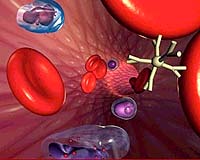
Their trick is to enclose the drug in polymer capsules that are peppered with gold nanoparticles and attached to tumour-seeking antibodies. When injected into the bloodstream, the capsules will concentrate inside tumours.
When enough capsules have gathered there, a pulse from an near-infrared laser will melt the gold, which strongly absorbs near-infrared wavelengths.
This will rupture the plastic capsules and release their contents. To make the capsules, the researchers repeatedly add the polymer to a suspension of drug particles around 1 micrometre wide until the polymer forms multi-layered spheres containing the drug payload.
They then add gold particles around 6 nanometres in diameter to the mix, which become embedded in the polymer. Finally they add a lipid, which forms an outer layer, and the antibodies that will target tumour cells.
In lab tests, the capsules were ruptured by a 10-nanosecond pulse from a near-infrared laser. While bulk gold has a melting point of 1064 �C, gold nanoparticles melt at far lower temperatures- between 600 and 800 �C.
The brief pulse was enough to melt the nanoparticles, which could be seen under an electron microscope to swell to up to 50 nanometres in diameter as they coalesced. The pulse was too short to damage the contents of the capsule. Caruso showed that a lysozyme enzyme did not lose its activity after being released from the capsules in this way.
In clinical use, the laser would be able to penetrate a few millimetres of tissue. It could be shone through the skin, or be beamed inside the body via an endoscope. The 100 millijoules per square centimetre of infrared energy that would be needed to rupture the capsules is well within safety limits.
"It's way below that used to remove tattoos," Caruso says.
Clinical use is still some way off, however, and even animal tests are several years away. The next refinement will be to make the capsules a lot smaller.
Caruso plans to shrink them from around 1 micrometre in diameter to a couple of hundred nanometres by starting with smaller drug particles.
Caruso thinks his team's key innovation has been in making the capsules react to a laser that is harmless to the body. Gold usually absorbs light from the visible to ultraviolet part of the electromagnetic spectrum, which can burn tissue.
But electromagnetic interactions between the gold nanoparticles in the capsules change the properties of the metal, making it absorb light from the near infrared instead. This light is the most transparent to tissue. Observers are impressed.
"This work is tremendously cool," says Matt Trau of the Nanotechnology and Biomaterials Centre at the University of Queensland in Brisbane. Photo-activating the capsules without damaging surrounding tissue is the particularly innovative part, he says.
The above article was written by New Scientist (appearing in its 8 January 2005 issue ), and was also reported on in Advanced Materials (vol 16, p 2184).
Related Links
 Utah To Launch Bionic War On Disabilities
 Salt Lake City UT (SPX) Jan 04, 2005
| The content herein, unless otherwise known to be public domain, are Copyright 1995-2006 - SpaceDaily.AFP and UPI Wire Stories are copyright Agence France-Presse and United Press International. ESA PortalReports are copyright European Space Agency. All NASA sourced material is public domain. Additionalcopyrights may apply in whole or part to other bona fide parties. Advertising does not imply endorsement,agreement or approval of any opinions, statements or information provided by SpaceDaily on any Web page published or hosted by SpaceDaily. Privacy Statement |