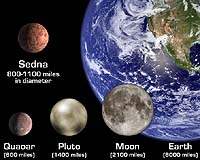
A couple of "old" planets and moons in our solar system... and a couple of "new" ones.
A couple of "old" planets and moons in our solar system... and a couple of "new" ones. |
The proposal before the 26th general assembly of the International Astronomical Union distinguishes between planets and smaller celestial bodies such as comets and asteroids.
That results in a 12-planet solar system with eight classical planets and three bodies including Pluto in a new and growing category called "plutons" - Pluto-like objects - plus a former asteroid, Ceres, the IAU said.
Powerful new telescopes that have discovered large objects in the outer regions of the solar system present a challenge to the historically based definition of a "planet", which comes from the Greek word meaning "wanderer".
"Recent new discoveries have been made of objects in the outer regions of our solar system that have sizes comparable to and larger than Pluto," said IAU President Ron Ekers in a statement.
"These discoveries have rightfully called into question whether or not they should be considered as new 'planets'."
The planetary debate blasted off in July 2005 when a US team of astronomers announced that Pluto is much smaller than an enigmatic object, 2003 UB313, which its discoverers claim is the solar system's 10th planet.
UB313, found some 15 billion kilometres (nine billion miles) from Earth, ignited a huge row as Pluto's defenders said UB313 was not a planet, just a rock, or KBO -- Kuiper Belt Object -- which is the term for the estimated 100,000 pieces of icy, primeval debris encircling the sun on the outskirts of the solar system.
Since its founding in 1919, the IAU has been the arbiter in astronomical debates and after two years of work a committee has come up with a new planet definition to present to some 2,500 astronomers gathered in Prague through August 25.
According to the draft definition, a "planet" must be in orbit around a star, while not being itself a star, and it must be massive enough for its own gravity to pull it into a nearly spherical shape.
"Our goal was to find a scientific basis for a new definition of planet and we chose gravity as the determining factor. Nature decides whether or not an object is a planet," said Richard Binzel, a member of the defining committee.
That puts about dozen "candidate planets" on the IAU watchlist, which means even more planets could be named in the future.
If the current proposal is passed by the IAU assembly, the solar system would consist of the planets Mercury, Venus, Earth, Mars, Ceres, Jupiter, Saturn, Uranus, Neptune, Pluto, Charon and 2003 UB313 (a "real" name to be chosen later).
The new "plutons" are distinguished from classical planets in that they reside in orbits around the sun that take longer than 200 years to complete -- meaning they are in orbit beyond Neptune.
The draft "planet definition" resolution will be discussed and refined during the Prague meeting and put up for a vote on August 24.
Related Links
 The IAU Draft Definition Of Planets And Plutons
 Prague, Czech (SPX) Aug 16, 2006
| The content herein, unless otherwise known to be public domain, are Copyright 1995-2006 - SpaceDaily.AFP and UPI Wire Stories are copyright Agence France-Presse and United Press International. ESA PortalReports are copyright European Space Agency. All NASA sourced material is public domain. Additionalcopyrights may apply in whole or part to other bona fide parties. Advertising does not imply endorsement,agreement or approval of any opinions, statements or information provided by SpaceDaily on any Web page published or hosted by SpaceDaily. Privacy Statement |