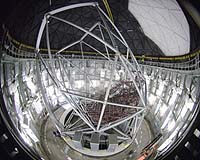
Fish eye photo of the inside of the SALT telescope.
Fish eye photo of the inside of the SALT telescope. |
The SALT (Southern African Largest Telescope), to be unveiled by President Thabo Mbeki near the arid Karoo town of Sutherland, will give astronomers a first rate glimpse of distant stars, galaxies and quasars.
Some of these were a billion times too faint to be seen with the unaided eye -- and are as faint as a candle flame on the moon's surface, astronomers have said.
"Government regards SALT as a flagship project for human quest for technology. It's about showing that first rate science can happen here," said Dave Laney of the Southern Africa Astronomical Observatory (SAAO).
"It allows people to see something happening here as opposed to science always being seen as happening in the United States, Europe or Japan," Laney told AFP.
SALT will "allow us to do things we could only dream of," said Laney.
With a mirror diameter of 11 metres (36 feet) SALT has a maximum resolution of 0.25 arcseconds -- which theoretically would enable an observer to spot a small coin at a distance of 10 kilometres (6.25 miles).
SALT cost 20 million dollars (17 million euros) and took five years to complete.
Funded by a consortium of international partners from South Africa, the United States, Germany, Poland, Britain and New Zealand, SALT will gather more than 25 times as much light as any existing African telescope.
Weighing in at a mammoth 82 tonnes, SALT is situated in a perfect geographical area in the remote town of Sutherland, one of the coldest and most arid places in South Africa about 350 kilometres (220 miles) northeast of Cape Town.
"It's an area devoid of light pollution... it is in such a dry area that it does not get enough rain and as a result scientists are not hampered by cloud cover when they need to do their work," SALT spokeswoman Mitzi Du Plessis said.
She also described the instrument as a "pinnacle of science, astronomy and technology in the world."
It would be beneficial for South Africa not only to look at the stars, but also reversing the country's so-called "brain-drain" by offering the latest technology available to young students to gain their confidence, she said.
"SALT is reversing the brain-drain because it's offering cutting edge science," Du Plessis told AFP.
"It's the first major science event of the new South Africa," added Phil Charles, the SAAO's director.
"With a major telescope like that, you are not looking at a five year project, you are looking at being here for decades," he added.
It is estimated that it would cost around 10 million dollars over the next 10 years to run SALT.
Related Links
 UCSC Physicists Deliver Detector For NASA's GLAST Telescope
 Santa Cruz CA (SPX) Nov 09, 2005
---------------------------------------------------------
New from Telescopes.com!
It's new. And it's downright terrific!
Celestron's CPC Schmidt-Cassegrain telescope is the scope you've been waiting for! It offers new alignment technology, advanced engineering, and bold new design at a new, low price!
In fact, Celestron's Professional Computerized (CPC) scope with revolutionary SkyAlign Alignment Technology redefines everything that amateur astronomers are looking for. It offers quick and simple alignment, GPS technology, unsurpassed optical quality, ease of use, advanced ergonomics, enhanced computerization and, most important, affordability.
Want to view M-31 tonight? One button takes you there!
Shop for telescopes online at Telescopes.com! today!
------------------------------------------------------------

| The content herein, unless otherwise known to be public domain, are Copyright 1995-2006 - SpaceDaily.AFP and UPI Wire Stories are copyright Agence France-Presse and United Press International. ESA PortalReports are copyright European Space Agency. All NASA sourced material is public domain. Additionalcopyrights may apply in whole or part to other bona fide parties. Advertising does not imply endorsement,agreement or approval of any opinions, statements or information provided by SpaceDaily on any Web page published or hosted by SpaceDaily. Privacy Statement |