
Subscribe free to our newsletters via your
. Military Space News .


FARM NEWS
Study Offers New Insights on Invasive Fly Threatening US Fruit Crops
by Staff Writers
Raleigh NC (SPX) Mar 20, 2013


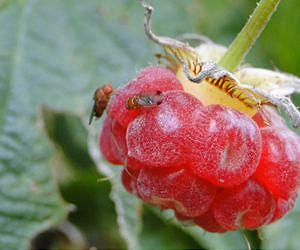
Male and female Drosophila suzukii on a berry. (Photo credit: Hannah Burrack)

Humans aren't the only species with a sweet tooth. Research from North Carolina State University shows that the invasive spotted-wing vinegar fly (Drosophila suzukii) also prefers sweet, soft fruit - giving us new insight into a species that has spread across the United States over the past four years and threatens to cause hundreds of millions of dollars in damage to U.S. fruit crops.

"Because we know that D. suzukii prefers softer, sweeter fruit, we can focus our research efforts into which wild fruits may serve as reservoirs for this species and help identify new crops that might be at risk," says Dr. Hannah Burrack, an assistant professor of entomology at NC State and lead author of a paper on the research. "These findings may also be a starting point for plant breeders interested in developing new fruit varieties that are more resistant to D. suzukii."

Originally from east Asia, D. suzukii were first detected in California in 2008. They have since spread to states from Wisconsin to North Carolina to Florida. The female flies use serrated blades on the tip of their abdomens to cut through the skin of ripe fruit and lay their eggs. The eggs hatch into larvae that feed on the flesh of the fruit until they reach maturity - ruining the fruit in the process.

Sellers go to great pains to remove infested fruit before it reaches the marketplace, so consumers won't notice a difference in fruit quality. But infestations can cause significant economic problems for fruit growers. For example, researchers estimate that D. suzukii has the potential to destroy 40 percent of blackberry and raspberry crops in the eastern U.S., which would affect berry prices and availability.

D. suzukii already causes tens of millions of dollars in crop damage annually to cherries, raspberries, blackberries, blueberries and strawberries. But researchers estimate that losses could climb into the hundreds of millions of dollars per year if the pest can't be controlled.

While ongoing studies explore pesticide-based approaches to control D. suzukii, the new research from NC State should help scientists and farmers with other control options.

For example, the study found that D. suzukii are more likely to infest certain varieties of raspberries and blackberries. This means growers may be able to limit crop damage by planting more of the varieties that D. suzukii tend to avoid. Similarly, this information allows farmers to focus pesticide treatment on varieties that are most susceptible to infestation.

The three-year study evaluated D. suzukii impacts in commercial blackberry and raspberry crops in North Carolina, and also encompassed laboratory experiments to help researchers determine which characteristics made fruits more likely to be infested. The work was supported by the Southern Region Small Fruit Consortium, North Carolina Tobacco Trust Fund Commission, North Carolina Department of Food and Agriculture, U.S. Department of Agriculture and North Carolina Blueberry Council.

The paper, "Variation in selection and utilization of host crops in the field and laboratory by Drosophila suzukii Matsumara (Diptera: Drosophilidae), an invasive frugivore," was published online March 14 in Pest Management Science. Co-authors are Dr. Gina Fernandez, a professor of horticultural science at NC State; Taylor Spivey, an undergraduate at Brevard College; and Dylan Kraus, an undergraduate at NC State.

.


Related Links
North Carolina State University
Farming Today - Suppliers and Technology


Comment on this article via your Facebook, Yahoo, AOL, Hotmail login.

Share this article via these popular social media networks
del.icio.usdel.icio.us DiggDigg RedditReddit GoogleGoogle


FARM NEWS
Shanghai river's dead pig total approaches 15,000
Shanghai (AFP) March 19, 2013
The number of dead pigs found in a river which runs through Shanghai had reached nearly 15,000, officials and reports said Tuesday, as a newspaper claimed the government was concealing the true tally. The images of dead pigs in China's commercial hub have proved a huge embarrassment for the city, which is seeking to become an international financial centre. Shanghai city workers retrieve ... read more


FARM NEWS
Russia dismisses US missile defence move

US move on missile defense could revive talks with Russia

US to boost missile defenses against N. Korea

Lockheed Martin Wins Aegis Combat System Engineering Agent Contract

FARM NEWS
Taiwan to aim 50 medium-range missiles at China: report

India's Nirbhay missile aborted in flight

Taiwan develops medium-range missile: report

US Newest Missile Warning Satellite Encapsulated in Launch Vehicle Payload Fairing

FARM NEWS
N. Korean leader watches 'drone' attack drill: KCNA

Friend or foe? Civilian drones stir debate

US drone strikes violate Pakistan sovereignty: UN

Iranian fighter tries to intercept US drone in Gulf: US

FARM NEWS
DARPA Seeks More Robust Military Wireless Networks

DoD Selects Northrop Grumman for Joint Command and Control System

Northrop Grumman Highlights Affordable Milspace Communications

Boeing Ships 5th WGS Satellite to Cape Canaveral for 2013 Launch

FARM NEWS
Seven killed in Marine Corps training accident

UN staring down a barrel over arms treaty

Boeing Names Ferra Engineering a Supplier for Extended Range JDAMs

Raytheon's new precision artillery ready for low-rate initial production

FARM NEWS
India reviews Italian envoy's immunity

Tough talks in final push for arms treaty

China replaces UK in top five arms exporters: report

Ban appeals for compromise at final UN arms talks

FARM NEWS
Commentary: Global gridlock -- and lockjaw

Australia signals Myanmar defense links

Outside View: Questions for Obama

Japan protests to France over military sales to China

FARM NEWS
Smallest Vibration Sensor in the Quantum World

New technique could improve optical devices

Silver nanoparticles may adversely affect environment

Scientists delve deeper into carbon nanotubes


The content herein, unless otherwise known to be public domain, are Copyright 1995-2014 - Space Media Network. AFP, UPI and IANS news wire stories are copyright Agence France-Presse, United Press International and Indo-Asia News Service. ESA Portal Reports are copyright European Space Agency. All NASA sourced material is public domain. Additional copyrights may apply in whole or part to other bona fide parties. Advertising does not imply endorsement,agreement or approval of any opinions, statements or information provided by Space Media Network on any Web page published or hosted by Space Media Network. Privacy Statement