
Subscribe free to our newsletters via your
. Military Space News .


FARM NEWS
Study: Ongoing bee decline could exacerbate malnutrition
by Brooks Hays
Burlington, Vt. (UPI) Jan 27, 2015


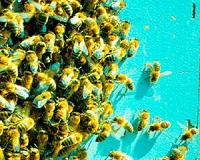
disclaimer: image is for illustration purposes only

Declining pollinator populations could push a quarter of the world's population back toward malnutrition, especially in developing countries where poverty is common and food is scarce.

Researchers at the University of Vermont and the Harvard School of Public Health set out to determine exactly how declining populations of pollinators, like bees, would affect food consumption in countries around the world. By comparing regional diets with the pollination requirements of staple crops, scientists were able to predict how declining pollinator populations might affect public health.

"The take-home is: Pollinator declines can really matter to human health, with quite scary numbers for vitamin A deficiencies, for example," study co-author Taylor Ricketts, a researcher at Vermont, explained in a press release, "which can lead to blindness and increase death rates for some diseases, including malaria."

In most of the developed world, diets are (even if they're not entirely healthy) plenty diverse and well fortified with all the necessary vitamins and nutrients. But in many less developed nations, diets barely suffice to keep populations stocked with the proper micronutrients, like vitamin A and folate. For more vulnerable countries like Mozambique and Uganda, a significant decline in pollinator populations could greatly affect the health of their inhabitants, leading to an uptick in malnutrition and diseases like malaria.

The new research is the first of its kind. Previous research has analyzed the effects of fewer pollinators on crop yields and the availability of food and nutrients.

"But to evaluate whether pollinator declines will really affect human nutrition, you need to know what people are eating," co-author Samuel Myers of Harvard said.

Combining pollinator data with regional eating habits allows scientists to pinpoint more precisely the potential effects of pollinator decline in the developing world. Zambia, for example, would be less affected than other similar countries, as its diet includes a surplus of vitamin A. Conversely, a country like Mozambique could suffer increases in infectious disease and incidents of blindness if bees and other pollinators continue to decline.

"Continued declines of pollinator populations could have drastic consequences for global public health," the team of researchers concluded in their paper.

The new study was published in the journal PLOS ONE on Jan. 9.


Thanks for being here;
We need your help. The Space Media Network continues to grow but revenues have never been harder to maintain.

With the rise of Ad Blockers, and Facebook - our traditional revenue sources via quality network advertising continues to decline. And unlike so many other news sites, we don't have a paywall - with those annoying usernames and passwords.

Our news coverage takes time and effort to publish 365 days a year.

If you find our news sites informative and useful then please consider becoming a regular supporter or for now make a one off contribution.
SpaceMediaNetwork Contributor
$5 Billed Once


credit card or paypal
SpaceMediaNetwork Monthly Supporter
$5 Billed Monthly


paypal only


.


Related Links
Farming Today - Suppliers and Technology


Comment on this article via your Facebook, Yahoo, AOL, Hotmail login.

Share this article via these popular social media networks
del.icio.usdel.icio.us DiggDigg RedditReddit GoogleGoogle


FARM NEWS
Fish catch break on world stage at global conference
East Lansing MI (SPX) Jan 28, 2015
Inland fishing - the powerful yet quieter sister to the large, salty marine aquaculture powerhouse - has gained what experts say is a much-needed visibility boost this as the first partnership between Michigan State University (MSU) and the Food and Agriculture Organization (FAO) of the United Nations goes on in Rome. These freshwater fish provide the food, sport and economic power across ... read more


FARM NEWS
Raytheon given $2.4B FMS contract for Patriot fire units

US delivers second radar defense system to Japan

US Ballistic Missile Defense Needs More Testing

Israel, US in abortive missile defence test

FARM NEWS
Russia to Test Strategic Missile Forces in Unscheduled Drills

Russia Will Test Launch Iskander-M Missiles During March Drills

Navy authorizes SM-6 missile for more ships

Hezbollah chief threatens Israel over Syria strikes

FARM NEWS
Drone entrepreneur settles US 'reckless flying' case

Exelis producing more bomb racks for MQ-9 Reapers

Advocates pressure US Congress to let small drones fly

UN saw drones before Israeli air strike on Syria

FARM NEWS
U.S. EA-18G Growlers getting new electronic warfare system

Third MUOS Satellite Launched And Responding To Commands

USAF orders addditional Boeing rescue radios

MUOS-3 satellite ready for launch

FARM NEWS
DRS touts new laser targeting gimbal

BAE Systems gets support contract for British Army vehicles

Prototype weapons launcher fitted onto B-52 bomber

Army opens THAAD training school

FARM NEWS
Germany halts arms exports to Saudi Arabia: report

NATO chief urges Germany to lead way on defence spending

Four Afghan Guantanamo detainees repatriated: Pentagon

Global arms treaty enters into force on Wednesday

FARM NEWS
Modi in diplomatic balancing act as Obama visits India

Ukraine's 'Russian Woodpecker' takes stab at Putin

Chinese conductor sees new bridges with West

China facing 'unprecedented' security risks, says Party

FARM NEWS
Nanoshuttle wear and tear: It's the mileage, not the age

ORNL researchers tune friction in ionic solids at the nanoscale

Silver nanowires demonstrate unexpected self-healing mechanism

Nano-beaker offers insight into the condensation of atoms


The content herein, unless otherwise known to be public domain, are Copyright 1995-2014 - Space Media Network. All websites are published in Australia and are solely subject to Australian law and governed by Fair Use principals for news reporting and research purposes. AFP, UPI and IANS news wire stories are copyright Agence France-Presse, United Press International and Indo-Asia News Service. ESA news reports are copyright European Space Agency. All NASA sourced material is public domain. Additional copyrights may apply in whole or part to other bona fide parties. Advertising does not imply endorsement, agreement or approval of any opinions, statements or information provided by Space Media Network on any Web page published or hosted by Space Media Network. Privacy Statement All images and articles appearing on Space Media Network have been edited or digitally altered in some way. Any requests to remove copyright material will be acted upon in a timely and appropriate manner. Any attempt to extort money from Space Media Network will be ignored and reported to Australian Law Enforcement Agencies as a potential case of financial fraud involving the use of a telephonic carriage device or postal service.