
Subscribe free to our newsletters via your
. Military Space News .


CLIMATE SCIENCE
Study shows lasting effects of drought in rainy eastern US
by Staff Writers
Boston MA (SPX) Apr 22, 2014


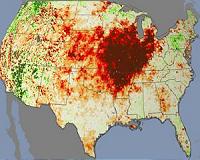
File image.

This spring, more than 40 percent of the western U.S. is in a drought that the USDA deems "severe" or "exceptional." The same was true in 2013. In 2012, drought even spread to the humid east.

It's easy to assume that a 3-year drought is an inconsequential blip on the radar for ecosystems that develop over centuries to millennia. But new research just released in Ecological Monographs shows how short-lived but severe climatic events can trigger cascades of ecosystem change that last for centuries.

Some of the most compelling evidence of how ecosystems respond to drought and other challenges can be found in the trunks of our oldest trees. Results from an analysis of tree rings spanning more than 300,000 square miles and 400 years of history in the eastern U.S. - led by scientists at Columbia's Lamont-Doherty Earth Observatory, the Harvard Forest, and elsewhere - point to ways in which seemingly stable forests could abruptly change over the next century.

"Trees are great recorders of information," says Dave Orwig, an ecologist at the Harvard Forest and co-author of the new study. "They can give us a glimpse back in time."

The tree records in this study show that just before the American Revolution, across the broadleaf forests of Kentucky, Tennessee, North Carolina, and Arkansas, the simultaneous death of many trees opened huge gaps in the forest-prompting a new generation of saplings to surge skyward.

There's no historical evidence that the dead trees succumbed to logging, ice storms, or hurricanes. Instead, they were likely weakened by repeated drought leading up to the 1770s, followed by an intense drought from 1772 to 1775.

The final straw was an unseasonable and devastating frost in 1774 that, until this study, was only known to historical diaries like Thomas Jefferson's Garden Book, where he recounts "a frost which destroyed almost every thing" at Monticello that was "equally destructive thro the whole country and the neighboring colonies."

The oversized generation of new trees that followed-something like a baby boom-shaped the old-growth forests that still stand in the Southeast today.

"Many of us think these grand old trees in our old-growth forests have always been there and stood the test of time," says Neil Pederson of the Lamont-Doherty Earth Observatory, lead author of the new study.

"What we now see is that big events, including climatic extremes, created large portions of these forests in short order through the weakening and killing of existing trees."

Pederson, who will become a senior ecologist at the Harvard Forest in fall 2014, notes that as climate warms, increasing drought conditions and earlier springs like that of 1774 could easily expose eastern forests to the kinds of conditions that changed them so abruptly in the 17th and 18th centuries.

"We are seeing more and more evidence of climate events weakening trees, making them more likely to succumb to insects, pathogens, or the next severe drought," says Orwig.

Pederson adds, "With this perspective, the changes predicted by models under future climate change seem more real."

The full paper in the journal Ecological Monographs, "The legacy of episodic climatic events in shaping temperate, broadleaf forests", is available here.

.


Related Links
Harvard University
Climate Science News - Modeling, Mitigation Adaptation


Comment on this article via your Facebook, Yahoo, AOL, Hotmail login.

Share this article via these popular social media networks
del.icio.usdel.icio.us DiggDigg RedditReddit GoogleGoogle


Memory Foam Mattress Review
Newsletters :: SpaceDaily :: SpaceWar :: TerraDaily :: Energy Daily
XML Feeds :: Space News :: Earth News :: War News :: Solar Energy News


CLIMATE SCIENCE
UC Geographers Develop a System to Track the Dynamics of Drought
Cincinnati OH (SPX) Apr 10, 2014
University of Cincinnati researchers are at work tracking drought patterns across the United States. Qiusheng Wu, a doctoral student and research assistant for the UC Department of Geography, and Hongxing Liu, a UC professor and head of the Department of Geography, will present details this week at the annual meeting of the Association of American Geographers (AAG) in Tampa, Fla To trace t ... read more


CLIMATE SCIENCE
Russia warns Ukraine against missile technologies proliferation

Japan orders to shoot down any new N Korea ballistic missile launches

US to send two more missile defence ships to Japan: Hagel

Russia's new S-500 system to destroy any target at any altitude

CLIMATE SCIENCE
GMLRS alternative warhead completes production qualification tests

Raytheon UK to export Paveway IV

Software update for Common Missile Warning System completes CDR

French test fire new cruise missile

CLIMATE SCIENCE
UAV production to remain profitable

S. Korea spurns North's call for joint drone probe

Google buys solar-powered drone maker Titan Aerospace

N. Korea denies link to drones recovered by South

CLIMATE SCIENCE
NGC Ships Payload Module For 4th Advanced EHF Protected ComSat

Harris, Exelis win Army radio contract

Fourth AEHF Protected Communications Satellite Begins Integration Months Ahead of Schedule

Intelsat and L-3 Test Protected Air Force Tactical Technology on Ku-band

CLIMATE SCIENCE
US actor Michael Douglas fronts disarmament initiative

Comtech continues Blue Force Tracking support

Croatia now operates former U.S. military vehicles

Britain taps BAE Systems for illumination artillery shells

CLIMATE SCIENCE
Bloomberg arms US gun control with $50 mn

Japan military in popularity push

Global military spending drops, led by US: SIPRI

German government to cancel Saudi tank deal: report

CLIMATE SCIENCE
Australian broadcaster ABC wins landmark China access

Ukraine army's humiliations pile up as eastern push fizzles

China's maritime area being carved up

Russia should be ready for non-contact war

CLIMATE SCIENCE
Nano shake-up

The Motion of the Medium Matters for Self-assembling Particles

Never say never in the nano-world

Nanosheets and nanowires


The content herein, unless otherwise known to be public domain, are Copyright 1995-2014 - Space Media Network. All websites are published in Australia and are solely subject to Australian law and governed by Fair Use principals for news reporting and research purposes. AFP, UPI and IANS news wire stories are copyright Agence France-Presse, United Press International and Indo-Asia News Service. ESA news reports are copyright European Space Agency. All NASA sourced material is public domain. Additional copyrights may apply in whole or part to other bona fide parties. Advertising does not imply endorsement, agreement or approval of any opinions, statements or information provided by Space Media Network on any Web page published or hosted by Space Media Network. Privacy Statement All images and articles appearing on Space Media Network have been edited or digitally altered in some way. Any requests to remove copyright material will be acted upon in a timely and appropriate manner. Any attempt to extort money from Space Media Network will be ignored and reported to Australian Law Enforcement Agencies as a potential case of financial fraud involving the use of a telephonic carriage device or postal service.