
Subscribe free to our newsletters via your
. Military Space News .


FARM NEWS
Tannins in sorghum and benefits focus of university, USDA study
by Staff Writers
Manhattan, KS (SPX) Jul 16, 2012


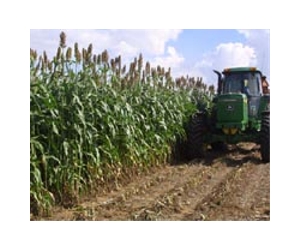
Sorghum is an old-world cereal grass that serves as a dietary staple for more than 500 million people in more than 30 countries, Yu said. In 2011, the United States was the No. 1 exporter of sorghum on the world market and the No. 2 producer (behind Nigeria), according to the U.S. Department of Agriculture. In 2011, Kansas produced 110.0 million bushels - 51 percent of the total U.S. crop. Sorghum production in the U.S., primarily for the feed industry, uses non-tannin sorghum hybrids.

They might be called a blessing or a curse - tannins, which are present in certain sorghums, contain health-promoting antioxidant properties, but also provide a bitter taste and decreased protein digestibility.

To better understand tannins, their role in sorghum and how they can be altered to improve sorghum's use as food and feed, a team of scientists led by Kansas State University and U.S. Department of Agriculture researchers, has cloned the tannin gene in sorghum.

Tannins' high antioxidant, anti-inflammatory and UV-protective functions promote human health, plus recent studies show they can be a tool in fighting obesity because they reduce digestibility, said Jianming Yu, associate professor of agronomy at Kansas State University. Tannins in sorghum also provide a natural chemical defense against bird predation and bacterial and fungal attack in the field.

On the other hand, tannins provide a bitter taste to some foods and decrease protein digestibility and feed efficiency in humans and livestock.

The team was led by Yu, along with Tesfaye Tesso, Kansas State University sorghum breeder and associate professor of agronomy and Scott Bean, scientist with the U.S. Department of Agriculture-Agricultural Research Service (USDA-ARS) and adjunct faculty in the university's Department of Agronomy.

Sorghum is an old-world cereal grass that serves as a dietary staple for more than 500 million people in more than 30 countries, Yu said. In 2011, the United States was the No. 1 exporter of sorghum on the world market and the No. 2 producer (behind Nigeria), according to the U.S. Department of Agriculture.

In 2011, Kansas produced 110.0 million bushels - 51 percent of the total U.S. crop. Sorghum production in the U.S., primarily for the feed industry, uses non-tannin sorghum hybrids.

Unlike many plants which employ C3 photosynthesis that uses water, carbon dioxide and solar energy to synthesize sugars, sorghum, which performs a modified form called C4 photosynthesis, has adapted to hot environments.

"One key reason to study tannins is to untangle their relationship with cold tolerance, a key agronomic trait to improve sorghum. The work is ongoing," said sorghum breeder Tesso. An earlier screening work found that a high proportion of cold tolerant sorghum lines contain tannins.

"Several other factors make tannins an important research subject," said Bean, noting their antioxidant capacity and relevant health benefits, their natural occurrence in some cereal crops, and their role in sorghum production.

"Knowledge of tannins in biosynthesis pathways can be used to generate lines that produce high-content tannins in sorghum and other cereals to promote health through their unique nutritional properties."

This study, like many studies in recent years, benefits from work done several years ago on Arabidopsis, which are small flowering plants related to cabbage and mustard, said Yuye Wu, the first author and Kansas State University research associate of agronomy.

"Many genes have been identified in Arabidopsis, through the mutational approach, but there is still much to be learned about the genetic control of tannins in cereal crops."

"This kind of genetic research in crops, coupled with nutritional and medical research, could open the possibility of producing different levels and combinations of phenolic compounds to promote human health," Yu said.

What the researchers learn about tannins in sorghum will be beneficial to the future study of tannins in other plants, including some fruits, vegetables and a few other grains such as finger millets and barley.

The researchers' study, "Presence of tannins in sorghum grains is conditioned by different natural alleles of Tannin1" was published in the June 26 issue of the Proceedings of the National Academy of Sciences of the United States of America (PNAS). Other researchers involved in the study were Mitch Tuinstra, Purdue University; Ming Li Wang, USDA-ARS, Griffin, Georgia; and Guihua Bai, USDA-ARS and adjunct professor of agronomy at Kansas State University.

.


Related Links
Kansas State University
Farming Today - Suppliers and Technology


Comment on this article via your Facebook, Yahoo, AOL, Hotmail login.

Share this article via these popular social media networks
del.icio.usdel.icio.us DiggDigg RedditReddit GoogleGoogle


FARM NEWS
From aflatoxin to sake
Nashville TN (SPX) Jul 16, 2012
What do beer, dogs and cats, and corn all have in common? All of them are the end products of the process of domestication. Almost everybody knows that a number of different animals and plants have been bred for qualities that benefit humans. But few people realize that a number of microbes have undergone a similar transformation. Take brewer's yeast, for example. It is the quintessential ... read more


FARM NEWS
Raytheon reveals new missile defense system architectural analysis capability

Raytheon awarded $636 million for Exoatmospheric Kill Vehicle

Israel-U.S. drill will boost missile plans

U.S., Israel map out joint missile plan

FARM NEWS
Ukraine jails two N. Koreans for missile spying

Israeli navy eyes new missile systems

Israel deploys missile system on Egypt border

U.S. Navy Awards Lockheed Martin Contract for Additional VLA Missiles

FARM NEWS
Russian drones can see obstacles

Laser Powers Lockheed Martin's Stalker UAS For 48 Hours

Boeing to Collaborate with Elbit Systems on Hermes 450 and 900 UAS

University of Texas at Austin researchers demonstrate first 'spoofing' of UAVs

FARM NEWS
Raytheon's vehicular soldier radio system links 37 different types of US, coalition radios

Lockheed Martin to Support Intelligence Analysis Worldwide Under DIA Solutions Contract

Raytheon already meets 80 percent of USAF requirements for alternate satellite terminal program

ONR Opens a Gateway to Improved Network Data Sharing on Navy Ships

FARM NEWS
Boeing Introduces Intelligent Sensor Camera System for Defense and Security Customers

Six charged in Britain over faulty Iraq bomb detectors

Ex-US commander McChrystal calls for reviving draft

Boeing Completes Wind Tunnel Tests on Silent Eagle Conformal Weapons Bay

FARM NEWS
Defence group EADS eyes launching own bank

Finmeccanica gains multinational deals

U.N. blasted for using security firms

NGOs complain at being excluded from UN arms talks

FARM NEWS
US, Russia discuss Syria, missile defense at Pentagon

China state media accuses Clinton of 'meddling'

Clinton lands in Israel on last-leg of world tour

Japan offers glimpse of history in MacArthur's office

FARM NEWS
UK nanodevice builds electricity from tiny pieces

Ferroelectricity on the Nanoscale

Unprecedented subatomic details of exotic ferroelectric nanomaterials

Tiny bubbles snap carbon nanotubes like twigs


The content herein, unless otherwise known to be public domain, are Copyright 1995-2014 - Space Media Network. AFP, UPI and IANS news wire stories are copyright Agence France-Presse, United Press International and Indo-Asia News Service. ESA Portal Reports are copyright European Space Agency. All NASA sourced material is public domain. Additional copyrights may apply in whole or part to other bona fide parties. Advertising does not imply endorsement,agreement or approval of any opinions, statements or information provided by Space Media Network on any Web page published or hosted by Space Media Network. Privacy Statement