
UAV NEWS
Teaching drones about the birds and the bees
by Staff Writers
Washington DC (SPX) Jul 07, 2016


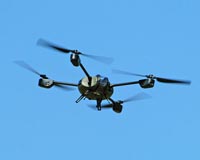
File image.

Unmanned Aerial Vehicles (UAVs) of the future will be able to visually coordinate their flight and navigation just like birds and flying insects do, without needing human input, radar or even GPS satellite navigation.

A research group at the University of Queensland, Australia is trying to make this future a reality by uncovering flying techniques that budgerigars and bees share, and applying their findings to UAV control programmes.

Prof Mandyam Srinivasan, leading the research, explains: "We study how small airborne creatures such as bees and birds use their vision to avoid collisions with obstacles, fly safely through narrow passages, control their height above the ground and more. We then use biologically-inspired principles to design novel vision systems and algorithms for the guidance of UAVs."

At first glance, insects and birds have very different brains in terms of size and architecture, yet the visual processing in both animals is very effective at guiding their flight.

"Bees' brains weigh a tenth of a milligram and carry far fewer neurones than our own brains; yet the insects are capable of navigating accurately to food sources over 10 km away from their hive," remarks Prof Srinivasan. "Birds too can perform incredible aerobatics and navigational feats. These animals are clearly using simple and elegant strategies, honed by thousands of years of evolution."

The team compares the flight of bees and budgies in particular because they are easy animals to study, as Prof Srinivasan explains: "These animals are clever, can be easily trained, and possess sophisticated visual systems that are not unlike those of our own." Regarding other benefits of the research, he says: "The study of their behaviour could also reveal some of the basic principles of visual guidance in a number of organisms including humans."

Comparing the flight behaviours of these animals using high-speed cameras will lead to drastically improved UAV guidance systems. Prof Srinivasan explains: "The biologically-inspired principles we uncover will foster a new generation of fully autonomous UAVs that do not rely on external help such as GPS or radar. These UAVs could be incredibly useful for applications like surveillance, rescue operations, defence, and planetary exploration."

.


Related Links
Society for Experimental Biology
UAV News - Suppliers and Technology


Comment on this article via your Facebook, Yahoo, AOL, Hotmail login.

Share this article via these popular social media networks
del.icio.usdel.icio.us DiggDigg RedditReddit GoogleGoogle

Previous Report
UAV NEWS
Thales gets Watchkeeper support contract
London (UPI) Jun 30, 2016
Thales has been awarded a $106 million U.K. Ministry of Defense contract for Watchkeeper drone training, maintenance and support operations, the company announced. The new future support contract builds on the previous initial support contract, Thales said in a statement. The contract will provide technical support in the coming years while providing important additional capacity ... read more


UAV NEWS
Saudi intercepts ballistic missile from Yemen: coalition

Raytheon to conduct Patriot missile system diagnostics and repair

Raytheon upgrading Kuwait's Patriot air defense system

Washington hopes to wrap up anti-missile deal with SKorea

UAV NEWS
Raytheon gets $23M Evolved Sea Sparrow contract

Varunastra missile handed over to Indian navy

Missiles to be tested at RIMPAC exercise

Russia to receive six more S-400 Triumf systems

UAV NEWS
Teaching drones about the birds and the bees

Thales gets Watchkeeper support contract

Insitu gets Coast Guard drone contract

Lockheed's Q-53 shows drone tracking capability

UAV NEWS
MUOS-5 secure communications satellite responding to ground control

How to Improve Enterprise Ground Services for Space

Testing Confirms Intelsat EpicNG Delivers a Whole New Ballgame

MUOS-5 Secure Communications Satellite to launch June 24

UAV NEWS
Exide Technologies gets $30.7 million DOD grant

Implant Sciences gets Canadian explosives detection contract

Hesco achieves body armor certification

IEE supplies display units for IED jamming devices

UAV NEWS
Guns, not roses: Conflicts fire up Bulgaria arms trade

CAE gets $111 million in UAE defense contracts

Senators look to block U.S. sale of bombs to Saudis for bombing of Yemen

US Navy admiral admits he lied in massive bribery scandal

UAV NEWS
NATO faces up to Russia in Brexit's shadow

No plans to open Turkish air base to Russia: minister

China to hold drills in disputed waters ahead of court ruling

NATO chief 'certain' of UK role despite Brexit

UAV NEWS
Tiniest imperfections make big impacts in nano-patterned materials

DNA shaping up to be ideal framework for rationally designed nanostructures

New 'ukidama' nanoparticle structure revealed

Shaping atomically thin materials in suspended structures