
Subscribe free to our newsletters via your
. Military Space News .


INTERN DAILY
Team develops transplantable bioengineered forelimb
by Staff Writers
Boston MA (SPX) Jun 09, 2015


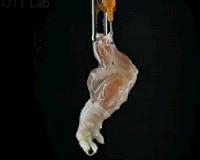
Over a period of 52 hours, infusion of a detergent solution removes cells from a rat forelimb, leaving behind the cell-free matrix scaffolding onto which new tissues can be regenerated. Image courtesy Bernhard Jank, M.D., Ott Laboratory, Massachusetts General Hospital Center for Regenerative Medicine. Watch a video on the research here.

A team of Massachusetts General Hospital (MGH) investigators has made the first steps towards development of bioartificial replacement limbs suitable for transplantation. In their report, which has been published online in the journal Biomaterials, the researchers describe using an experimental approach previously used to build bioartificial organs to engineer rat forelimbs with functioning vascular and muscle tissue. They also provided evidence that the same approach could be applied to the limbs of primates

"The composite nature of our limbs makes building a functional biological replacement particularly challenging," explains Harald Ott, MD, of the MGH Department of Surgery and the Center for Regenerative Medicine, senior author of the paper.

"Limbs contain muscles, bone, cartilage, blood vessels, tendons, ligaments and nerves - each of which has to be rebuilt and requires a specific supporting structure called the matrix. We have shown that we can maintain the matrix of all of these tissues in their natural relationships to each other, that we can culture the entire construct over prolonged periods of time, and that we can repopulate the vascular system and musculature."

The authors note that more than 1.5 million individuals in the U.S. have lost a limb, and although prosthetic technology has greatly advanced, the devices still have many limitations in terms of both function and appearance. Over the past two decades a number of patients have received donor hand transplants, and while such procedures can significantly improve quality of life, they also expose recipients to the risks of life-long immunosuppressive therapy.

While the progenitor cells needed to regenerate all of the tissues that make up a limb could be provided by the potential recipient, what has been missing is the matrix or scaffold on which cells could grow into the appropriate tissues.

The current study uses technology Ott discovered as a research fellow at the University of Minnesota, in which living cells are stripped from a donor organ with a detergent solution and the remaining matrix is then repopulated with progenitor cells appropriate to the specific organ. His team and others at MGH and elsewhere have used this decellularization technique to regenerate kidneys, livers, hearts and lungs from animal models, but this is the first reported use to engineer the more complex tissues of a bioartificial limb.

The same decellularization process used in the whole-organ studies - perfusing a detergent solution through the vascular system - was used to strip all cellular materials from forelimbs removed from deceased rats in a way that preserved the primary vasculature and nerve matrix. After thorough removal of cellular debris - a process that took a week - what remained was the cell-free matrix that provides structure to all of a limb's composite tissues. At the same time, populations of muscle and vascular cells were being grown in culture.

The research team then cultured the forelimb matrix in a bioreactor, within which vascular cells were injected into the limb's main artery to regenerate veins and arteries. Muscle progenitors were injected directly into the matrix sheaths that define the position of each muscle.

After five days in culture, electrical stimulation was applied to the potential limb graft to further promote muscle formation, and after two weeks, the grafts were removed from the bioreactor. Analysis of the bioartificial limbs confirmed the presence of vascular cells along blood vessel walls and muscle cells aligned into appropriate fibers throughout the muscle matrix.

Functional testing of the isolated limbs showed that electrical stimulation of muscle fibers caused them to contract with a strength 80 percent of what would be seen in newborn animals. The vascular systems of bioengineered forelimbs transplanted into recipient animals quickly filled with blood which continued to circulate, and electrical stimulation of muscles within transplanted grafts flexed the wrists and digital joints of the animals' paws. The research team also successfully decellularized baboon forearms to confirm the feasibility of using this approach on the scale that would be required for human patients.

Ott notes that, while regrowing nerves within a limb graft and reintegrating them into a recipient's nervous system is one of the next challenges that needs to be faced, the experience of patients who have received hand transplants is promising.

"In clinical limb transplantation, nerves do grow back into the graft, enabling both motion and sensation, and we have learned that this process is largely guided by the nerve matrix within the graft. We hope in future work to show that the same will apply to bioartificial grafts. Additional next steps will be replicating our success in muscle regeneration with human cells and expanding that to other tissue types, such as bone, cartilage and connective tissue."


Thanks for being here;
We need your help. The Space Media Network continues to grow but revenues have never been harder to maintain.

With the rise of Ad Blockers, and Facebook - our traditional revenue sources via quality network advertising continues to decline. And unlike so many other news sites, we don't have a paywall - with those annoying usernames and passwords.

Our news coverage takes time and effort to publish 365 days a year.

If you find our news sites informative and useful then please consider becoming a regular supporter or for now make a one off contribution.
SpaceMediaNetwork Contributor
$5 Billed Once


credit card or paypal
SpaceMediaNetwork Monthly Supporter
$5 Billed Monthly


paypal only


.


Related Links
Massachusetts General Hospital
Hospital and Medical News at InternDaily.com


Comment on this article via your Facebook, Yahoo, AOL, Hotmail login.

Share this article via these popular social media networks
del.icio.usdel.icio.us DiggDigg RedditReddit GoogleGoogle


INTERN DAILY
DNA blood test can identify every virus you have ever had
Washington (UPI) Jun 5, 2015
New research has developed a DNA-based blood test that can reveal every single virus that has ever invaded your body, the journal Science published Thursday. Scientists had been working on the test hoping that it will lead to early detection of various medical conditions and eventually help explain what triggers certain diseases and cancers. The test, called VirScan, takes a pers ... read more


INTERN DAILY
US Defense Department to deploy radar in alaska to protect Pacific coast

Northrop's battle command system brings down ballistic missile target

US Aegis Ships Could Pose Threat to Russia

US, NATO Have 'No Plans' to Place Missile Defense Systems in Ukraine

INTERN DAILY
US Might Add Missiles to Its Military Buildup in Europe to Counter Russia

Navy orders more Raytheon SM-6 air defense missiles

Indian Air Force jet test fires Harpoon missile

N. Korea leader hails 'miracle' missile test

INTERN DAILY
Military Sensor Optics For UAVs

IAI shines spotlight on loitering attack drone

China monitors university entrance exams with drones

Insect mating behavior has lessons for drones

INTERN DAILY
US Navy accepts third LMC-Built MUOS comsat

Continued Momentum for Commercial Satellite Acquisition Reform

IOC status for upgraded French AWACS aircraft

Russian Radio-Electronic Forces to Conduct Drills in Armenian Mountains

INTERN DAILY
VSE wins places on Army TACOM contracts

US Air Force Develops Electromagnetic Pulse Weapon

Russia to Produce Successor of Tu-160 Strategic Bomber After 2023

Northrop Grumman intros new sensor pod system

INTERN DAILY
Spain to decide on lifting A400M flight suspension next week

US Defense Secretary Carter signs defence projects with India

Army contracting official charged in parts investigation

French arms exports in 2014 'best in 15 years'

INTERN DAILY
Obama heads for G7 summit focused on Ukraine

Merkel, Obama: Russia sanctions to stay until Ukraine truce implemented

Philippines welcomes Japan security role; As G7 looks at issue

Google puts India PM in criminal search line-up

INTERN DAILY
Scientists observe photographic exposure live at the nanoscale

Measuring the mass of molecules on the nano-scale

Novel X-ray lens sharpens view into the nano world

Engineering phase changes in nanoparticle arrays


The content herein, unless otherwise known to be public domain, are Copyright 1995-2014 - Space Media Network. All websites are published in Australia and are solely subject to Australian law and governed by Fair Use principals for news reporting and research purposes. AFP, UPI and IANS news wire stories are copyright Agence France-Presse, United Press International and Indo-Asia News Service. ESA news reports are copyright European Space Agency. All NASA sourced material is public domain. Additional copyrights may apply in whole or part to other bona fide parties. Advertising does not imply endorsement, agreement or approval of any opinions, statements or information provided by Space Media Network on any Web page published or hosted by Space Media Network. Privacy Statement All images and articles appearing on Space Media Network have been edited or digitally altered in some way. Any requests to remove copyright material will be acted upon in a timely and appropriate manner. Any attempt to extort money from Space Media Network will be ignored and reported to Australian Law Enforcement Agencies as a potential case of financial fraud involving the use of a telephonic carriage device or postal service.