
 |
 |
 |
 |
 |
 |
 |
 |
 |
 |

| . |  |
. |
Telescope Used In Search For Extraterrestrial Life
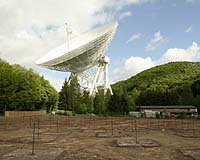
Leiden, Netherlands (SPX) Jun 18, 2008 ASTRON is researching the potential role of the LOFAR telescope in the Search for Extra-Terrestrial Intelligence (SETI). This initiative has been taken by Professor Michael Garrett, General Director of ASTRON and professor of radio techniques in astronomy at Leiden University in the Netherlands. Researchers from all over the world will contribute to this effort to find ways in which LOFAR can be used in the search for extraterrestrial life. There are about 100 thousand million stars in the galaxy and most of these are expected to harbour planetary systems; some of these planets might actually be suitable for life. Many scientists believe that life is probably wide-spread across the galaxy, although technically advanced civilisations might be relatively rare or at least widely separated from each other. LOFAR (the Low Frequency Array), a new telescope that is currently being built by ASTRON, consists of about 25,000 small antennas that will receive signals from space. Despite the huge distances between stars, the next generation of radio telescopes, such as LOFAR, begin to offer the possibility of detecting radio signals beamed towards the Earth by other intelligent beings. For the nearest stars, LOFAR might even be able to detect the leakage radiation associated with extraterrestrial radio and TV transmitters. According to Professor Garrett, LOFAR is well suited to SETI research. 'LOFAR can extend the search for extra-terrestrial intelligence to an entirely unexplored part of the low-frequency radio spectrum, an area that is heavily used for civil and military communications here on Earth. In addition, LOFAR can survey large areas of the sky simultaneously - an important advantage if SETI signals are rare or transient in nature.' Professor Dan Werthimer, the SETI@home project Scientist at the University of Berkeley in the United States, says: 'SETI searches are still only scratching the surface, we need to use as many different telescopes, techniques and strategies as possible, in order to maximize our chances of success.' Professor Garrett thinks it is high time European scientists began to support their colleagues from the United States in this exciting area of research. 'I cannot think of a more important question humanity can ask and perhaps now answer. Are we truly alone in the Universe or are there other civilisations out there waiting to be discovered? Either way, the implications are tremendous.' ASTRON is part of the Netherlands Organisation for Scientific Research (NWO). Community Email This Article Comment On This Article Share This Article With Planet Earth
Related Links ASTRON SETI LOFAR telescope Life Beyond Earth Lands Beyond Beyond - extra solar planets - news and science
 Deep Hydrogen
 Moffett Field CA (SPX) Jun 17, 2008
Hydrogen is the simplest, lightest, and most common element in the universe. Although the hydrogen molecule (H2) is highly reactive, and therefore rare in Earth's atmosphere, it is usually found at parts per million levels in deep drill holes. |
|
|

| The content herein, unless otherwise known to be public domain, are Copyright 1995-2007 - SpaceDaily.AFP and UPI Wire Stories are copyright Agence France-Presse and United Press International. ESA Portal Reports are copyright European Space Agency. All NASA sourced material is public domain. Additional copyrights may apply in whole or part to other bona fide parties. Advertising does not imply endorsement,agreement or approval of any opinions, statements or information provided by SpaceDaily on any Web page published or hosted by SpaceDaily. Privacy Statement |
 del.icio.us
 Digg
Digg Reddit
 YahooMyWeb
 Google
 Facebook