. Military Space News .
The Growing-Up Of A Star

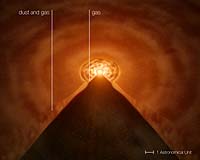
Artist's impression of the disc of matter surrounding MWC 147 as inferred from observations made with ESO's Very Large Telescope Interferometer. A slice has been cut to show the inner structure better. The disc extends out to 100 times the distance between the Earth and the Sun (100 Astronomical Units - 100 AU). It is inclined by about 50 degrees as seen from Earth. The dust in the outer disc emits mainly at mid-infrared wavelengths, while close to the star there is also strong near-infrared emission from very hot gas. This gas is transported towards the forming star, increasing its mass at a rate of 7 millionths of the mass of the Sun - or about 2 times the mass of the Earth - per year.
by Staff Writers
Paris, France (SPX) Jan 31, 2008
Using ESO's Very Large Telescope Interferometer, astronomers have probed the inner parts of the disc of material surrounding a young stellar object, witnessing how it gains its mass before becoming an adult. The astronomers had a close look at the object known as MWC 147, lying about 2,600 light years away towards the constellation of Monoceros ('the Unicorn').

MWC 147 belongs to the family of Herbig Ae/Be objects. These have a few times the mass of our Sun and are still forming, increasing in mass by swallowing material present in a surrounding disc.

MWC 147 is less than half a million years old. If one associated the middle-aged, 4.6 billion year old Sun with a person in his early forties, MWC 147 would be a 1-day-old baby.

The morphology of the inner environment of these young stars is however a matter of debate and knowledge of it is important to better understand how stars and their cort�ge of planets form.

The astronomers Stefan Kraus, Thomas Preibisch, and Keiichi Ohnaka have used the four 8.2-m Unit Telescopes of ESO's Very Large Telescope to this purpose, combining the light from two or three telescopes with the MIDI and AMBER instruments.

"With our VLTI/MIDI and VLTI/AMBER observations of MWC147, we combine, for the first time, near- and mid-infrared interferometric observations of a Herbig Ae/Be star, providing a measurement of the disc size over a wide wavelength range," said Stefan Kraus, lead-author of the paper reporting the results. "Different wavelength regimes trace different temperatures, allowing us to probe the disc's geometry on the smaller scale, but also to constrain how the temperature changes with the distance from the star."

The near-infrared observations probe hot material with temperatures of up to a few thousand degrees in the innermost disc regions, while the mid-infrared observations trace cooler dust further out in the disc.

The observations show that the temperature changes with radius are much steeper than predicted by the currently favoured models, indicating that most of the near-infrared emission emerges from hot material located very close to the star, that is, within one or two times the Earth-Sun distance (1-2 AU). This also implies that dust cannot exist so close to the star, since the strong energy radiated by the star heats and ultimately destroys the dust grains.

"We have performed detailed numerical simulations to understand these observations and reached the conclusion that we observe not only the outer dust disc, but also measure strong emission from a hot inner gaseous disc. This suggests that the disc is not a passive one, simply reprocessing the light from the star," explained Kraus. "Instead, the disc is active, and we see the material, which is just transported from the outer disc parts towards the forming star."

The best-fit model is that of a disc extending out to 100 AU, with the star increasing in mass at a rate of seven millionths of a solar mass per year.

"Our study demonstrates the power of ESO's VLTI to probe the inner structure of discs around young stars and to reveal how stars reach their final mass," said Stefan Kraus.
Community
Email This Article
Comment On This Article

Related Links
Stellar Chemistry, The Universe And All Within It


Memory Foam Mattress Review
Newsletters :: SpaceDaily :: SpaceWar :: TerraDaily :: Energy Daily
XML Feeds :: Space News :: Earth News :: War News :: Solar Energy News


Hyperfast Star HE 0437-5439 Proven To Be Alien
Washington DC (SPX) Jan 29, 2008
A young star is speeding away from the Milky Way so fast that astronomers have been puzzled by where it came from; based on its young age it has traveled too far to have come from our galaxy.


  • Military Matters: Rebuilding states
  • US-China developing better military ties: US admiral
  • Analysis: Taiwan faces better PLA ability
  • India showcases military might

  • Iran vows to win nuclear tussle with West
  • NKorea's Kim says stance on nuclear deal unchanged: report
  • Commentary: Talibanization and nukes
  • A New Nuclear Weapons Doctrine 2008 Part One

  • Outside View: Pakistan tests its IRBM
  • Taiwan arms warship with supersonic missiles: report
  • NATO Could Use US Missiles For South East Theater Defense
  • Analysis: Capabilities of Chinese missiles

  • US Navy Test Confirms Missile Firing Capability Of Aegis Open Architecture
  • Japan boosts missile defences in Tokyo
  • Northrop Grumman Spehar VP Kinetic Energy Interceptors
  • Olmert Backs Iron Dome Of Layered Missile Defense For Israel

  • China to build 97 new airports by 2020
  • Qatar Airways looking to natural gas fuel
  • EADS offers to build military, civilian aircraft in US
  • Purdue Wind Tunnel Key For Hypersonic Vehicles And Future Space Planes

  • Northrop Grumman's Global Hawk UAS Surpasses Expectations, Establishes Delivery Record In 2007
  • Iraq War See Widespread Use Of Unmanned Air Vehicles
  • BAE Systems Delivers UAV Target Detection Systems To US Army
  • Unmanned Aerial Vehicles Show Battlefield To Soldiers

  • Feature: U.S. begins Diyala outreach
  • US not interested in permanent Iraq bases: Gates
  • Democrats want Congress to OK any military agreement with Iraq
  • Iraq military deal won't tie US hands: State dept

  • Defense Focus: FCS follies -- Part 1
  • Boeing And SAIC Announce Accelerated Testing Of FCS Early Prototype Systems
  • Military eyes new robotic vision system
  • Eurofighter Typhoon Logs Over 35,000 Flying Hours

  • The content herein, unless otherwise known to be public domain, are Copyright 1995-2007 - SpaceDaily.AFP and UPI Wire Stories are copyright Agence France-Presse and United Press International. ESA Portal Reports are copyright European Space Agency. All NASA sourced material is public domain. Additional copyrights may apply in whole or part to other bona fide parties. Advertising does not imply endorsement,agreement or approval of any opinions, statements or information provided by SpaceDaily on any Web page published or hosted by SpaceDaily. Privacy Statement