
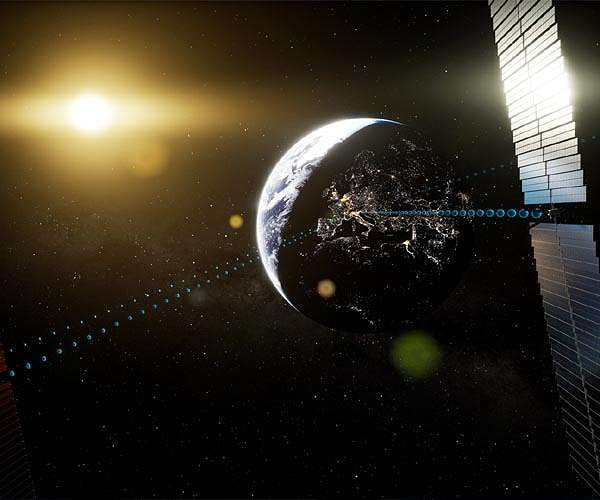
SpaceX's FCC filing states that its orbital data center satellites will stay cool by using "radiative heat dissipation" – pointing the waste-heat side of the spacecraft at the cold of deep space, no water required, no atmosphere needed. This is real engineering. Every serious satellite uses some version of it. The problem is that it works perfectly for a solar power array and is physically inadequate for a GPU cluster. Understanding exactly why is the key to understanding how a $1.75 trillion investment narrative was assembled around a technically real solution to the wrong problem.
What The Shadow Side Actually Is
Every spacecraft has a thermal budget. The only mechanism available to reject waste heat in the vacuum of space is electromagnetic radiation – infrared photons emitted from warm surfaces to the cold of deep space, governed by the Stefan-Boltzmann law. There is no air to convect heat away, no water to carry it to a cooling tower, no ground to conduct it into. Only radiation.
Spacecraft engineers have managed this for six decades using surface coatings, heat pipes, and careful geometric design. The shadow side – the face of the spacecraft permanently shielded from direct sunlight – is the natural location for radiator surfaces, because it sees deep space at approximately 4 Kelvin rather than direct solar flux at 1,361 watts per square metre. Heat pipes – sealed tubes containing a working fluid that evaporates at the hot end and condenses at the cold end – move thermal energy from electronics to radiator panels. The result is a passive, elegant, zero-maintenance thermal system that has flown successfully on tens of thousands of spacecraft.
SpaceX's filing cites this as the solution to the data centre cooling problem. The claim is not fabricated. It is incomplete in a way that conceals the most important fact about orbital thermal management: the amount of heat you can reject per square metre of radiator is physically fixed by the temperature of the radiating surface and the Stefan-Boltzmann constant, and that fixed amount is orders of magnitude too small for the heat density of a GPU cluster.
The Stefan-Boltzmann Ceiling And Why It Cannot Be Raised
The Stefan-Boltzmann law states that a blackbody surface radiates power proportional to the fourth power of its absolute temperature. At a chip-tolerable operating temperature of 70 degrees Celsius (343 Kelvin) with best-case emissivity, a shadow-side radiator facing deep space can reject approximately 780 watts per square metre. That sounds useful until you examine what a GPU cluster actually generates.
An NVIDIA H100 die measures approximately 815 square millimetres and dissipates up to 700 watts – a heat flux of roughly 86 watts per square centimetre at the chip surface. A domestic electric hotplate runs at around 10 watts per square centimetre. A nuclear reactor fuel rod runs at 50 to 150 watts per centimetre of length. The GPU die is among the most intense heat sources in routine engineering.
A single NVL72 rack consumes 120 kilowatts. At 780 watts per square metre of shadow-side rejection, that rack requires approximately 154 square metres of perfectly oriented radiator at theoretical best case. The International Space Station – the most sophisticated thermal management system ever flown – rejects 70 kilowatts across 422 square metres of active, pumped, articulating radiator panels assembled over thirteen years by spacewalking astronauts. Its effective rejection density is approximately 166 watts per square metre, not 780, because real systems include structural mass, plumbing losses, and orientation penalties.
At the ISS demonstrated rate, a single NVL72 rack requires 723 square metres of radiator. A 10-megawatt GPU cluster needs 60,000 square metres. A 1-gigawatt orbital data centre needs approximately 6 square kilometres of deployed, maintained, articulating radiator surface. The gap between the theoretical claim and operational reality is a factor of more than four. The gap between GPU heat flux density and radiator rejection capacity is a factor of approximately 11,000. Neither of these is a rounding error solvable with better materials.
Can You Capture And Reuse The Heat?
On Earth, data centre waste heat recovery is real and growing. GPU waste heat at 40 to 70 degrees Celsius is classified as low-grade thermal energy, adequate for district heating, greenhouse agriculture, and desalination pre-treatment. Helsinki, Amsterdam, and Stockholm already pipe data centre waste heat into city heating networks. The Milwaukee School of Engineering heats its entire campus from a GPU supercomputer. At current rack densities of 100 kilowatts or more, a hyperscale data centre is effectively a district heating plant that also does computation.
In orbit, the options collapse. You cannot store the heat indefinitely – a thermally insulated vessel just becomes a hot object that still has to radiate eventually, and the mass of insulation must itself be launched at several thousand dollars per kilogram. You cannot convert it back to electricity efficiently – GPU waste heat at 40 to 70 degrees Celsius produces a Carnot efficiency ceiling of roughly 25 to 30 percent at best, with real conversion systems achieving perhaps 8 to 12 percent after mechanical and electrical losses. For every 100 watts of waste heat recovered you get perhaps 10 watts of electricity, while the conversion machinery adds kilograms that themselves require launch. There is no nearby city to heat. There is no downstream customer for low-grade thermal energy in low Earth orbit. The heat must be radiated.
Does The Shadow Side Geometry Help More Than The Numbers Suggest?
Pointing at deep space at 4 Kelvin rather than Earth at 255 Kelvin average does improve rejection – from approximately 465 watts per square metre to approximately 780 watts per square metre, a genuine 68 percent improvement. But three geometric realities limit the benefit in practice.
First, sun-synchronous orbit is, by design, almost continuously sunlit – that is the point of SSO for power generation. During the overwhelming majority of the orbit in full sunlight, the shadow side does not face deep space. It faces Earth albedo, reflected sunlight from cloud tops and ice fields, and at different orbital geometries, direct solar flux at glancing angles. A flat-panel shadow-side radiator in SSO does not see 4 Kelvin for 99 percent of the orbit. Performance degrades by 20 to 40 percent on average.
Second, the requirement for shadow-side orientation conflicts directly with the requirement for sun-side power collection. A satellite that rotates to keep its radiator pointed at deep space is also rotating its solar panels away from the Sun. The ISS addresses this with large articulating radiator booms that track independently of the solar arrays – complex, expensive, mass-intensive engineering that required thirteen years of spacewalk assembly.
Third, and most fundamentally, the shadow side improvement halves the problem rather than solving it. Even at 780 watts per square metre – the theoretical best case – a 10-megawatt GPU cluster still requires approximately 12,800 square metres of perfectly oriented shadow-side radiator. The shadow side is not the answer. It is a refinement of the wrong answer.
What The Shadow Side Actually Solves
Here is the asymmetry the data centre narrative deliberately obscures. For a solar power array, the shadow side thermal solution works correctly and elegantly.
A photovoltaic panel in orbit converts approximately 28 to 33 percent of absorbed sunlight to electricity. The remainder – roughly 67 to 72 percent – becomes heat. At orbital solar intensity of 1,361 watts per square metre, this amounts to approximately 900 to 970 watts per square metre of thermal load distributed across the entire panel area. The panel itself, operating at 50 to 80 degrees Celsius, radiates from both its front and back surfaces. Net radiation from a panel at 60 degrees Celsius to deep space on the shadow side is approximately 580 to 640 watts per square metre. The array manages its thermal load at operating temperature without pumped cooling loops, without deployable radiator booms, without ammonia systems, and without any moving parts.
The critical distinction is heat flux density. A solar panel distributes its thermal load across its entire collection area. A GPU concentrates its thermal load on a postage-stamp-sized die. The former is compatible with passive radiative rejection. The latter is not. This is not a matter of degree. It is a categorical difference.
The D3 Chip As The Implicit Admission
SpaceX's S-1, filed May 20, discloses Terafab – a proposed $20 to $25 billion semiconductor fabrication joint venture with Tesla and Intel – which would produce a space-hardened chip designated the D3. The D3 is described as designed to "run hotter" specifically to reduce radiator mass in vacuum. Running a chip hotter improves radiative rejection – the fourth-power relationship means a chip at 100 degrees Celsius radiates approximately 70 percent more than one at 70 degrees Celsius.
This is real engineering thinking. It also concedes, implicitly, that the thermal problem is severe enough to require an entirely new chip architecture, at a cost and on a timeline that the S-1 explicitly does not guarantee. The filing notes that neither Tesla nor Intel are obligated to remain in the Terafab project and that SpaceX "may not enter into any such definitive agreements." The D3 chip is the admission that standard commercial silicon cannot work in orbit at AI-cluster densities. It is presented as a solution. It is equally legible as a confession that the problem the data centre narrative claims is solved has not yet been solved at all.
The Load-Bearing Technical Claim
In the context of a $1.75 trillion IPO, the shadow side thermal solution is the load-bearing technical claim that allows the entire data centre narrative to sound credible to institutional investors and regulators who are not thermal engineers. The pitch goes: terrestrial data centres use enormous quantities of water and grid power for cooling. Orbital data centres use none – they cool passively using the cold of deep space. This sounds like a solved problem. It is technically accurate as a description of how spacecraft reject heat. It is entirely misleading as a description of whether that mechanism can handle GPU-class thermal loads at commercial scale.
On Earth, the same principle – passive radiative cooling to a cold background – is being developed as a genuine supplement to conventional data centre cooling in arid climates. Rooftop radiative panels, sub-ambient sky-cooling films, and passive thermal storage are real and growing markets. At 120 watts per square metre under ideal conditions, cooling a 10-megawatt data centre requires 83,000 square metres of rooftop panel – roughly twelve football fields on a building that might occupy two. Radiative sky cooling is a useful supplement. It is not a replacement. The same structural limitation applies on Earth as in orbit: radiative rejection density is low, chip heat flux density is high, and the gap between them is bridged by liquid cooling infrastructure that both the terrestrial and orbital pitches are trying to eliminate.
The shadow side thermal solution is real technology applied to the wrong problem, described in language accurate enough to mislead without being false enough to litigate. For a solar power array or an orbital power generation network, the thermal problem self-solves. For a GPU cluster, the numbers are off by a factor of 11,000. The data centre narrative borrows the credibility of the working solution and applies it to the context where it fails. The borrowing is technically precise enough to survive casual scrutiny. It does not survive the numbers.
