
Subscribe free to our newsletters via your
. Military Space News .


INTERN DAILY
The light of fireflies for medical diagnostics
by Staff Writers
Lausanne, Switzerland (SPX) Jul 24, 2015


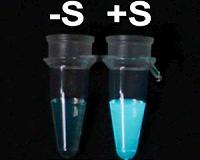
This is an example of the luminescence produced by the chemical modifications described in this article. Key: -S, a tube without streptavidin; +S, with streptavidin. Image courtesy Kai Johnsson/EPFL. For a larger version of this image please go here.

In biology and medicine, we often need to detect biological molecules. For example, in cancer diagnostics, doctors need quick and reliable ways of knowing if tumor cells are present in the patient's body. Although such detection methods exist, they often require a lot of time, work and money.

EPFL scientists have chemically tweaked the enzyme responsible for the light of fireflies to make it "sniff out" target biological molecules and give out a light signal. The result is a cheap, simple and highly accurate detection system that can change the face of the field. The work, now part of an EPFL startup, is published in Nature Communications.

The lab of Kai Johnsson at EPFL, led by Alberto Schena and Rudolf Griss, were able to add a small chemical tag on the enzyme luciferase, which produces the light of fireflies. The tag detects a target protein, and the luciferase gives out a light signal that can be seen with a naked eye.

The team has proven expertise in this field: in 2014, they developed a quick and easy drug-monitoring molecule that led to a startup company, Lucentix. Thinking outside the box, they bypassed the pains of protein engineering altogether: instead of mutating the luciferase to make it sensitive for a target protein - which would require enormous labor - they simply attached it to a small chemical tag.

The tag acts as a switch: it blocks luciferase, preventing it from producing light. When the tag detects its target protein, it attaches to that instead, removing the block from lucifarase. As a result, luciferase is free to turn on the lights, which is the signal that the target has been found. In short, the scientists have created a chemical solution for a biological problem.

"You can think of the tagged luciferase as a cyborg molecule," says Kai Johnsson. "Half bio, half synthetic. How could you make luciferase sensitive to the presence of another protein just through mutations? It's a lot of work. With this chemical trick, all we have to worry about is designing an appropriate tag that can recognize the target protein."

The activation of luciferase when it detects its target protein is dramatic enough to see with a naked eye. This means that the system does not demand expensive and complicated readout devices.

But the success has wider implications. "This is a generalized design," says Kai Johnsson. "It shows how you can exploit synthetic chemistry to create sophisticated biosensor proteins."

Schena A, Griss R, Johnsson K. Modulating protein activity using tethered ligands with mutually exclusive binding sites. Nature Communications 22 July 2015. DOI: 10.1038/ncomms8830


Thanks for being here;
We need your help. The Space Media Network continues to grow but revenues have never been harder to maintain.

With the rise of Ad Blockers, and Facebook - our traditional revenue sources via quality network advertising continues to decline. And unlike so many other news sites, we don't have a paywall - with those annoying usernames and passwords.

Our news coverage takes time and effort to publish 365 days a year.

If you find our news sites informative and useful then please consider becoming a regular supporter or for now make a one off contribution.
SpaceMediaNetwork Contributor
$5 Billed Once


credit card or paypal
SpaceMediaNetwork Monthly Supporter
$5 Billed Monthly


paypal only


.


Related Links
Ecole Polytechnique Federale de Lausanne
Hospital and Medical News at InternDaily.com


Comment on this article via your Facebook, Yahoo, AOL, Hotmail login.

Share this article via these popular social media networks
del.icio.usdel.icio.us DiggDigg RedditReddit GoogleGoogle


Memory Foam Mattress Review
Newsletters :: SpaceDaily :: SpaceWar :: TerraDaily :: Energy Daily
XML Feeds :: Space News :: Earth News :: War News :: Solar Energy News


INTERN DAILY
Futuristic brain probe allows for wireless control of neurons
Washington DC (SPX) Jul 20, 2015
A study showed that scientists can wirelessly determine the path a mouse walks with a press of a button. Researchers at the Washington University School of Medicine, St. Louis, and University of Illinois, Urbana-Champaign, created a remote controlled, next-generation tissue implant that allows neuroscientists to inject drugs and shine lights on neurons deep inside the brains of mice. The r ... read more


INTERN DAILY
US Awards Contract to Develop Missile Defense Command System

US Authorizes 'Forward-Based' Missile Defense System for Allies

USAF Early Warning Satellites Get No-Cost Update from Lockheed Martin

Boecore to support Army missile defense

INTERN DAILY
Israel jails Palestinian engineer over Hamas rocket design

Successful flight tests for Lockheed Martin missile

Russia to launch space based missile warning system

The Hypersonic Missile Arm Race

INTERN DAILY
Pakistan says it has shot down an Indian spy drone

US to entice drone pilots with $15,000 bonus

Pakistan summons Indian envoy after 'spy drone' shot down

Drones and phones to tackle Indonesian holiday road chaos

INTERN DAILY
Lockheed Martin set to advance RF sensors development

Navy engineer invents new data transmission system

Fourth MUOS arrives in Florida for August launch

Airbus DS unveils new mobile welfare communication portfolio

INTERN DAILY
Canada orders trucks from Mack Defense

Lockheed Martin orders weapons stabilization system

Europe's Eighth NATO Radar Operational in Hungary

23 conscripts killed in Russian military barracks collapse

INTERN DAILY
India clears $4.74 billion defence purchase

US military to consider transgender troops

State Dept. gives nod to possible border security system sale to Egypt

Russia wants Iran arms embargo 'lifted as soon as possible'

INTERN DAILY
US-Cuba relations: A half-century of twists and turns

US-led drills in Ukraine may threaten peace process: Moscow

Beijing chides US over South China Sea flight

Manila to base jets, frigates near China-claimed waters

INTERN DAILY
Plantations of nanorods on carpets of graphene capture the Sun's energy

Nanoscale light-emitting device has big profile

Nanowires highly 'anelastic'

Polymer mold makes perfect silicon nanostructures


The content herein, unless otherwise known to be public domain, are Copyright 1995-2014 - Space Media Network. All websites are published in Australia and are solely subject to Australian law and governed by Fair Use principals for news reporting and research purposes. AFP, UPI and IANS news wire stories are copyright Agence France-Presse, United Press International and Indo-Asia News Service. ESA news reports are copyright European Space Agency. All NASA sourced material is public domain. Additional copyrights may apply in whole or part to other bona fide parties. Advertising does not imply endorsement, agreement or approval of any opinions, statements or information provided by Space Media Network on any Web page published or hosted by Space Media Network. Privacy Statement All images and articles appearing on Space Media Network have been edited or digitally altered in some way. Any requests to remove copyright material will be acted upon in a timely and appropriate manner. Any attempt to extort money from Space Media Network will be ignored and reported to Australian Law Enforcement Agencies as a potential case of financial fraud involving the use of a telephonic carriage device or postal service.