
. Military Space News .


.
NANO TECH
Tiny levers, big moves in piezoelectric sensors
by Staff Writers
Washington DC (SPX) Nov 30, 2011

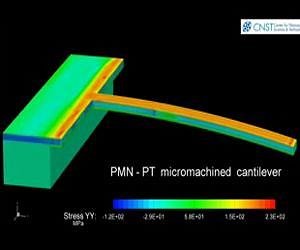
Stil from an animation of PMN-PT microcantilever. Credit: NIST.

A team of university researchers, aided by scientists at the National Institute of Standards and Technology (NIST), have succeeded in integrating a new, highly efficient piezoelectric material into a silicon microelectromechanical system (MEMS). This development could lead to significant advances in sensing, imaging and energy harvesting.

A piezoelectric material, such as quartz, expands slightly when fed electricity and, conversely, generates an electric charge when squeezed. Quartz watches take advantage of this property to keep time: electricity from the watch's battery causes a piece of quartz to expand and contract inside a small chamber at a specific frequency that circuitry in the watch translates into time.

Piezoelectric materials are also in sensors in sonar and ultrasound systems, which use the same principle in reverse to translate sound waves into images of, among other things, fetuses in utero and fish under the water.

Although conventional piezoelectric materials work fairly well for many applications, researchers have long sought to find or invent new ones that expand more and more forcefully and produce stronger electrical signals.

More reactive materials would make for better sensors and could enable new technologies such as "energy harvesting," which would transform the energy of walking and other mechanical motions into electrical power.

Enter a material named PMN-PT
A large team led by scientists from the University of Wisconsin-Madison developed a way to incorporate PMN-PT into tiny, diving-board like cantilevers on a silicon base, a typical material for MEMS construction, and demonstrated that PMN-PT could deliver two to four times more movement with stronger force - while using only 3 volts - than most rival materials studied to date.

It also generates a similarly strong electric charge when compressed, which is good news for those in the sensing and energy harvesting businesses.

To confirm that the experimental observations were due to the piezoelectric's performance, NIST researcher Vladimir Aksyuk developed engineering models of the cantilevers to estimate how much they would bend and at what voltage. Aksyuk also made other performance measures in comparison to silicon systems that achieve similar effects using electrostatic attraction.

"Silicon is good for these systems, but it is passive and can only move if heated or using electrostatics, which requires high voltage or large dissipated power," says Aksyuk.

"Our work shows definitively that the addition of PMN-PT to MEMS designed for sensing or as energy harvesters will provide a tremendous boost to their sensitivity and efficiency. A much bigger 'bend for your buck,' I guess you could say."

Other participants included researchers from Penn State University; the University of California, Berkeley; the University of Michigan; Cornell University; and Argonne National Laboratory. S.H. Baek, J.Park, D.M. Kim, V.A. Aksyuk, R.R. Das, S.D. Bu, D.A. Felker, J. Lettieri, V. Vaithyanathan, S.S.N. Bharadwaja, N. Bassiri-Gharb, Y.B. Chen, H.P. Sun, C.M. Folkman, H.W. Jang, D.J. Kreft, S.K. Streiffer, R. Ramesh, X.Q. Pan, S. Trolier-McKinstry, D.G. Schlom, M.S. Rzchowski, R.H. Blick and C.B. Eom. Giant piezoelectricity on Si for hyperactive MEMS. Science. Published Nov. 18, 2011. Vol. 334 no. 6058 pp. 958-961. DOI: 10.1126/science.1207186.

Related Links
National Institute of Standards and Technology
Nano Technology News From SpaceMart.com
Computer Chip Architecture, Technology and Manufacture


.
.
Get Our Free Newsletters Via Email
...
Buy Advertising Editorial Enquiries


.

. Comment on this article via your Facebook, Yahoo, AOL, Hotmail login.

Share this article via these popular social media networks
del.icio.usdel.icio.us DiggDigg RedditReddit GoogleGoogle


NANO TECH
New magnetic-field-sensitive alloy could find use in novel micromechanical devices
Washington DC (SPX) Nov 25, 2011
Led by a group at the University of Maryland (UMd), a multi-institution team of researchers has combined modern materials research and an age-old metallurgy technique to produce an alloy that could be the basis for a new class of sensors and micromechanical devices controlled by magnetism.* The alloy, a combination of cobalt and iron, is notable, among other things, for not using rare-earth elem ... read more


NANO TECH
Medvedev threatens missile deployment on EU borders

Boeing and Northrop Grumman GMD Team Statement on Competitive Missile Defense Contract

Iran 'builds own missile defense system'

Northrop Grumman Plays Key Role in Unprecedented Joint Service Air and Missile Defense Demonstration

NANO TECH
MEADS Conducts First Flight Test At White Sands Missile Range

General killed in Iran blast 'was working on missiles'

Arms blast death toll rises to at least 36: Iran media

India: more AWACS and BrahMos missiles

NANO TECH
Argus One UAV Completes Flight Testing With New Pod Bay and Propulsion System

Kratos on Winning Team to Provide Army Unmanned Aerial System Technical Support

US drone kills six militants: Pakistani officials

Lockheed Martin Wins Major Contract From US Army To Maintain Aerostat Detection Systems

NANO TECH
Raytheon First to Successfully Test With On-Orbit AEHF Satellite

Lockheed Martin AMF JTRS Team Demonstrates Communications and Tactical Data Sharing At Army Exercise

Boeing Ships WGS-4 to Cape Canaveral for January Launch

Harris to maintain satellite ground system

NANO TECH
Boeing Receives Contract to Upgrade F-15C Trainers

Lockheed Martin Awarded Contract to Support US Army Maneuver Training

New Weapon for Australian Soldiers

Cambodia landmine summit sparks hopes for survivor

NANO TECH
Japan firm raided over tech exports to China: reports

Contest for $1 billion jet deal heats up

S. African paper publishes 'sealed' arms deal interview

Mercosur mulls focus on arms suppliers

NANO TECH
India-China meeting off over Dalai Lama: source

In Myanmar trip, US seeks clout on China doorstep

Perry says China's communists doomed, lack virtue

Three-way US-China drills possible: Australia

NANO TECH
Rheinmetall demonstrates laser weapons

LockMart Directed Energy Leader Receives Purdue's Outstanding Aerospace Engineer Award


.

The content herein, unless otherwise known to be public domain, are Copyright 1995-2011 - Space Media Network. AFP and UPI Wire Stories are copyright Agence France-Presse and United Press International. ESA Portal Reports are copyright European Space Agency. All NASA sourced material is public domain. Additional copyrights may apply in whole or part to other bona fide parties. Advertising does not imply endorsement,agreement or approval of any opinions, statements or information provided by Space Media Network on any Web page published or hosted by Space Media Network. Privacy Statement