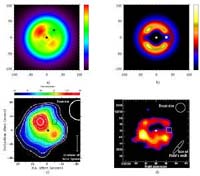
File Image of Vega Dust Zones
File Image of Vega Dust Zones |
The finding could change ideas about how organic molecules form in the universe, and how those molecules� critical interaction with dust causes stars and planets to form.
The scientists compared the results of experiments from an international team of chemists to telescopic measurements of the amount of methyl formate - a product of alcohol and formaldehyde - in the swirling dust clouds that dot our Milky Way galaxy. On Earth, methyl formate is commonly used as an insecticide.
Based on telescope data, if the gaseous methyl formate condensed into liquid form, a typical dust cloud would contain a thousand trillion trillion gallons of the chemical.
Interstellar dust clouds contain the chemical seeds of new stars and planetary systems, explained Eric Herbst, Distinguished Professor of Mathematical and Physical Sciences at Ohio State. Most people are probably familiar with the dust cloud known as the Horsehead Nebula in the constellation Orion.
While scientists have long known that hydrogen is the most common chemical element in the universe, just 10 years ago Herbst - a professor of physics, chemistry, and astronomy - and his colleagues discovered that there were also large quantities of alcohol in dust clouds in space.
The presence of methyl formate suggests that other molecules may play a more prominent role in star and planet formation than scientists ever suspected.
"Even using our best models of interstellar chemistry, we still don�t fully understand how these molecules could have formed," Herbst said. "Clearly, something else is going on."
Herbst reported the new results June 23 at the International Symposium on Molecular Spectroscopy in Columbus.
Three groups of chemists from the United States, Canada, and Norway had previously conducted laboratory experiments to determine how alcohol and other molecules produce methyl formate.
Herbst and Ohio State postdoctoral researcher Helen Roberts used that data to construct a new model of how such reactions happen in space, and then used the model to predict how much methyl formate would be found in the typical interstellar dust cloud.
Next, the Ohio State scientists consulted the radio spectrum of the dust clouds, which gives them the unique chemical signatures of the different molecules floating inside.
The spectra showed that the average ratio of hydrogen molecules to molecules of methyl formate was a billion to one. But the model that Herbst and Roberts derived had predicted only a fraction of that amount.
"We calculated the ratio to be 100 billion to one, so the model must be deficient," Herbst said.
Scientists will have to refine the models before they can truly know how stars and planets form, he said.
According to accepted theory, gas molecules floating in these clouds must join and nuclear reactions must begin before stars can form. Dust particles are key to the process because they provide a surface for reactions to take place.
Among their future goals, Herbst, Roberts, and their colleagues want to determine exactly what space dust is made of and what the surface texture is like, since both would affect chemical reactions - a task that amounts to studying individual dust grains thousands of light years away.
Modeling such large, complex systems requires a great deal of computing power, and measuring the actual amounts of chemicals in these faraway clouds is difficult.
Herbst said that supercomputers and telescopes are just beginning to advance to the point where such things are possible. In the future, he would like to form a consortium of researchers in molecular astronomy to pool ideas and resources.
Related Links
 Arizona Astronomers Use Novel Camera To Hunt For Extrasolar Planets
 Tucson (SPX) Jun 23, 2004
| The content herein, unless otherwise known to be public domain, are Copyright 1995-2006 - SpaceDaily.AFP and UPI Wire Stories are copyright Agence France-Presse and United Press International. ESA PortalReports are copyright European Space Agency. All NASA sourced material is public domain. Additionalcopyrights may apply in whole or part to other bona fide parties. Advertising does not imply endorsement,agreement or approval of any opinions, statements or information provided by SpaceDaily on any Web page published or hosted by SpaceDaily. Privacy Statement |