
. Military Space News .
INTERN DAILY
Towards better hip replacements
by Staff Writers
Montreal, Canada (SPX) Nov 07, 2016


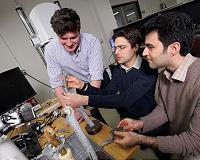
This is Damiano Pasini preparing the implant for testing with students Sajad Arabnejad and Burnett Johnston. Image courtesy Owen Egan. For a larger version of this image please go here.

Some potentially good news for aging Baby Boomers: researchers believe that they have developed a hip replacement that will last longer and create fewer problems for the people who receive them than those currently in use. The secret? An implant that "tricks" the host bone into remaining alive by mimicking the varying porosity of real bones.

Interestingly, the key factor that distinguishes the new implant is that is LESS rather than more solid than those in current use, while still being just as strong.

Damiano Pasini, the man behind the design of the new hip replacement, points at the pyramid-like shapes visible on its surface. The implant is known as a femoral stem and connects the living femur with the artificial hip joint. "What we've done throughout the femoral stem is to replicate the gradations of density found in a real femur by using hollowed-out tetrahedra," he explains.

"Despite the fact that there are spaces within the tetrahedra, these forms are incredibly strong and rigid so they're a very efficient way of carrying a load. Just think of the lattice-work in the legs of the Tour Eiffel."

Pasini teaches mechanical engineering at McGill University and first started working on the concept for the implant more than 6 years ago. He smiles ruefully as he pulls earlier versions of the implant down from the shelves in his office to show how far he has come since then. He elaborates:

"So because the implant loosely mimics the cellular structure of the porous part of the surrounding femur, it can "trick" the living bone into keeping on working and staying alive. This means that our implant avoids many of the problems associated with those in current use."

Indeed, the main problem with most implants is that because they are solid, or only porous on the surface, they are much harder and more rigid than natural bone. As a result, the implants absorb much of the stress along with the weight-bearing role that is normally borne by the living femur.

Without sufficient stress to stimulate cell formation, the bone material in the living femur then becomes reabsorbed by the body and the bone itself begins to deteriorate and become less dense. This is one of the reasons that many implants become painful and need to be replaced after a time. It also explains why people often have difficulty if they have to have the same hip replaced a second time, because there simply isn't enough normal, healthy bone to hold the implant in place.

It is a problem that orthopaedic surgeons are seeing more and more frequently.

Dr. Michael Tanzer from the Jo Miller Orthopaedic Research Laboratory at McGill has been collaborating with Damiano Pasini for several years. "Because people engage in various sports where they may be injured more than they did in the past, we see younger people needing hip replacements more frequently," says Dr. Tanzer.

"And because people are also living longer, they often need to have the same hip replaced a second time. Unfortunately, I've seen many cases where people simply don't have enough living bone for that to work easily. We are optimistic that this implant will reduce these kinds of problems."

After successfully performing various tests on their implant, the researchers are so convinced that their femoral stem will work that they have already filed patents on it. They believe that because their current design is fully compatible with existing surgical technology for hip replacements it should be easier for the FDA to approve and surgeons to adopt.

In the meantime, Burnett Johnston, who started working with Damiano Pasini on developing the implants when he was a Masters student has now enrolled at McGill's medical school.

His goal? To be the first person to actually implant one of these replacement hips once he qualifies as a surgeon and the new femoral stems have been fully tested, adjusted and accepted - something that Damiano Pasini estimates may happen in about three-five years' time.

Research paper


Comment on this article using your Disqus, Facebook, Google or Twitter login.


Thanks for being here;
We need your help. The Space Media Network continues to grow but revenues have never been harder to maintain.

With the rise of Ad Blockers, and Facebook - our traditional revenue sources via quality network advertising continues to decline. And unlike so many other news sites, we don't have a paywall - with those annoying usernames and passwords.

Our news coverage takes time and effort to publish 365 days a year.

If you find our news sites informative and useful then please consider becoming a regular supporter or for now make a one off contribution.
SpaceMediaNetwork Contributor
$5 Billed Once


credit card or paypal
SpaceMediaNetwork Monthly Supporter
$5 Billed Monthly


paypal only


.


Related Links
McGill University
Hospital and Medical News at InternDaily.com


Share this article via these popular social media networks
del.icio.usdel.icio.us DiggDigg RedditReddit GoogleGoogle

Previous Report
INTERN DAILY
New coating is too slippery for bacteria to grow on
Boston (UPI) Nov 1, 2016
It's hard for biofilm to develop on the surface of an object if bacteria can't latch on to it. Scientists believe a new, ultra-low adhesive coating could thwart bacterial growth before it starts by making medical implants and other devices extra slippery. The new coating material is called SLIPS, short for "slippery liquid-infused porous surfaces." In tests, the coating reduced bacteria ... read more


INTERN DAILY
Yemen rebel missile shot down near Mecca: coalition

US to deploy missile defense to South Korea 'soon'

China, Russia blast US missile defence at regional forum

Raytheon to update the Netherlands' Patriot missile system

INTERN DAILY
USS Carl Vinson test-fires Rolling Airframe Missile, Phalanx

Is China's new short-range missile system designed to compete with Iskander

Raytheon receives Rolling Airframe Missile contract modification

BAE receives max $600 million U.S. Navy contract for laser-guided rockets

INTERN DAILY
China to export CH-5 drone

Drones take off in plant ecological research

Iran unveils 'suicide drone'

Airbus Helicopters, DCNS team for future helicopter drone

INTERN DAILY
Lockheed Martin gets $92 million military satellite contract modification

Russia develops new satellite communication system for military use

Arizona aerospace company wins $19M Navy satellite contract

Canada defence dept selects Newtec for first DVB-S2X Airborne Modem

INTERN DAILY
Lasers, hybrid power for Army's next-gen combat vehicle, experts say

Ceradyne producing next-gen helmets, body armor

First U.S. Stryker with 30mm cannon debuts

L-3 Oceania to supply Australia with night fighting equipment

INTERN DAILY
Turkish foreign minister hits back at 'weak' Iraq PM

Pentagon suspends clawback of decade-old enlistment bonuses

Saab buys Danish defense company

Airbus protests furiously over Poland's handling of chopper deal

INTERN DAILY
Kerry calls ties to Manila 'ironclad' despite 'differences'

Ex-Philippine leader resigns as Duterte's China envoy

China president slams 'conspiracies' in Communist Party

S. Korea coastguard fires machine guns at Chinese trawlers

INTERN DAILY
Nanoparticle taxicab materials can identify, collect and transport debris on surfaces

First time physicists observed and quantified tiny nanoparticle crossing lipid membrane

A tiny machine

Nanoantenna lighting-rod effect produces fast optical switches


The content herein, unless otherwise known to be public domain, are Copyright 1995-2024 - Space Media Network. All websites are published in Australia and are solely subject to Australian law and governed by Fair Use principals for news reporting and research purposes. AFP, UPI and IANS news wire stories are copyright Agence France-Presse, United Press International and Indo-Asia News Service. ESA news reports are copyright European Space Agency. All NASA sourced material is public domain. Additional copyrights may apply in whole or part to other bona fide parties. All articles labeled "by Staff Writers" include reports supplied to Space Media Network by industry news wires, PR agencies, corporate press officers and the like. Such articles are individually curated and edited by Space Media Network staff on the basis of the report's information value to our industry and professional readership. Advertising does not imply endorsement, agreement or approval of any opinions, statements or information provided by Space Media Network on any Web page published or hosted by Space Media Network. General Data Protection Regulation (GDPR) Statement Our advertisers use various cookies and the like to deliver the best ad banner available at one time. All network advertising suppliers have GDPR policies (Legitimate Interest) that conform with EU regulations for data collection. By using our websites you consent to cookie based advertising. If you do not agree with this then you must stop using the websites from May 25, 2018. Privacy Statement. Additional information can be found here at About Us.