
SPACEWAR
US Space Surveillance Telescope in Australia achieves initial operational capability
by SpOC Staff Writer
Peterson SFB CO (SPX) Oct 06, 2022

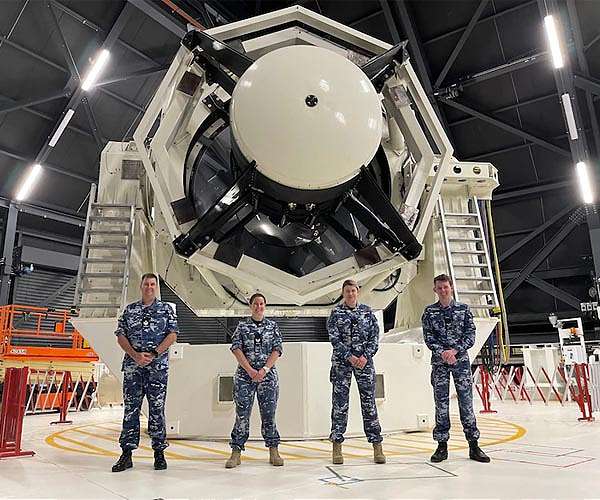
(l-r) Air Surveillance Operators from No. 1 Remote Sensor Unit, Flight Sergeant Peter Merritt, Sergeant Emma Barker, Leading Aircraftwoman Amy Clements and Leading Aircraftman Corey Tuddenham, at the Air Forces Space Surveillance Telescope in Western Australia. Air Surveillance Operators at No. 1 Remote Sensor Unit based at RAAF Base Edinburgh concluded training on 23 April 2021 to operate the Units newest capability, the first RAAF Space Surveillance Telescope (SST).

The Australian Department of Defence and the U.S. Space Force declared initial operational capability for the Space Surveillance Telescope at Naval Communication Station Harold E. Holt, Australia, Sept. 30, 2022.

The SST is a military telescope that provides ground-based, broad-area search, detection and tracking of faint objects in deep space to help predict and avoid potential collisions, as well as detect and monitor asteroids.

Commander Defence Space Command, Air-Vice Marshal Cath Roberts said this milestone was an important step for the Alliance and the future of space capability in Australia.

"In an increasingly contested and congested space environment, The Space Surveillance Telescope will provide enhanced awareness of the space domain and contribute to greater Alliance cooperation," Roberts said. "The bespoke facilities and supporting infrastructure are as much of a milestone as the telescope itself and represent a significant achievement by Defence and Australian industry."

The SST was relocated from White Sands Missile Range, New Mexico, to Australia in 2017 as a combined effort to develop Australia's space domain awareness capabilities. While the U.S. still owns the SST, Australia is responsible for the facilities and infrastructure, operators, and training.

U.S. Space Force Gen. John "Jay" Raymond, Chief of Space Operations, emphasized the need for strong international partnerships to continually improve U.S. and Allied space capabilities.

"Reaching initial operational capability is a major achievement that underscores the importance of working together to secure the ultimate high ground," Raymond said. "My thanks and congratulations to our Australian partners and our Guardians and Airmen who have been collaborating for almost a decade to make this possible. I'm impressed at how far we've come together and look forward to continuing our close partnership as we work toward full operational capability."

The SST will contribute to the U.S. Space Surveillance Network, a U.S. Space Command capability operated by the USSF to detect, track, catalog and identify artificial objects orbiting the earth. The telescope's strategic location in Australia provides unique space domain awareness coverage in the region.

In November 2013, then-U.S. Secretary of Defense Chuck Hagel and then-Australian Defence Minister David Johnston signed a memorandum of understanding to relocate and jointly operate the telescope. In March 2020, the SST captured its first images from Australia of objects in space. Since then, it has undergone a rigorous test and evaluation program to transition it from a scientific research system to a military asset ready to support ongoing operations. Full operational capability is projected to be achieved in late 2023.

The SST is capable of imaging objects in geosynchronous orbit, approximately 22,000 miles above earth. Its data processing system can filter through more than a terabyte of data per night, as well as receive and process images in real time to determine precise satellite positions.

Space domain awareness refers to the study and monitoring of artificial objects, such as satellites and debris, orbiting the earth. In the USSF, this responsibility falls under Space Delta 2 - Space Domain Awareness. Delta 2 prepares and presents assigned and attached forces for the purpose of executing combat-ready space domain awareness operations to deter aggression and, if necessary, fight to protect and defend the U.S. and Allies from attack in, through and from space.


Related Links
Space Operations Command
Military Space News at SpaceWar.com

SPACEWAR
Space Norway Is Building A Radar Satellite System For Real Time Maritime Surveillance
Oslo, Norwar (SPX) Aug 28, 2022
On the 25th of August 2022 Space Norway AS signed contracts with vendors and will immediately start building a radar satellite system optimized for maritime surveillance in Norwegian areas of interest. The payloads will be developed and built by Norwegian suppliers, while the satellite bus and the radar antenna will be built in the UK. The first satellite will be launched early 2025. In the following years, the plan is to launch a number of radar satellites to establish a constellation. The ... read more

Comment using your Disqus, Facebook, Google or Twitter login.

Share this article via these popular social media networks
del.icio.usdel.icio.us DiggDigg RedditReddit GoogleGoogle

SPACEWAR
Lockheed Martin's next gen interceptor achieves communications testing milestone

ULA launches missile warning satellite for US Space Force

US OKs $5 bn sale of missile defense systems to Saudi, UAE

MDA selects NC and Raytheon to further develop Glide Phase Interceptor prototype

SPACEWAR
Failed missile launch triggers panic in South Korean city

N.Korea conducts third ballistic missile launch in 5 days

Raytheon and Northrop Grumman to deliver hypersonic air-breathing missile to USSF

Iran unveils new medium-range missile: state TV

SPACEWAR
NASA's upgraded Mobile Mission Control Center to analyze Advanced Air Mobility flight tests

Team V-BAT offers a proven tactical UAS solution for RCN ISTAR

Iranian drones bring back fear for Ukrainians

Outpost completes successful flight tests of their autonomous paraglider

SPACEWAR
Viasat to sell its Link 16 Tactical Data Links business to L3Harris Technologies

SIMBA Chain awarded SpaceWERX Orbital Prime Contract

HawkEye 360 awarded radio frequency contract by NRO

Spire Global awarded NRO contract for radio frequency data

SPACEWAR
Homemade 'DIY' weapons boost Ukraine war arsenal

Soviet-era rocket launchers still serving on Ukraine frontline

In the Ukrainian army, Soviet-era artillery bows out

Germany military must become Europe's 'best equipped': Scholz

SPACEWAR
Norway seeks to up defence spending over Ukraine war

One killed, two missing in Bulgaria arms factory blast

Sweden allows military exports to Turkey after NATO application

N. Korea denies exporting weapons to Russia

SPACEWAR
'Inevitable': Views on US bases shift in Japan's Okinawa

Russian elite voice growing anger as losses mount in Ukraine

Hong Kong to not enforce sanctions on megayacht linked to Putin ally

US, Australia and Japan vow to work together against China

SPACEWAR
Physicists generate new nanoscale spin waves

'Naturally insulating' material emits pulses of superfluorescent light at room temperature

Making nanodiamonds out of bottle plastic

Towards stable, sustained Raman imaging of large samples at the nanoscale