
. Military Space News .


.
INTERN DAILY
Vampire Bacteria Has Potential as Living Antibiotic
by Fariss Samarrai
Charlottesville VA (SPX) Nov 04, 2011

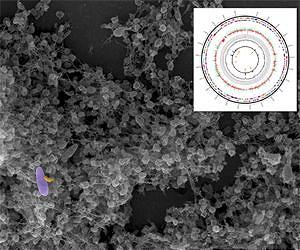
The bacterium Micavibrio aeruginosavorus (yellow), attached to and leeching on a Pseudomonas aeruginosavorus bacterium (purple), surrounded by dead P. aeruginosavorus (gray) cells.

A vampire-like bacteria that leeches onto specific other bacteria - including certain human pathogens - has the potential to serve as a living antibiotic for a range of infectious diseases, a new study indicates.

The bacterium, Micavibrio aeruginosavorus, was discovered to inhabit wastewater nearly 30 years ago, but has not been extensively studied because it is difficult to culture and investigate using traditional microbiology techniques.

However, biologists in the University of Virginia's College of Arts and Sciences, Martin Wu and graduate student Zhang Wang, have decoded its genome and are learning "how it makes its living," Wu said.

The bacterium "makes its living" by seeking out prey - certain other bacteria - and then attaching itself to its victim's cell wall and essentially sucking out nutrients. Unlike most other bacteria, which draw nutrients from their surroundings, M. aeruginosavorus can survive and propagate only by drawing its nutrition from specific prey bacteria.

This kills the prey - making it a potentially powerful agent for destroying pathogens.

One bacterium it targets is Pseudomonas aeruginosavorus, which is a chief cause of serious lung infections in cystic fibrosis patients.

"Pathologists may eventually be able to use this bacterium to fight fire with fire, so to speak, as a bacterium that will aggressively hunt for and attack certain other bacteria that are extremely harmful to humans," Wu said.

His study, detailing the DNA sequence of M. aeruginosavorus, is published online in the journal BMC Genomics. It provides new insights to the predatory lifestyle of the bacterium and a better understanding of the evolution of bacterial predation in general.

"We used cutting-edge genomic technology in our lab to decode this bacterium's genome," Wu said. "We are particularly interested in the molecular mechanisms that allow it to hunt for and attack prey. This kind of investigation would have been extremely difficult and expensive to do only a few years ago."

He noted that overuse of traditional antibiotics, which work by either inhibiting bacteria propagation or interfering with cell wall formation, are creating so-called "super bugs" that have developed resistances to treatment strategies. He suggests that new approaches are needed for attacking pathogens without building up their resistance.

Additionally, because M. aeruginosavorus is so selective a feeder, it is harmless to the thousands of beneficial bacteria that dwell in the general environment and in the human body.

"It is possible that a living antibiotic such as M. aeruginosavorus - because it so specifically targets certain pathogens - could potentially reduce our dependence on traditional antibiotics and help mitigate the drug-resistance problem we are now facing," Wu said.

Another benefit of the bacterium is its ability to swim through viscous fluids, such as mucus. P. aeruginosavorus, the bacterium that colonizes the lungs of cystic fibrosis patients, creates a glue-like biofilm, enhancing its resistance to traditional antibiotics. Wu noted that the living cells of M. aeruginosavorus can swim through mucus and biofilm and attack P. aeruginosavorus.

M. aeruginosavorus also might have industrial uses, such as reducing bacteria that form biofilms in piping, and for medical devices, such as implants that are susceptible to the formation of biofilms.

Wu said M. aeruginosavorus requires further study for a more thorough understanding of its gene functions. He said genetic engineering would be required to tailor the predatory attributes of the bacterium to specific uses in the treatment of disease.

"We have a map now to work with, and we will see where it leads," he said.

Wu and Wang's co-author is Daniel E. Kadouri, a researcher at the New Jersey Dental School. Kadouri is interested in M. aeruginosavorus as an agent for fighting oral biofilms, such as plaque.

Related Links
University of Virginia
Hospital and Medical News at InternDaily.com


.
.
Get Our Free Newsletters Via Email
...
Buy Advertising Editorial Enquiries


.

. Comment on this article via your Facebook, Yahoo, AOL, Hotmail login.

Share this article via these popular social media networks
del.icio.usdel.icio.us DiggDigg RedditReddit GoogleGoogle


INTERN DAILY
Lung regeneration closer to reality with new discovery
New York BY (SPX) Nov 03, 2011
Researchers at Weill Cornell Medical College say they have taken an important step forward in their quest to "turn on" lung regeneration - an advance that could effectively treat millions of people suffering from respiratory disorders. In the Oct. 28 issue of the journal Cell, the research team reports that they have uncovered the biochemical signals in mice that trigger generation of new ... read more


INTERN DAILY
P and W Rocketdyne Selected to Test New Liquid Propulsion System

Russian foreign minister targets NATO missile shield

Israel gets ready to unveil David's Sling

Russia shows little interest in new US missile offer: report

INTERN DAILY
Lockheed Martin Conducts Pac-3 Missile Test at White Sands Missile Range

ATK Awarded Contract for Third LRIP Lot of AARGM

Israel hikes missile range over Iran fears

Pakistan test-fires nuclear-capable stealth missile

INTERN DAILY
NMSU psychology professor sees automated cargo delivery in the future

AeroVironment Receives $7.3 Million Order for Puma Unmanned Aircraft System Support Services

US drone kills three in N.W. Pakistan: officials

UAV Payload Market Will Reach $2.9bn in 2011

INTERN DAILY
AEHF-1 Satellite Arrives at Its Operational Orbit After 14-Month Journey

China suspect in US satellite interference: report

Emirates seek French military satellite

First MEADS Battle Manager Begins Integration Testing in the United States

INTERN DAILY
CREW: Helping Defeat IEDs

Cassidian has Developed Most Powerful Ground Surveillance Radar Worldwide

Northrop Grumman Awarded Contract for Counter-Rocket, Artillery and Mortar Systems

Boeing Receives Contract to Upgrade B-1 Bomber Avionics Software

INTERN DAILY
US ready to sell F-35 fighter to India: Pentagon

Outside View: Needed: A new Nixon

Eurocopter breaks ground on Mexico plant

US finds Russian 'merchant of death' guilty

INTERN DAILY
War, what war? Issues to dodge in 2012 election

Commentary: New world order?

China won't save Europe: Xinhua commentary

Commentary: Communist boogeyman

INTERN DAILY
LockMart Directed Energy Leader Receives Purdue's Outstanding Aerospace Engineer Award


.

The content herein, unless otherwise known to be public domain, are Copyright 1995-2011 - Space Media Network. AFP and UPI Wire Stories are copyright Agence France-Presse and United Press International. ESA Portal Reports are copyright European Space Agency. All NASA sourced material is public domain. Additional copyrights may apply in whole or part to other bona fide parties. Advertising does not imply endorsement,agreement or approval of any opinions, statements or information provided by Space Media Network on any Web page published or hosted by Space Media Network. Privacy Statement