
Subscribe free to our newsletters via your
. Military Space News .


CLIMATE SCIENCE
Villagers in Zimbabwe skip meals to save scant food
By Fanuel JONGWE
Bindura, Zimbabwe (AFP) Sept 24, 2015


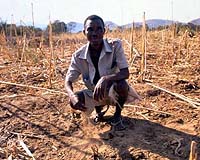
Villagers in Zimbabwe are skipping meals and foraging for wild fruit as food stocks run out after a poor harvest blamed on drought and controversial land reforms.

"Even if the children complain of hunger there is nothing we can do about it," says Rabian Chidamba, 40, a mother of four who lives in Musana district northwest of the capital Harare.

She has cut the family's meals to two a day as she ekes out her small stock of the staple food, corn.

Breakfast is tea with home-baked cornmeal bread, while supper is cornmeal and fried kale, occasionally supplemented with a small portion of meat.

"When the children get hungry between meals they go and look for wild fruit," Chidamba says.

She still has some corn in her makeshift granary, unlike many of her compatriots in other districts whose food stores are empty, but the next harvest is not due until April or May next year.

"Our harvest came to 10 bags of maize instead of the 30 bags we usually get," she said.

Chidamba usually sells surplus corn to raise money for her children's school fees and other necessities, but this year's harvest is not enough even to feed her own family.

At least 1.5 million Zimbabweans are in need of food aid, according to the United Nations World Food Programme and other aid agencies.

Once a major producer of corn, Zimbabwe has become a perennial importer of food following a slump in agricultural production blamed on President Robert Mugabe's land reforms, which saw the seizure of land from white commercial farmers for redistribution to landless blacks.

This year, drought has played a major role in reducing harvests in many southern African countries, with Malawi, Zimbabwe, Namibia and Botswana among the worst-hit.

An estimated 27.4 million people out of the region's combined population of 292 million -- or nearly one in 10 people -- will be depending on food handouts by the end of the year.

- Desperate villagers -

World Food Programme spokesman David Orr told AFP Zimbabwe and Malawi were facing their "worst food security crisis" in a decade.

Mugabe says the low yields are due to erratic rains caused by climate change, along with a lack of fertilizer, seed and farming equipment for the beneficiaries of his land reforms, most of whom lacked the means to run farms.

To alleviate hunger this year, the government has relaxed import regulations to allow individuals and private companies to import grain to supplement local supplies.

So far imports consist of maize grain from Zambia and maize meal from South Africa, according to the agriculture ministry.

Vice President Emmerson Mnangagwa has appealed for cash from "development agencies and the private sector" to ensure that the vulnerable are not "exposed to hunger and starvation".

However, the USAid-funded Famine Early Warning System Network has warned that "the lean season humanitarian assistance is expected to be lower than average due to a challenging funding situation".

WFP said it will start distributing food at the end of September to recipients who will work on projects including building small dams, repairing roads and starting vegetable gardens.

"Because of the poor harvest this year, food security levels are deteriorating earlier during the lean season than usual," said WFP information officer Tinashe Mubaira.

"Consumption coping strategies at the moment are reduction of portion sizes and eating fewer meals. Communities in districts bordering neighbouring countries are crossing over to Mozambique and Zambia for casual labour," he said.

Zvidzai Nyakudirwa, a storekeeper in Chinamhora communal lands, said desperate villagers were bartering their livestock for maize, often getting a bad deal.

They were also selling their livestock "at very low prices", he said.

"It's tough for many families here," said Nyakudirwa, noting that most of his customers were now travellers passing through, rather than the villagers themselves.

Among the worst affected areas are the southern province of Matabeleland North, Masvingo and Matabeleland South, according to government figures.

South Africa, the regional breadbasket, has also been hard hit by drought, recording a 31 percent decline in output this year.

The current maize harvest in South Africa is "the lowest yield since 2007," the country's agriculture department told AFP, adding that the country will have to import around 600,000 tonnes of maize to cover the deficit and meet its contractual export obligations.


Thanks for being here;
We need your help. The Space Media Network continues to grow but revenues have never been harder to maintain.

With the rise of Ad Blockers, and Facebook - our traditional revenue sources via quality network advertising continues to decline. And unlike so many other news sites, we don't have a paywall - with those annoying usernames and passwords.

Our news coverage takes time and effort to publish 365 days a year.

If you find our news sites informative and useful then please consider becoming a regular supporter or for now make a one off contribution.
SpaceMediaNetwork Contributor
$5 Billed Once


credit card or paypal
SpaceMediaNetwork Monthly Supporter
$5 Billed Monthly


paypal only


.


Related Links
Climate Science News - Modeling, Mitigation Adaptation


Comment on this article via your Facebook, Yahoo, AOL, Hotmail login.

Share this article via these popular social media networks
del.icio.usdel.icio.us DiggDigg RedditReddit GoogleGoogle


Memory Foam Mattress Review
Newsletters :: SpaceDaily :: SpaceWar :: TerraDaily :: Energy Daily
XML Feeds :: Space News :: Earth News :: War News :: Solar Energy News


CLIMATE SCIENCE
California Drought Causing Valley Land to Sink
Pasadena CA (JPL) Aug 20, 2015
As Californians continue pumping groundwater in response to the historic drought, the California Department of Water Resources released a new NASA report showing land in the San Joaquin Valley is sinking faster than ever before, nearly 2 inches (5 centimeters) per month in some locations. "Because of increased pumping, groundwater levels are reaching record lows - up to 100 feet (30 meters ... read more


CLIMATE SCIENCE
Raytheon to gather long-lead components for missile interceptor

Russian Anti-Missile Warning System Protects on Multiple Tiers

Russian Missile Warning System Can Detect Mass Launch of Ballistic Missiles

US runs missile defense wargames to break Russian jamming

CLIMATE SCIENCE
Britain contracts MBDA for new ASRAAM missile variant

Poland to Receive U.S. cruise missiles

Malaysia to acquire air defense system from Thales UK

Lockheed Martin receives first order for GMLRS alternative warhead

CLIMATE SCIENCE
To Watch and to Strike: Russia Developing Multi Role Heavy Drone

British Military to Buy Solar-Powered Drones Flying on Edge of Space

Drones Are Now Being Used To Stop Rhino Poachers In Their Tracks

US Tests New Cerberus Electronic Attack System on Drones

CLIMATE SCIENCE
Skynet 5A satellite move to Asia-Pacific complete

Harris Corporation supplying ground-to-air radios to ANG

BAE Systems modernizing Australia's military communications

GSAT-6 military satellite put in its orbital slot

CLIMATE SCIENCE
Australian Army explores U.S. tactile technology for pilots

Slovakia procures Saab's M4 shoulder-fired weapon system

U.S. Army orders anti-armor weapon from Saab

Australia funds military technology development

CLIMATE SCIENCE
U.K. Defense Ministry to industry: Focus on exports

Mega arms fair met with protest in Britain

U.S. defense industry pushes Congress for budget deal

Lockheed Martin protests new armored truck contract

CLIMATE SCIENCE
Pope Francis and the little girl who could

Top Obama aide hosts NGOs before Xi visit

China says Japan security law 'threat' to regional peace

Pope prepares to take US bow after Cuba stopover

CLIMATE SCIENCE
Science provides new way to peer into pores

Realizing carbon nanotube integrated circuits

Using DNA origami to build nanodevices of the future

Nanoporous gold sponge makes DNA detector


The content herein, unless otherwise known to be public domain, are Copyright 1995-2014 - Space Media Network. All websites are published in Australia and are solely subject to Australian law and governed by Fair Use principals for news reporting and research purposes. AFP, UPI and IANS news wire stories are copyright Agence France-Presse, United Press International and Indo-Asia News Service. ESA news reports are copyright European Space Agency. All NASA sourced material is public domain. Additional copyrights may apply in whole or part to other bona fide parties. Advertising does not imply endorsement, agreement or approval of any opinions, statements or information provided by Space Media Network on any Web page published or hosted by Space Media Network. Privacy Statement All images and articles appearing on Space Media Network have been edited or digitally altered in some way. Any requests to remove copyright material will be acted upon in a timely and appropriate manner. Any attempt to extort money from Space Media Network will be ignored and reported to Australian Law Enforcement Agencies as a potential case of financial fraud involving the use of a telephonic carriage device or postal service.