
Subscribe free to our newsletters via your
. Military Space News .


BIO FUEL
Water heals a bioplastic
by Staff Writers
University Park PA (SPX) Sep 03, 2015


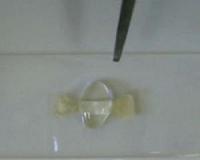
Watch a video of squid ring teeth derived plastic being cut in two and self healing with water and pressure. Image courtesy Demirel Lab, Penn State.

A drop of water self-heals a multiphase polymer derived from the genetic code of squid ring teeth, which may someday extend the life of medical implants, fiber-optic cables and other hard to repair in place objects, according to an international team of researchers.

"What's unique about this plastic is the ability to stick itself back together with a drop of water," said Melik Demirel, professor of engineering science and mechanics, Penn State. "There are other materials that are self healing, but not with water."

Demirel and his team looked at the ring teeth of squid collected around the world - in the Mediterranean, Atlantic, near Hawaii, Argentina and the Sea of Japan - and found that proteins with self-healing properties are ubiquitous. However, as they note in a recent issue of Scientific Reports, "the yield of this proteinaceous material from natural sources is low (about 1 gram of squid ring teeth protein from 5 kilograms of squid) and the composition of native material varies between squid species."

So as not to deplete squid populations, and to have a uniform material, the researchers used biotechnology to create the proteins in bacteria. The polymer can then either be molded using heat or cast by solvent evaporation.

The two-part material is a copolymer consisting of an amorphous segment that is soft and a more structured molecular architecture. The structured portion consists of strands of amino acids connected by hydrogen bonds to form a twisted and/or pleated sheet. This part also provides strength for the polymer, but the amorphous segment provides the self-healing.

The researchers created a dog-bone shaped sample of the polymer and then cut it in half. Using warm water at about 113 degrees Fahrenheit - slightly warmer than body temperature - and a slight amount of pressure with a metal tool, the two halves reunited to reform the dog-bone shape. Strength tests showed that the material after healing was as strong as when originally created.

"If one of the fiber-optic cables under the ocean breaks, the only way to fix it is to replace it," said Demirel. "With this material, it would be possible to heal the cable and go on with operation, saving time and money.

"Maybe someday we could apply this approach to healing of wounds or other applications," he said. "It would be interesting in the long run to see if we could promote wound healing this way so that is where I'm going to focus now."

Also working on this project at Penn State were Abdon Pena-Francesch and Huihun Jung, graduate students in engineering science and mechanics; and Carlos Pacheco, NMR spectroscopist. Others include Metin Sitti, Max Planck Institute at Stuttgart, Germany and Carnegie Mellon University; Veikko Sariola, former postdoctoral fellow at Carnegie Mellon University; and Murat Cetinkaya, BASF SE, Ludwigshafen, Germany. Sariola and Pena-Francesch were co-first authors of this paper.


Thanks for being here;
We need your help. The Space Media Network continues to grow but revenues have never been harder to maintain.

With the rise of Ad Blockers, and Facebook - our traditional revenue sources via quality network advertising continues to decline. And unlike so many other news sites, we don't have a paywall - with those annoying usernames and passwords.

Our news coverage takes time and effort to publish 365 days a year.

If you find our news sites informative and useful then please consider becoming a regular supporter or for now make a one off contribution.
SpaceMediaNetwork Contributor
$5 Billed Once


credit card or paypal
SpaceMediaNetwork Monthly Supporter
$5 Billed Monthly


paypal only


.


Related Links
Penn State
Bio Fuel Technology and Application News


Comment on this article via your Facebook, Yahoo, AOL, Hotmail login.

Share this article via these popular social media networks
del.icio.usdel.icio.us DiggDigg RedditReddit GoogleGoogle


BIO FUEL
Methanotrophs: Could bacteria help protect our environment?
Newcastle, UK (SPX) Sep 01, 2015
New insight into methanotrophs, bacteria that can oxidise methane, may help us develop an array of biotechnological applications that exploit methane and protect our environment from this potent greenhouse gas. Publishing in Nature, scientists led by Newcastle University have provided new understanding of how methanotrophs are able to use large quantities of copper for methane oxidation. T ... read more


BIO FUEL
Russian Anti-Missile Warning System Protects on Multiple Tiers

Russian Missile Warning System Can Detect Mass Launch of Ballistic Missiles

US runs missile defense wargames to break Russian jamming

Japan requests Aegis systems for new destroyers

BIO FUEL
Advanced Sidewinder missile approved for full-rate production

Moscow, Tehran Sign Roadmap For S-300 Deal Implementation

Air-launched Sidewinder tested as ground-based weapon

Hundreds of Russian R-73 Air-to-Air Missiles in High Demand Worldwide

BIO FUEL
DARPA project studies new uses for drones

WB Electronics,Thales to offer UAS to Polish military

CIA, US special forces launch drone campaign in Syria: media

Spaceport America and ARCA to jointly test Launch Vehicles and High Altitude UAVs

BIO FUEL
MUOS-4 Responding Normally To Ground Control Post-Launch

US Military to Launch 'Smartphone' Communications Satellite on Monday

Russia, China discuss joint mobile satellite communications

Harris delivers Falcon tactical radios

BIO FUEL
After Humvee, US Army to unleash latest beast

Russia's Newest Grom Smart Bombs Unveiled at MAKS 2015

U.S. creating National Manufacturing Innovation Institute

Pentagon joins Silicon Valley in 'flexible' tech hub

BIO FUEL
Middle Eastern leaders flood to Moscow for Syrian talks, aerospace salon

Growth for Turkish defense industry

Nigeria to step up local arms manufacture in Boko Haram fight

French defence minister visits Cairo after warplane deal

BIO FUEL
India announces major pensions overhaul for army veterans

Philippines, Vietnam to sign partnership deal by year-end

Tale of two parades as ordinary Chinese barred from display

China lauds power, proclaims peace at military spectacular

BIO FUEL
Nanoporous gold sponge makes DNA detector

Researchers use laser to levitate, glowing nanodiamonds in vacuum

Nanoparticles - small but unique

Making nanowires from protein and DNA


The content herein, unless otherwise known to be public domain, are Copyright 1995-2014 - Space Media Network. All websites are published in Australia and are solely subject to Australian law and governed by Fair Use principals for news reporting and research purposes. AFP, UPI and IANS news wire stories are copyright Agence France-Presse, United Press International and Indo-Asia News Service. ESA news reports are copyright European Space Agency. All NASA sourced material is public domain. Additional copyrights may apply in whole or part to other bona fide parties. Advertising does not imply endorsement, agreement or approval of any opinions, statements or information provided by Space Media Network on any Web page published or hosted by Space Media Network. Privacy Statement All images and articles appearing on Space Media Network have been edited or digitally altered in some way. Any requests to remove copyright material will be acted upon in a timely and appropriate manner. Any attempt to extort money from Space Media Network will be ignored and reported to Australian Law Enforcement Agencies as a potential case of financial fraud involving the use of a telephonic carriage device or postal service.