
. Military Space News .
FARM NEWS
Wheat virus crosses over, harms native grasses
by Staff Writers
East Lansing MI (SPX) Jan 18, 2017


Once upon a time, it was thought that crop diseases affected only crops. New research shows, however, that a common wheat virus can spread and harm perennial native grasses.

Once upon a time, it was thought that crop diseases affected only crops. New research shows, however, that a common wheat virus can spread and harm perennial native grasses.

In the current issue of the Journal of Ecology, researchers from Michigan State University, University of Kansas and University of Virginia show that farmers and scientists need to think about how best to protect native plants from diseases emanating from crops.

"Crop fields were once considered tiny islands in a sea of wild vegetation, so farmers and scientists focused on protecting crops from wild pathogens," said Carolyn Malmstrom, MSU plant biologist and co-lead author of the study. "Now, around the world, the situation has reversed, and diseases from agricultural fields affect not only crops, but also substantially harm native plants, such as switchgrass."

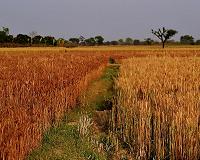
The findings were based on a multi-year field study in Kansas. There, like in much of the Midwest, plains of native grasses have been transformed to fields of wheat or other cereal crops. Now, it's the patches of grasses that are the islands in an ocean of crops.

A widespread wheat pathogen, barley yellow dwarf virus, can cross over and affect switchgrass, a prime candidate for biofuel research. The research team combined the field results with a statistical model and showed that the virus can reduce the vitality of switchgrass by 30 percent.

Interestingly, the infection can affect switchgrass' growth even though the native plant displays hardly any signs of sickness.

"Crops have been bred for yield, sometimes at the cost of plant defense. If they are susceptible, fast-growing crops can serve as highly competent hosts that amplify viruses within a region," Malmstrom said. "In these 'domesticated' landscapes, farmers, conservation biologists and epidemiologists need to be aware that diseases from crops can move into wild and native plants, which may need protection."

While the study focused on merely one virus, it shows that science needs to catch up in understanding how crops influence native plants and to build more knowledge of virus ecology in general.

"There are many mysteries surrounding how crop viruses affect natural ecosystems," Malmstrom said. "It's important that we build a base of research in this area. For example, if a novel virus emerges and threatens important species, we will need to draw on baseline information about virus ecology to address it; the big gaps in understanding need to be tackled."


Comment on this article using your Disqus, Facebook, Google or Twitter login.


Thanks for being here;
We need your help. The Space Media Network continues to grow but revenues have never been harder to maintain.

With the rise of Ad Blockers, and Facebook - our traditional revenue sources via quality network advertising continues to decline. And unlike so many other news sites, we don't have a paywall - with those annoying usernames and passwords.

Our news coverage takes time and effort to publish 365 days a year.

If you find our news sites informative and useful then please consider becoming a regular supporter or for now make a one off contribution.
SpaceMediaNetwork Contributor
$5 Billed Once


credit card or paypal
SpaceMediaNetwork Monthly Supporter
$5 Billed Monthly


paypal only


.


Related Links
Michigan State University
Farming Today - Suppliers and Technology


Share this article via these popular social media networks
del.icio.usdel.icio.us DiggDigg RedditReddit GoogleGoogle

Previous Report
FARM NEWS
Common crop chemical leaves bees susceptible to deadly viruses
University Park PA (SPX) Jan 17, 2017
A chemical that is thought to be safe and is, therefore, widely used on crops - such as almonds, wine grapes and tree fruits - to boost the performance of pesticides, makes honey bee larvae significantly more susceptible to a deadly virus, according to researchers at Penn State and the U.S. Department of Agriculture. "In the lab, we found that the commonly used organosilicone adjuvant, Syl ... read more


FARM NEWS
Israel army gets new ballistic missile interceptors

Italy joins EUROSAM's Aster 30 B1NT program

SBIRS GEO Flight 3 encapsulated for launch

U.S. Air Force prepares SBIRS satellite for launch

FARM NEWS
Russian Smerch, Uragan Rocket Launchers to Get Stealth Cloaks

U.S. Navy helos getting Lockheed Martin counter-missile capability

India test-fires guided Pinaka Rocket Mark-II

Raytheon, U.S. Navy complete Tomahawk flight tests

FARM NEWS
AUDS counter-UAV system achieves TRL-9 status

GenDyn offers Bluefin SandShark mini-drone for sale online

UAV performs first ever perched landing using machine learning algorithms

Liteye, Tribalco to deliver AUDS systems to U.S. armed forces

FARM NEWS
Northrop Grumman receives $140m BACN contract modification

Sharing battlefield information at multiple classification levels via mobile handheld devices

BAE Systems contracted for radio frequency countermeasure services

Harris secures $403 million tactical radio support contract

FARM NEWS
U.S. Army orders rough-terrain forklifts

Retired US generals to Trump: 'Torture is unnecessary'

What Russia's railgun can really do

Safran to design new inertial navigation system

FARM NEWS
Canada sidelines a top admiral amid reports of leaks

Damascus says Israel missiles caused airbase explosions

Saudi unblocks military aid to Lebanon: Lebanese source

Pro-Iraqi militias using arms from 16 countries: Amnesty

FARM NEWS
Estonians join paramilitary forces to face Russia fears

Trump shakes postwar order, in blow to Europe

Saudi Arabia sees China rise as stabilising

China's sea militarisation 'very troubling': Philippine defence chief

FARM NEWS
Creating atomic scale nanoribbons

New research helps to meet the challenges of nanotechnology

Lighting up ultrathin films

Zeroing in on the true nature of fluids within nanocapillaries


The content herein, unless otherwise known to be public domain, are Copyright 1995-2024 - Space Media Network. All websites are published in Australia and are solely subject to Australian law and governed by Fair Use principals for news reporting and research purposes. AFP, UPI and IANS news wire stories are copyright Agence France-Presse, United Press International and Indo-Asia News Service. ESA news reports are copyright European Space Agency. All NASA sourced material is public domain. Additional copyrights may apply in whole or part to other bona fide parties. All articles labeled "by Staff Writers" include reports supplied to Space Media Network by industry news wires, PR agencies, corporate press officers and the like. Such articles are individually curated and edited by Space Media Network staff on the basis of the report's information value to our industry and professional readership. Advertising does not imply endorsement, agreement or approval of any opinions, statements or information provided by Space Media Network on any Web page published or hosted by Space Media Network. General Data Protection Regulation (GDPR) Statement Our advertisers use various cookies and the like to deliver the best ad banner available at one time. All network advertising suppliers have GDPR policies (Legitimate Interest) that conform with EU regulations for data collection. By using our websites you consent to cookie based advertising. If you do not agree with this then you must stop using the websites from May 25, 2018. Privacy Statement. Additional information can be found here at About Us.