
Subscribe free to our newsletters via your
. Military Space News .


INTERN DAILY
Wireless electronic implants stop staph, then dissolve
by Staff Writers
Medford MA (SPX) Nov 26, 2014


Researchers at Tufts University School of Engineering have demonstrated for the first time a dissolving electronic implant, made of silk and magnesium, that eliminated bacterial infection in mice by delivering heat to infected tissue when triggered by a remote wireless signal. The devices then harmlessly dissolved. In vitro studies also showed the devices could kill bacteria by releasing antibiotics. This is an important step forward for future development of on-demand medical devices that can be turned on remotely to perform a therapeutic function, such as managing post-surgical infection, and then degrade in the body. Image courtesy Tufts University.

Researchers at Tufts University, in collaboration with a team at the University of Illinois at Champaign-Urbana, have demonstrated a resorbable electronic implant that eliminated bacterial infection in mice by delivering heat to infected tissue when triggered by a remote wireless signal.

The silk and magnesium devices then harmlessly dissolved in the test animals. The technique had previously been demonstrated only in vitro. The research is published online in the Proceedings of the National Academy of Sciences Early Edition.

"This is an important demonstration step forward for the development of on-demand medical devices that can be turned on remotely to perform a therapeutic function in a patient and then safely disappear after their use, requiring no retrieval," said senior author Fiorenzo Omenetto, professor of biomedical engineering and Frank C. Doble professor at Tufts School of Engineering.

"These wireless strategies could help manage post-surgical infection, for example, or pave the way for eventual 'wi-fi' drug delivery."

Implantable medical devices typically use non-degradable materials that have limited operational lifetimes and must eventually be removed or replaced.

The new wireless therapy devices are robust enough to survive mechanical handling during surgery but designed to harmlessly dissolve within minutes or weeks depending on how the silk protein was processed, noted the paper's first author, Hu Tao, Ph.D., a former Tufts post-doctoral associate who is now on the faculty of the Shanghai Institute of Microsystem and Information Technology, Chinese Academy of Sciences.

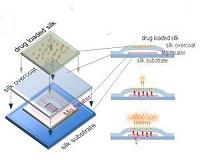
Each fully dissolvable wireless heating device consisted of a serpentine resistor and a power-receiving coil made of magnesium deposited onto a silk protein layer. The magnesium heater was encapsulated in a silk "pocket" that protected the electronics and controlled its dissolution time.

Devices were implanted in vivo in S. aureus infected tissue and activated by a wireless transmitter for two sets of 10-minute heat treatments. Tissue collected from the mice 24 hours after treatment showed no sign of infection, and surrounding tissues were found to be normal. Devices completely dissolved after 15 days, and magnesium levels at the implant site and surrounding areas were comparable to levels typically found in the body.

The researchers also conducted in vitro experiments in which similar remotely controlled devices released the antibiotic ampicillin to kill E. coli and S. aureus bacteria. The wireless activation of the devices was found to enhance antibiotic release without reducing antibiotic activity.


Thanks for being here;
We need your help. The Space Media Network continues to grow but revenues have never been harder to maintain.

With the rise of Ad Blockers, and Facebook - our traditional revenue sources via quality network advertising continues to decline. And unlike so many other news sites, we don't have a paywall - with those annoying usernames and passwords.

Our news coverage takes time and effort to publish 365 days a year.

If you find our news sites informative and useful then please consider becoming a regular supporter or for now make a one off contribution.
SpaceMediaNetwork Contributor
$5 Billed Once


credit card or paypal
SpaceMediaNetwork Monthly Supporter
$5 Billed Monthly


paypal only


.


Related Links
Tufts University
Hospital and Medical News at InternDaily.com


Comment on this article via your Facebook, Yahoo, AOL, Hotmail login.

Share this article via these popular social media networks
del.icio.usdel.icio.us DiggDigg RedditReddit GoogleGoogle


INTERN DAILY
New Technique Allows Ultrasound To Penetrate Bone, Metal
Raleigh NC (SPX) Nov 21, 2014
Researchers from North Carolina State University have developed a technique that allows ultrasound to penetrate bone or metal, using customized structures that offset the distortion usually caused by these so-called "aberrating layers." "We've designed complementary metamaterials that will make it easier for medical professionals to use ultrasound for diagnostic or therapeutic applications ... read more


INTERN DAILY
U.S Navy sending Aegis-equipped destroyers to Japan

U.S. holds test on Aegis tracking capability

Russia to Create Space-Based Ballistic Missile Warning System

LockMart and NGC Deliver Payload for Fourth SBIRS Satellite

INTERN DAILY
Elbit's anti-missile system to feature on German A400M transports

Destroyer simultaneously fires SM-2 and SM-3 missiles

Air Force orders more Paveway II Plus guided bomb kits

Exelis, Airbus offer missile warning capability for F-16s

INTERN DAILY
Law firm forms unit for civilian UAV issues

US can pursue 'reckless' drone flyers, panel rules

New Global Hawk support contract for Northrop Grumman

Altavian Inc., Lockheed Martin providing sensor payload to Army

INTERN DAILY
Harris Corporation supplying Falcon III radios to Canadian military

GenDyn Canada contracted to connect military to WGS system

Northrop Grumman continues Joint STARS sustainment services

Harris Corporation opens engineering support facility

INTERN DAILY
Marines get counter-IED training from A-T Solutions

Raytheon touts its Agile software development process

First of 71 Finnish armored personnel carriers modernized

Air Force investigators tap A-T Solutions for software modifications

INTERN DAILY
Nammo subsidiary buying Patria ammunition facility

Greece asks U.S. to continue sustainment support for its F-16s

U.S. lowers surcharge on Foreign Military Sales program contracts

Britain seeks to improve agency for military equipment

INTERN DAILY
US troops to stay in Poland, Baltics through 2015: general

China policies fuel tensions with US: commission

Russia urges Ukraine not to join NATO

NATO reports 400 intercepts of Russian aircraft in 2014

INTERN DAILY
UO-industry collaboration points to improved nanomaterials

Penn engineers efficiently 'mix' light at the nanoscale

On-demand conductivity for graphene nanoribbons

Measuring nano-vibrations


The content herein, unless otherwise known to be public domain, are Copyright 1995-2014 - Space Media Network. All websites are published in Australia and are solely subject to Australian law and governed by Fair Use principals for news reporting and research purposes. AFP, UPI and IANS news wire stories are copyright Agence France-Presse, United Press International and Indo-Asia News Service. ESA news reports are copyright European Space Agency. All NASA sourced material is public domain. Additional copyrights may apply in whole or part to other bona fide parties. Advertising does not imply endorsement, agreement or approval of any opinions, statements or information provided by Space Media Network on any Web page published or hosted by Space Media Network. Privacy Statement All images and articles appearing on Space Media Network have been edited or digitally altered in some way. Any requests to remove copyright material will be acted upon in a timely and appropriate manner. Any attempt to extort money from Space Media Network will be ignored and reported to Australian Law Enforcement Agencies as a potential case of financial fraud involving the use of a telephonic carriage device or postal service.