. Military Space News .
XMM-Newton Discovers Part Of Missing Matter In The Universe

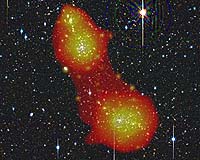
Composite optical and X-ray image of galaxy clusters Abell 222 and Abell 223. The cluster pair is connected by a filament permeated by hot X-ray emitting gas. The optical image was obtained by SuprimeCam at the Subaru telescope, the X-ray image showing the distribution of the diffuse hot gas (yellow to red) was obtained by XMM-Newton. Credits: ESA/ XMM-Newton/ EPIC/ ESO (J. Dietrich)/ SRON (N. Werner)/ MPE (A. Finoguenov)
by Staff Writers
Paris, France (SPX) May 07, 2008
ESA's orbiting X-ray observatory XMM-Newton has been used by a team of international astronomers to uncover part of the missing matter in the universe. 10 years ago, scientists predicted that about half of the missing 'ordinary' or normal matter made of atoms exists in the form of low-density gas, filling vast spaces between galaxies.

All the matter in the universe is distributed in a web-like structure. At dense nodes of the cosmic web are clusters of galaxies, the largest objects in the universe. Astronomers suspected that the low-density gas permeates the filaments of the web.

The low density of the gas hampered many attempts to detect it in the past. With XMM-Newton's high sensitivity, astronomers have discovered its hottest parts. The discovery will help them understand the evolution of the cosmic web.

Only about 5% of our universe is made of normal matter as we know it, consisting of protons and neutrons, or baryons, which along with electrons, form the building blocks of ordinary matter. The rest of our universe is composed of elusive dark matter (23%) and dark energy (72%).

Small as the percentage might be, half of the ordinary baryonic matter is unaccounted for. All the stars, galaxies and gas observable in the universe account for less than a half of all the baryons that should be around.

Scientists predicted that the gas would have a high temperature and so it would primarily emit low-energy X-rays. But its very low density made observation difficult.

Astronomers using XMM-Newton were observing a pair of galaxy clusters, Abell 222 and Abell 223, situated at a distance of 2300 million light-years from Earth, when the images and spectra of the system revealed a bridge of hot gas connecting the clusters.

"The hot gas that we see in this bridge or filament is probably the hottest and densest part of the diffuse gas in the cosmic web, believed to constitute about half the baryonic matter in the universe," says Norbert Werner from SRON Netherlands Institute for Space Research, leader of the team reporting the discovery.

"The discovery of the warmest of the missing baryons is important. That's because various models exist and they all predict that the missing baryons are some form of warm gas, but the models tend to disagree about the extremes," adds Alexis Finoguenov, a team member.

Even with XMM-Newton's sensitivity, the discovery was only possible because the filament is along the line of sight, concentrating the emission from the entire filament in a small region of the sky. The discovery of this hot gas will help better understand the evolution of the cosmic web.

"This is only the beginning. To understand the distribution of the matter within the cosmic web, we have to see more systems like this one. And ultimately launch a dedicated space observatory to observe the cosmic web with a much higher sensitivity than possible with current missions. Our result allows to set up reliable requirements for those new missions." concludes Norbert Werner. ESA's XMM-Newton Project Scientist, Norbert Schartel, comments on the discovery, "This important breakthrough is great news for the mission. The gas has been detected after hard work and more importantly, we now know where to look for it. I expect many follow-up studies with XMM-Newton in the future targeting such highly promising regions in the sky."
Community
Email This Article
Comment On This Article

Related Links
XMM-Newton overview
Understanding Time and Space


Memory Foam Mattress Review
Newsletters :: SpaceDaily :: SpaceWar :: TerraDaily :: Energy Daily
XML Feeds :: Space News :: Earth News :: War News :: Solar Energy News


High-Flying Electrons May Provide New Test Of Quantum Theory
Washington DC (SPX) May 02, 2008
Researchers at the National Institute of Standards and Technology (NIST) and Max Planck Institute for Physics in Germany believe they can achieve a significant increase in the accuracy of one of the fundamental constants of nature by boosting an electron to an orbit as far as possible from the atomic nucleus that binds it.


  • Outside View: Russia's Blackjack power
  • China defends maritime rights, but silent on nuclear sub base report
  • Red Square bash masks military ills: analysts
  • CIA chief says China's rapid military buildup troubling

  • US envoys head to Asia in new bid for NKorean nuclear declaration
  • 79 Religious Organizations Oppose Energy Department Plan For New Nuclear Bomb Plant
  • SKorea expects NKorea nuke talks soon
  • Khamenei rules out halt to Iran's nuclear drive

  • Joint Air-to-Surface Standoff Missile Program Moves Forward To Serve Warfighters
  • Analysis: China to get SAMs from Russia
  • ATK Delivers Second Advanced Anti-Radiation Guided Missile Test Bed Aircraft
  • SKorea says it will buy air-to-ground missiles from abroad

  • BMD Focus: West trumps East -- Part 2
  • US says 'optimistic' on missile shield deal with Poland
  • BMD Watch: SASC agrees to fund BMD bases
  • BMD Focus: West trumps East -- Part 1

  • Analysis: Can airplanes go green?
  • Belgian airline says it will cut costs, emissions by slowing down
  • Airbus, Boeing sign accord to cut air traffic impact on environment
  • Oil spike, cost of planes led to Oasis collapse: founders

  • Georgia denies Abkhaz, Russian claims over spy planes
  • GD And Elbit Conduct First US Demo Of UAS For US Armed Forces
  • Protonex Receives Contract To Extend UAV Propulsion Systems
  • NATO chief would 'eat tie' over Russia drone claim: spokesman

  • Feature: U.S., Mehdi Army battle over wall
  • Four US marines killed in Iraq blast
  • Analysis: The new Iraq rebuilding report
  • Iraq war jolts US presidential campaign

  • US Army, Navy And Air Force Gain New Intelligence And Surveillance Capability
  • Raytheon Sarcos Exoskeleton Robotic Suit Linked To Iron Man Superhero
  • Grand Challenge Vehicles Gear Up For Final Showdown
  • Fungi Have A Hand In Depleted Uranium's Environmental Fate

  • The content herein, unless otherwise known to be public domain, are Copyright 1995-2007 - SpaceDaily.AFP and UPI Wire Stories are copyright Agence France-Presse and United Press International. ESA Portal Reports are copyright European Space Agency. All NASA sourced material is public domain. Additional copyrights may apply in whole or part to other bona fide parties. Advertising does not imply endorsement,agreement or approval of any opinions, statements or information provided by SpaceDaily on any Web page published or hosted by SpaceDaily. Privacy Statement